Global Smart Ports Market Overview (2024–2030)
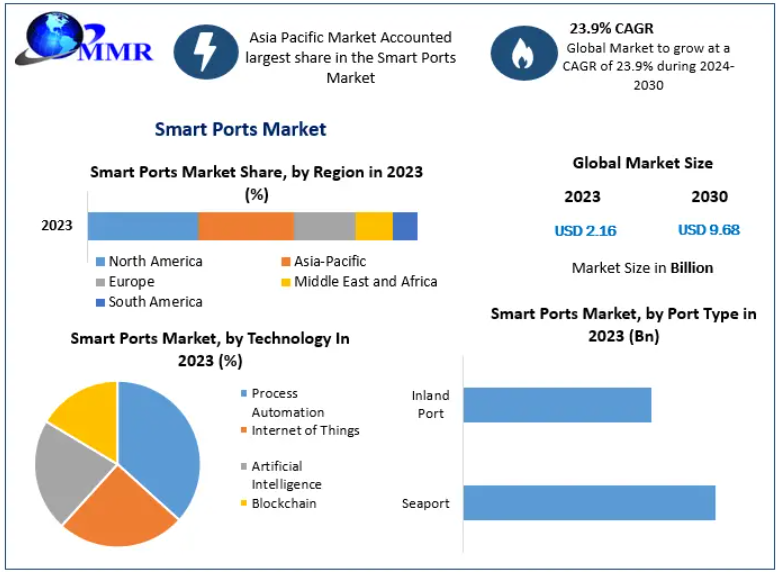
The Global Smart Ports Market is projected to reach USD 9.68 billion by 2030, growing at a robust CAGR of 23.9% during the forecast period. The market’s expansion is primarily driven by the global shift toward sustainable and technologically advanced port operations, aimed at improving efficiency, safety, and environmental performance.
Download a Free Sample Report Today:https://www.maximizemarketresearch.com/request-sample/32861/
Market Dynamics
Drivers:
The rapid adoption of green initiatives and increasing emphasis on environmental compliance are key factors accelerating the development of smart ports worldwide. Governments are enforcing stringent emission control regulations, pushing port authorities to leverage big data analytics, IoT, and cloud computing to reduce carbon emissions and optimize operations. Moreover, the growing need for digital transformation in logistics and maritime trade is promoting the integration of AI-based systems and automation technologies within port ecosystems.
Restraints and Challenges:
Despite the promising growth trajectory, the market faces several constraints. Data privacy and cybersecurity concerns, coupled with a shortage of skilled personnel, hinder the seamless adoption of smart technologies. Additionally, high initial investment costs and integration complexities between legacy and modern systems pose significant challenges for port authorities, especially in developing economies.
Smart Ports Market Segmentation
By Element:
- Terminal Automation & Cargo Handling
- Port Community System
- Traffic Management System
- Smart Port Infrastructure
- Smart Safety & Security
By Throughput Capacity:
- Extensively Busy (More Than 18 Million TEU)
- Moderately Busy (5–18 Million TEU)
- Scarcely Busy (Less Than 5 Million TEU)
Among these, the Extensively Busy segment is expected to witness the fastest growth, as high-traffic ports possess stronger financial capabilities to invest in automation and smart infrastructure to boost throughput and reduce congestion.
By Technology:
- Process Automation
- Internet of Things (IoT)
- Artificial Intelligence (AI)
- Blockchain
By Port Type:
- Seaport
- Inland Port
The Seaport segment currently dominates the global market, driven by the vast volume of international trade and the increasing number of commercial and passenger vessels docking at coastal ports.
Regional Insights
Asia Pacific leads the global Smart Ports Market, owing to the rapid industrialization and digital transformation of economies such as China, Japan, Singapore, and South Korea. These nations are at the forefront of smart port development, integrating AI, IoT, and blockchain to enhance efficiency and transparency in maritime logistics. Singapore and Hong Kong, in particular, serve as vital trade hubs forming an integral part of the global trade corridor.
Furthermore, the availability of affordable technology solutions in China and Taiwan is fostering large-scale adoption of smart port systems in the region. The growing export-import activities, coupled with government initiatives to modernize port infrastructure, further strengthen APAC’s dominant position in the market.
Europe and North America are also witnessing significant investments in digital port infrastructure, with ports like Rotterdam, Hamburg, and Los Angeles leading in automation and data-driven port management. Meanwhile, the Middle East and Africa region is gaining traction, supported by smart port projects in UAE and Saudi Arabia aimed at transforming maritime logistics in line with Vision 2030 strategies.
Download a Free Sample Report Today:https://www.maximizemarketresearch.com/request-sample/32861/
Competitive Landscape
The Smart Ports Market is highly competitive, with global technology leaders and port authorities collaborating to create interconnected, efficient, and sustainable port systems.
Key Players Include:
- Port of Rotterdam
- Trelleborg
- Royal HaskoningDHV
- IBM
- Accenture
- General Electric
- Abu Dhabi Ports
- ABB
- Wipro
- Ramboll Group
- Ikusi Velatia
- Port Solutions
- Scientific Enterprises
- Navis
- Awake.AI
- Cisco Systems
- Siemens AG
- Roambee
- Washington Maritime Blue
- WISTA The Netherlands
Strategic Developments:
- ABB has pioneered the use of autonomous shipping technologies, such as the ABB Ability Marine Pilot Control (AMPC) system, which enhances port productivity and safety. The company’s collaboration with the Shanghai government (2023) aims to advance innovation in maritime digitalization.
- IBM and Accenture are investing heavily in AI and blockchain-based port management platforms, focusing on predictive analytics and secure trade documentation.
- Abu Dhabi Ports is integrating smart logistics and terminal automation systems to establish itself as a regional leader in maritime digital transformation.
Report Scope
| Report Coverage | Details |
|---|---|
| Base Year | 2023 |
| Forecast Period | 2024–2030 |
| Historical Data | 2018–2023 |
| Market Size (2023) | USD 2.16 Bn |
| Forecast Market Size (2030) | USD 9.68 Bn |
| CAGR (2024–2030) | 23.9% |
| Segments Covered | By Element, Throughput Capacity, Technology, and Port Type |
| Regions Covered | North America, Europe, Asia Pacific, Middle East & Africa, Latin America |
Conclusion
The Global Smart Ports Market is on a transformative path, driven by technological innovation and the urgent need for sustainable maritime operations. As ports increasingly adopt digital systems—integrating IoT, AI, and blockchain—the industry is set to redefine global trade efficiency. Asia Pacific remains the growth nucleus, while collaborative innovations by global technology firms and port operators are expected to shape the future of smart maritime logistics.
