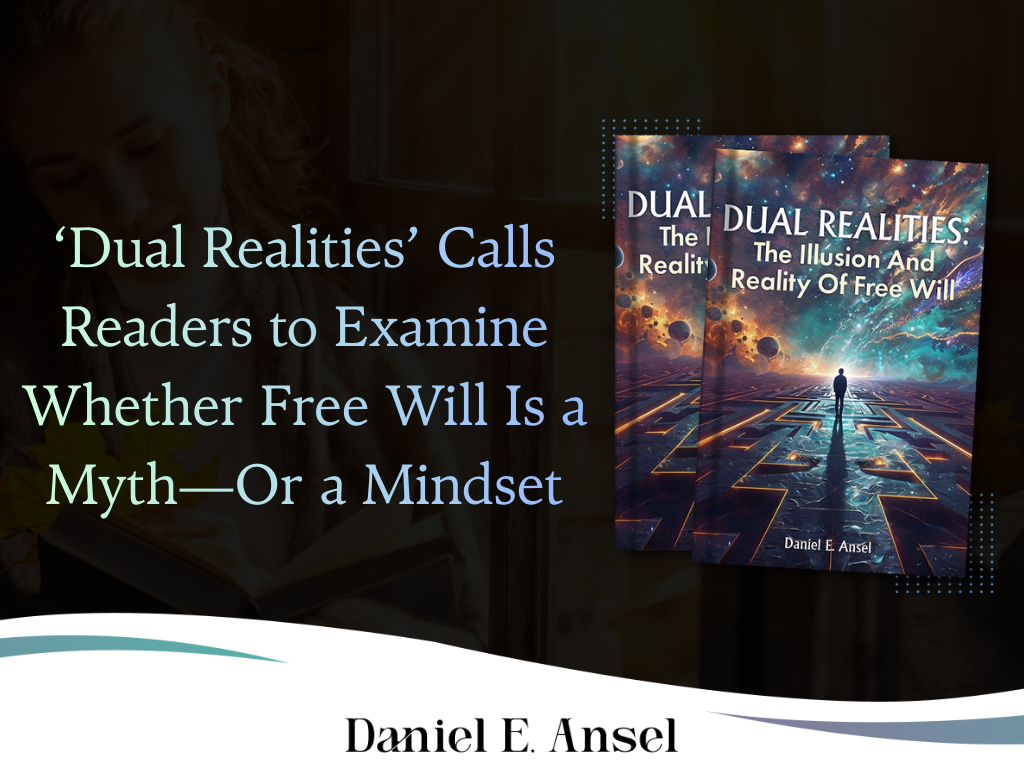
The new book is provoking and radical to the point of challenging people to reevaluate one of the most basic questions regarding human existence. The book Dual Realities: The Illusion and Reality of Free Will, by Daniel E. Ansel, challenges the readers to understand whether free will is a true human ability or an effective mind leading towards culture, consciousness and unknown factors.
The question at the core of this book is a question that seems to be so simple: Do we choose freely or do we think we choose freely? Ansel is answering this question in an exceptionally clear manner and it shows how scientific studies and the old philosophical debates are congruent. The book draws on the current neuroscience research which reveals that the brain makes decisions that people become unaware of making until several milliseconds have passed. This result goes against the intuitive assumption that behavior is driven by conscious intention.
But the book does not conclude with a scientific critique as such. Ansel also discusses the role played by culture and religion in influencing the way humanity understands the concept of free will. By engaging in the debates regarding Christian doctrines, Islamic views, Buddhist ideas, and ancient cultural stories he proves that beliefs concerning the personal independence are usually inherited, not created individually. It is in these stories that people are guided on the meaning of success, failure, morality, and purpose. To some, free will is a gift of God, to others, it is a societal requirement and to many people, it is a psychological need.
The book goes a step further in exploring how society supports the value of individual choice. Legal systems presume that individuals are fully aware and hence they ought to be held responsible. Discipline, will, and responsibility are applauded through social norms. By such structures, society establishes a thought process whereby free will does not just exist in belief, but it is anticipated. However, as demonstrated by Ansel, this expectation becomes complex after subconscious expectation, trauma, mental illness and environmental demands come into play.
Although it poses some tough questions, this book does not claim that the free will is completely a myth. Rather, Ansel has a more empowering and balanced view that gives free will as limited, yet as something that can be increased. The book brings the concept of the possibility of space in terms of making decisions that are more deliberate due to insight and self-awareness. As soon as individuals recognize their prejudices, emotional habits, and automatic responses, they can start breaking those forces to make more conscious decisions. In this respect, free will is a way of thinking, a trained skill to respond to both internal and external forces adequately.
Such a characteristic approach makes this book more than a scientific or philosophical text. It is a manual towards self-development, empathy and greater insight. This book invites its readers to be more realistic yet optimistic about the possibility of reclaiming agency by revealing the concealed infrastructure of human action; wherein awareness, reflection, and intention are all tools that may be used to regain control.
Dual Realities: The Illusion and Reality of Free Will is a revolutionary contribution to the current debate regarding the meaning of making choices. Daniel E. Ansel encourages the readers to challenge the assumptions they have had over time, analyze the forces that influence their choices, and finally make their own decision on whether free will is a myth, illusion or a powerful mindset that can be reinforced through the power of insight.
Contact:
Author: Daniel E. Ansel
Website: https://danieleansel.com/
Amazon: DUAL REALITIES: THE ILLUSION AND REALITY OF FREE WILL
Email: anseldan@gmail.com
FaceBook: https://www.facebook.com/profile.php?id=61581907173422
Instagram: https://www.instagram.com/danieleansel.author/
