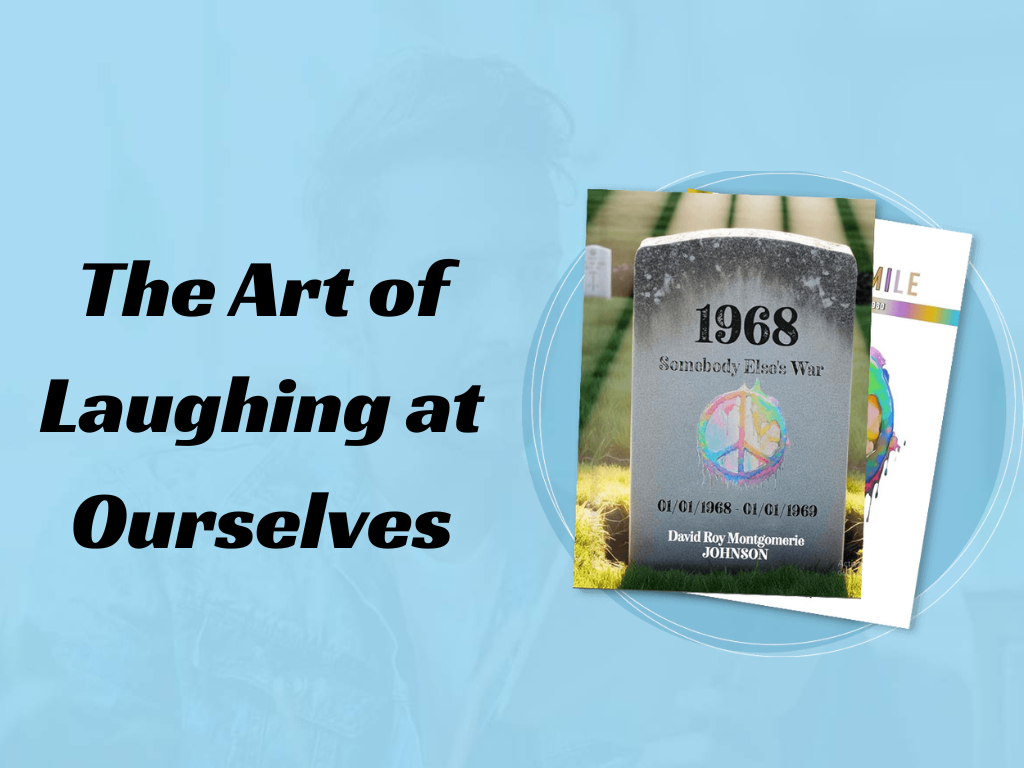
Laughter is particularly deeply restorative in a world that takes itself very seriously, particularly when it is thrown inwards. It is one of the most human things that we could do, and laugh at our faults, mistakes, and contradictions. It is also one of the most potent. 1968 – Somebody Else’s War by David Roy Montgomerie Johnson is a wonderful portrayal of that rare art. Against the backdrop of 1968, a year full of political turmoil, war, and upheaval of social changes, this novel reveals how humor can transform the confusion of life into focus and how self-deprecation can be a kind of wisdom.
It is all about people, and at its core, 1968 – Somebody Else’s War is not simply a history or a political book. Average, imperfect, and incredibly ridiculous individuals who fumble in the fantastic periods. The Newport on the Lake is a small town, which becomes a stage for Johnson, who is a microcosm of the 1960s with its sloppiness. As the rest of the world struggles with the Vietnam War, racial tension, and cultural revolution, the small town of Newport’s residents are fighting their own little but equally significant battle with pride, guilt, loneliness, and themselves.
This notwithstanding, the book is full of laughter despite the havoc. Johnson does not ridicule his characters, but he asks the readers to laugh. That’s where the magic lies. His humor is sympathetic, and it is based on the knowledge that the absurdities of life are not to be embarrassed by but to be glorified. His quickness of thinking and memorable cast remind us that laughter is not just medicine; it is perspective.
An example is Lord Mayor Wentworth Clarkson-Hayes IV, who is pompous, dignified, and about one small calamity off. He is a man who is obsessed with order in a world that does not even want to follow the rules. However, rather than criticizing him, Johnson makes him an image of all people who tried and were unable to suppress the uncontrollable. We laugh when he goes wrong, and yet we know him ourselves. That is what makes the book so powerful: this combination of humor and humanity.
Then there is Captain Sammy Enfield, a police captain who is attempting to juggle between duty and the haunts of his past. Johnson uncovers one of the most difficult lessons in life through his humor: that there are times when the only way to deal with pain is to laugh at it. The story of Sammy is a reflection of the strength that laughter may offer, the kind that does not take away sadness but makes it bearable.
In 1968 – Somebody Else’s War laughter is treated as survival means. The end of the 1960s was a decade of doublespeak, peace marches, and war zones, love songs and assassinations, and moral breakdowns.
Johnson employs satire to entertain as well as to tell the truth. He demonstrates how the only logical reaction to a crazy world is sometimes to laugh at the craziness of the world and consequently to laugh at ourselves as being a part of the craziness.
Laughing at ourselves, as Johnson puts it, is not about denying reality or mocking the truth. It is about boldly accepting the fact. The author’s characters represent the humor as a type of humbleness, a recognition that we are all merely attempt to make sense of things that we cannot fully comprehend. Every minute is a little lesson that perfection is an empty notion when the mayor can trip over words, when Sammy is in a tantrum, and when the adults like April May June act like children.
Johnson’s humor has depth. By writing his book, he not only provides the readers with nostalgia but also reflection. We laugh at the past, and we learn too.
Among the most memorable lessons in the book is the one that is simple yet eternal: you cannot control that which you cannot control. Learn that lesson and laugh. We live in a time when pride and self-importance tend to be the order of the day, and 1968 – Somebody Else’s War is something that welcomes its readers to release, to find the humor in its collective stupidity, and the fact that laughter is the way to freedom . The less we hold to our egos, the happier we become.
It is what makes this novel so refreshing. It does not take itself too seriously, and neither does it allow the readers to do the same. It is a festivity of flaws of human stupidity, as well as hope and survival.
Z.E. EYE HOSPITAL – Best Eye Hospital in Karachi for Comprehensive Eye OPD Services in Karachi
Fun Summer Solstice Party Ideas for Everyone
Southampton Taxi Service: Choose Soton Cars for Reliable Rides
Trusted Folding Doors Dubai Contractors
Kia Finance America: Everything You Need to Know About Auto Financing
