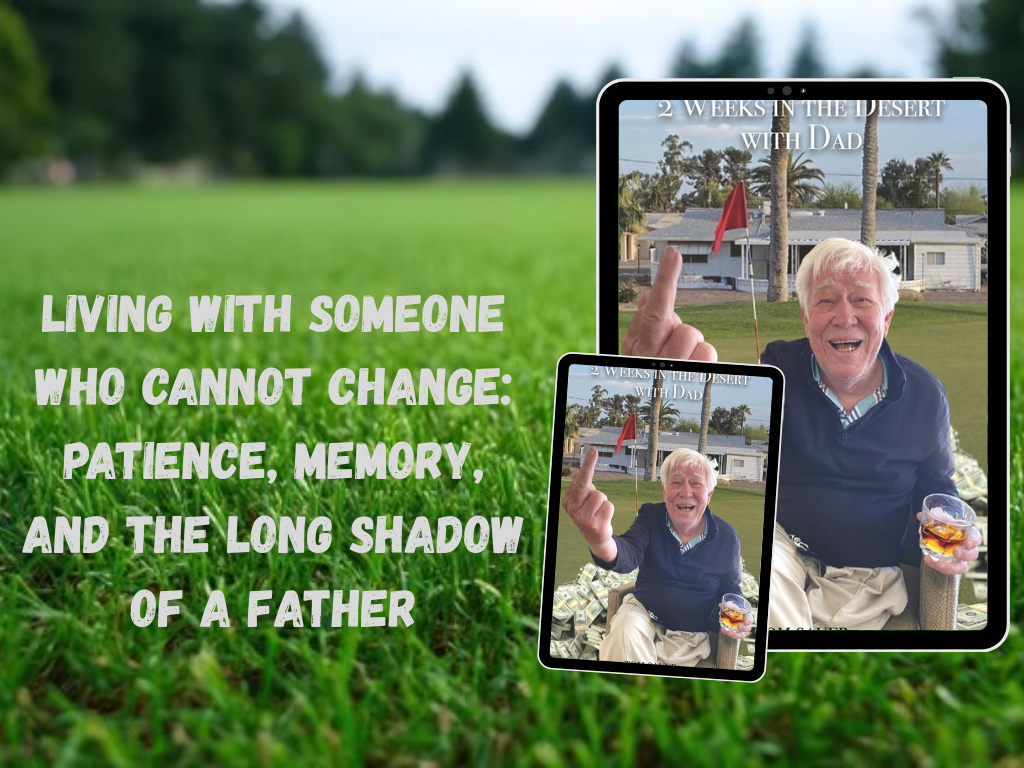
There is a moment that comes for many adult children when they finally accept a hard truth: their parent is not going to change. Not because they don’t want to, and not because they are cruel, but because the habits, fears, and beliefs they built their life around are too deeply set. 2 Weeks in the Desert With Dad sits squarely in that realization.
Tom Sauer doesn’t write this book to fix his father. He writes it because fixing isn’t possible. What he documents instead is what it looks like to live alongside someone whose worldview has hardened with age, and how exhausting, confusing, and strangely clarifying that can be.
Throughout the two weeks in Sun City, Sauer watches the same patterns repeat themselves. Every issue—big or small—funnels back to the same place. Money. Distrust. Fear of being taken advantage of. Whether it’s tipping a wheelchair attendant, replacing a furnace, fixing a car, or dealing with doctors, the response never changes. The world is wrong. People are incompetent. Someone is trying to steal from him.
At first, Sauer reacts the way most people would. He explains. He reasons. He tries logic. He reminds his father that times are different now, that systems have changed, that service still exists. None of it works. The arguments don’t escalate, but they don’t go anywhere either. They simply repeat.
This repetition becomes one of the most realistic elements of the book. Caregiving is not a series of dramatic moments. It is a loop. The same conversations come back again and again, wearing down patience in small, quiet ways. Sauer captures this without exaggeration. There is no screaming match that resolves things. There is just endurance.
What makes this dynamic even harder is that Sauer understands where it comes from. His father’s worldview was shaped early. Growing up with instability, an abusive alcoholic parent, and constant financial insecurity taught him one lesson above all others: never let go of your money. That belief kept him safe once. It also isolated him later.
Sauer doesn’t try to rewrite his father’s past. He simply shows how it bleeds into the present. The Arizona house is full of objects that were never replaced because replacing them would require spending. The car is kept alive far past its reasonable lifespan. Medical care is resented even when it works. Every dollar spent feels like a failure, not a necessity.
The emotional weight of this shows up most clearly in the quieter moments. Sauer’s father doesn’t ask for help easily. He resists it. Yet he cannot function without it. He cannot be alone. He does not handle silence well. He does not want conversation, but he needs presence. This contradiction defines much of their time together.
Sauer becomes a constant buffer between his father and the world. He makes phone calls. He negotiates with service people. He absorbs complaints. He steps in when things stall. And he does this while carrying the history of a strained relationship that never quite healed.
The book doesn’t dwell heavily on childhood memories, but when Sauer reflects on them, they matter. His father was not nurturing. Encouragement was rare. Emotional connection wasn’t modeled. Sauer grew up feeling unseen in many ways, especially when it came to his interests and talents. Those feelings don’t vanish just because a parent gets old.
What’s striking is how Sauer holds both truths at once. He can acknowledge his father’s limitations while still showing up for him. He doesn’t rewrite the past to make the present easier. He accepts that some things were missing and always will be.
Health issues add another layer to this acceptance. Sauer’s father has survived serious illnesses that could have easily ended his life. Kidney cancer. Lung cancer. Dangerous infections. Early detection and treatment saved him. Yet gratitude never fully replaces suspicion. Doctors are still questioned. Medications are still resisted. Even survival becomes something to argue about.
Sauer’s response to this is telling. He doesn’t try to force gratitude. He doesn’t demand perspective. He simply notes it. He lets the contradiction exist on the page, because that’s how it exists in real life.
Writing becomes Sauer’s way of processing what he cannot change. The book itself is not planned. It grows out of necessity. He starts taking notes because the days are overwhelming, because thoughts pile up, because the experience demands somewhere to land. In that sense, the book is as much for the author as it is for the reader.
There are moments of humor scattered throughout, but they are not jokes in the traditional sense. They are the kind of humor that emerges when frustration has nowhere else to go. A stubborn car that refuses to die. A middle finger raised playfully for photos. A comment about eating crow that turns into a running joke. These moments don’t erase the tension. They make it survivable.
What the book shows, more than anything, is the slow shift from resistance to acceptance. Sauer doesn’t stop disagreeing with his father. He stops expecting different outcomes. That change is subtle, but it matters. It allows him to conserve energy for what actually counts: staying present, keeping things moving, and protecting his own peace where possible.
There is no final revelation where father and son suddenly understand each other completely. That would be dishonest. Instead, there is a quiet acknowledgment that time is limited. That whatever relationship exists now is the one they have to work with. That waiting for a different version of a parent only leads to disappointment.
By the end of the two weeks, Sauer has not solved his father’s fears. He has not convinced him to spend money differently. He has not reshaped his worldview. What he has done is bear witness. He has seen his father clearly, flaws and all, and chosen to stay anyway.
For readers who have lived through similar experiences, this is where the book hits hardest. It validates the feeling that love can exist alongside frustration. That caregiving doesn’t always bring closure. That understanding someone does not mean agreeing with them. And that sometimes the most meaningful thing you can do is simply remain.
2 Weeks in the Desert With Dad doesn’t argue that people can change at the end of their lives. It suggests something quieter and more honest: that change isn’t always the point. Sometimes the work is learning how to live with what is already set in stone.
