Buying marble has always been a mix of excitement and anxiety.
You stand in front of a stunning slab at a showroom, imagining how it might look on your floor, wall, or countertop. But deep down, there’s a question you can’t ignore: will it actually look this good in my space?
Lighting, room size, furniture, wall colors — everything changes once the slab leaves the showroom. This is exactly why the marble slab visualizer is quickly becoming a must-have tool for marble brands, architects, interior designers, and homeowners alike.
In this guide, we’ll explore what a marble slab visualizer is, how it works, why it matters, and how it’s reshaping the way marble is selected and sold — all in simple, practical terms.
What Is a Marble Slab Visualizer?
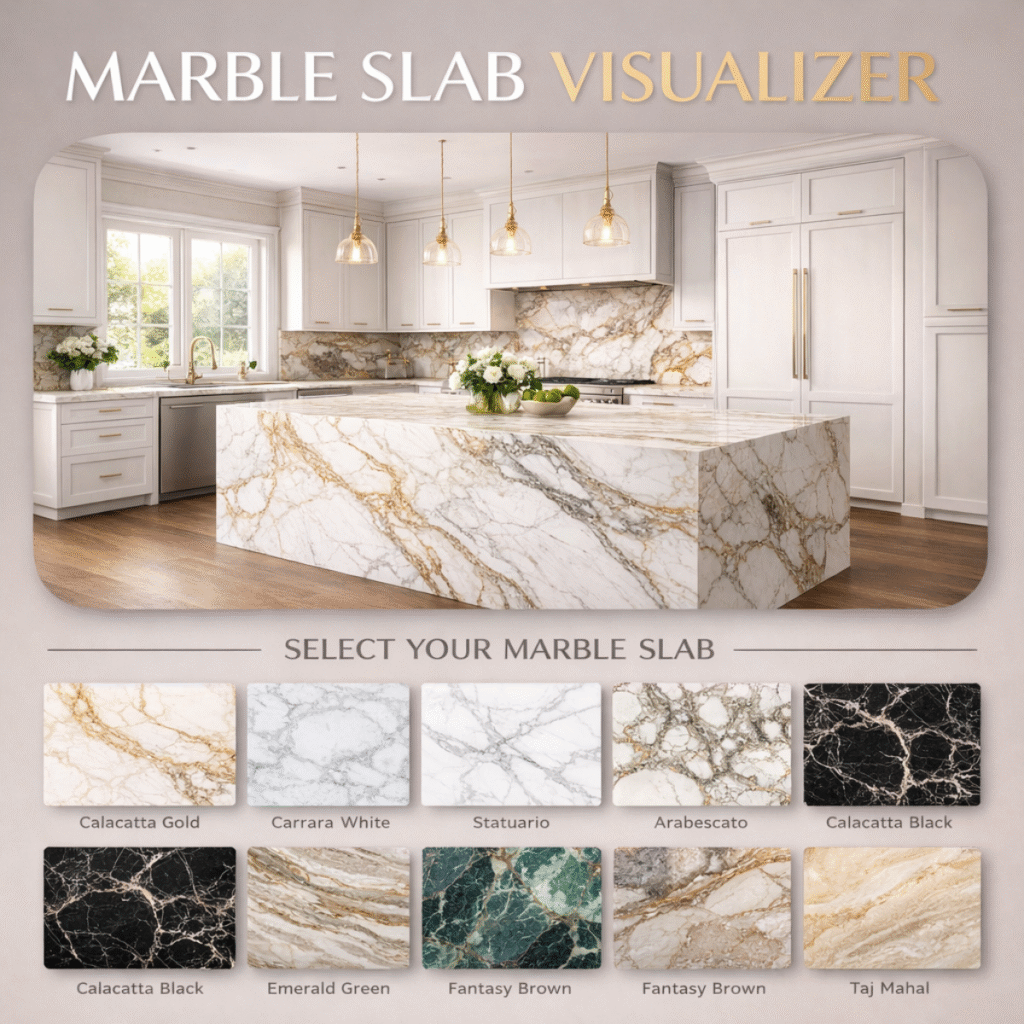
A marble slab visualizer is a digital tool that allows users to see a realistic preview of a marble slab applied inside an actual space. Instead of guessing or relying on imagination, users can upload a room photo and instantly visualize how a specific marble slab will look on floors, walls, countertops, or feature surfaces.
Unlike traditional tile previews or sample boards, this tool focuses on full slabs — meaning the natural veining, scale, and flow of marble are preserved accurately. This is critical for materials where patterns are unique and continuity matters.
For anyone dealing with high-value natural stone, a marble slab visualizer bridges the gap between showroom beauty and real-world application.
Why Traditional Marble Selection Often Fails
Marble is not like ceramic tiles or laminates. Each slab is unique.
Yet, most buying decisions are still made using:
• Small samples
• Printed catalogs
• Isolated slab photos
• Verbal explanations from sales staff
This leads to common problems:
• Customers hesitate or delay decisions
• Final installations don’t match expectations
• Costly replacements or rework
• Lower trust in the brand or dealer
A marble slab visualizer solves these issues by putting clarity before commitment.
How a Marble Slab Visualizer Works
While the experience feels simple to the user, the technology behind it is quite powerful.
At a high level, here’s how it works:
- The user uploads a photo of their room or selects a pre-existing scene.
- The system identifies surfaces like floors, walls, or counters.
- A selected marble slab is applied with correct scale, perspective, and alignment.
- Veining direction, lighting, and surface realism are preserved.
- The final output looks like a real photograph, not a render.
Modern visualizers go beyond basic overlays. They simulate lighting conditions, gloss levels, and slab continuity — all of which are crucial for marble.
Real-World Example: Showroom to Site Without Surprises
Imagine a homeowner choosing Italian marble for their living room floor.
In the showroom, the slab looks elegant. But the room at home has warm lighting, wooden furniture, and large windows. Using a marble slab visualizer, the homeowner sees exactly how the marble interacts with natural daylight and surrounding elements.
The result?
• Faster decision-making
• Zero uncertainty
• Strong emotional confidence
For the seller, this often means fewer objections and quicker closures.
Key Benefits of Using a Marble Slab Visualizer
1. Confidence-Driven Buying Decisions
Seeing marble inside a real space removes doubt. Customers no longer ask “What if?” — they know what they’re getting.
2. Reduced Returns and Rejections
Many post-installation issues happen because expectations don’t match reality. Visualization aligns both before purchase.
3. Faster Sales Cycles
When customers visualize clearly, they decide faster. This is especially valuable for premium slabs with limited inventory.
4. Better Communication Between Stakeholders
Architects, designers, and clients can all view the same visual reference, reducing misinterpretation.
5. Premium Brand Perception
Brands that offer visualization tools are seen as modern, transparent, and customer-focused.
Who Should Use a Marble Slab Visualizer?
This technology isn’t limited to one type of user.
• Marble manufacturers showcasing premium collections
• Marble dealers and showrooms improving conversion rates
• Architects presenting concepts to clients
• Interior designers validating material choices
• Homeowners making high-investment decisions
Whether B2B or B2C, the value remains consistent — clarity sells.
Marble Slab Visualizer vs Tile Visualizer: Why It’s Different
Many people assume marble visualization is the same as tile visualization. It’s not.
Tiles repeat patterns. Marble slabs do not.
A proper marble slab visualizer must:
• Preserve natural veining flow
• Handle bookmatching or slab continuity
• Maintain true scale without repetition
• Respect edge cuts and surface transitions
Without these capabilities, the visual output becomes misleading.
This is why purpose-built marble visualization tools outperform generic surface preview tools.
Digital Visualization and the Future of Marble Sales
The marble industry is evolving.
Buyers today expect:
• Transparency
• Speed
• Digital-first experiences
Just as people won’t buy furniture without seeing it in their room, marble buyers are moving away from blind selection.
Brands adopting visualization early are gaining:
• Higher trust
• Better-qualified leads
• Shorter sales cycles
• Stronger differentiation
Platforms like Nirwana.ai are helping marble brands modernize their sales experience by bringing real-room visualization into websites, showrooms, and sales teams — without disrupting existing workflows.
How Marble Visualization Helps Sales Teams
For sales teams, explaining marble is hard. Visualizing it is easy.
Instead of long explanations about veining, scale, and finish, sales professionals can simply show it. This reduces fatigue, improves clarity, and lets the product speak for itself.
In high-footfall showrooms or exhibitions, a marble slab visualizer becomes a silent salesperson — working consistently, accurately, and persuasively.
Common Mistakes to Avoid When Using a Marble Slab Visualizer
Not all visualization experiences are equal.
Avoid tools that:
• Distort slab proportions
• Over-saturate colors unrealistically
• Ignore lighting conditions
• Repeat patterns unnaturally
The goal is realism, not exaggeration. Trust is built when visuals match reality.
The Competitive Advantage for Marble Brands
In a crowded market, differentiation matters.
When two brands offer similar marble quality and pricing, the one that helps customers visualize clearly almost always wins.
That’s because the buying decision becomes emotional, not just technical.
Solutions like Nirwana.ai focus on making visualization practical, scalable, and accurate — helping brands move from static catalogs to interactive experiences without overwhelming complexity.
Conclusion: Seeing Is Believing
Marble is timeless. But how we sell and choose it doesn’t have to be outdated.
A marble slab visualizer removes guesswork, builds trust, and creates confident buyers — whether online or in-store. It turns imagination into certainty and interest into action.
As customer expectations continue to rise, visualization is no longer a luxury — it’s a necessity.
If you’re exploring smarter ways to present marble and elevate buying experiences, start by letting your customers see before they decide. Sometimes, one clear visual is worth more than a thousand samples.
