




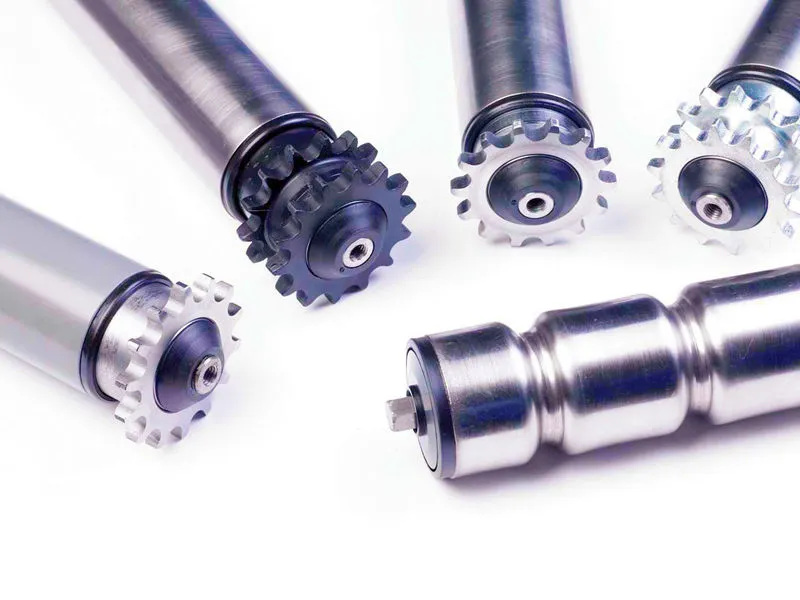
Unplanned conveyor downtime rarely comes from a single catastrophic failure. In most plants and warehouses, stoppages trace back to a small group of wearable conveyor parts that degrade over time. With consistent inspection, proper lubrication, and a focused spare-parts strategy, many failures can be detected early or avoided entirely.
Before addressing specifics, a reminder: conveyors include rotating components and pinch points. Always follow lockout procedures and keep guards in place before clearing jams or performing service.
- Bearings (Rollers, Pulleys, Shafts)
Bearings allow rollers, pulleys, and shafts to rotate smoothly under load. They reduce friction, support radial and axial forces, and enable consistent conveyor movement. Because they operate constantly, bearings are among the most critical and failure-prone components.
Early signs
- Grinding or squealing noise
- Excess heat after shutdown
- New vibration patterns
Why they fail
Most bearing failures are linked to improper lubrication or contamination. Dirt ingress and over-greasing are common contributors.
Prevention
- Standardize lubrication type, quantity, and interval
- Protect seals and keep surrounding areas clean
- Train technicians to recognize early warning signs
Spares
Stock common bearing sizes and seals used across multiple lines.
- Rollers and Idlers
Rollers and idlers support the belt and load while maintaining alignment and minimizing drag. Return rollers guide the belt back to the drive, while carry rollers support loaded sections.
Early signs
- Belt or product drifting
- Increased noise
- Seized or flat-spotted rollers
Why they fail
Rollers experience continuous load and contamination. Misalignment accelerates wear and increases belt stress.
Prevention
- Conduct routine walk-through inspections
- Verify alignment after any roller replacement
- Remove material buildup that alters belt tracking
Spares
Keep complete roller assemblies ready for rapid replacement.
- Belts and Belt Joints
The belt transports material through the system. Splices or lacing hold belt sections together and must withstand tension, impact, and repeated flexing.
Early signs
- Frayed edges
- Splice or lacing wear
- Increased spillage
Why they fail
Mis-tracking, off-center loading, and buildup on pulleys create uneven wear. Structural misalignment compounds the issue.
Prevention
- Keep pulleys and rollers clean
- Maintain centered loading
- Recheck tracking after belt work at low speed
Spares
Maintain appropriate lacing kits, tools, and contingency plans for critical lines.
- Pulleys, Lagging, and Take-Up Components
Pulleys transmit motion and tension to the belt. Lagging improves grip, while take-up systems maintain proper belt tension.
Early signs
- Belt slippage
- Frequent re-tensioning
- Uneven wear
Why they fail
Lagging wear and improper take-up settings affect traction and belt tension. Environmental changes can worsen these issues.
Prevention
- Inspect lagging during scheduled downtime
- Verify take-up travel and settings seasonally
- Track adjustments to identify recurring problems
Spares
Stock high-wear take-up components and commonly damaged hardware.
- Drive Train (Motor, Gearbox, Coupling)
The drive train provides the power that moves the conveyor. Motors, gearboxes, and couplings must operate within design limits to avoid overload.
Early signs
- Rising motor amperage
- Gearbox noise or leaks
- Overheating
Why they fail
Drive components often fail due to upstream issues such as drag, misalignment, or buildup.
Prevention
- Trend motor amps on critical conveyors
- Address root causes instead of repeated replacements
- Monitor lubrication and seals
Spares
For high-impact lines, keep a spare reducer or gearmotor, or at least seals and oil.
- Conveyor Chain and Sprockets
Chain-driven conveyors rely on conveyor chains and sprockets to transmit motion between shafts. These systems are common in pallet handling and heavy-duty applications.
Early signs
- Surging motion or chain slap
- Uneven speed
- Hooked sprocket teeth
Why they fail
A conveyor chain wears at pins and bushings, leading to elongation. Misalignment and poor lubrication accelerate wear and damage sprockets.
Prevention
- Maintain sprocket alignment
- Lubricate consistently based on the environment and speed
- Measure elongation and set replacement thresholds
Spares
Stock master links, spare sprockets, and a short section of conveyor chain for critical systems.
- Sensors and Safety Devices
Sensors, photoeyes, and limit switches control flow, detect jams, and protect personnel. While small, they can stop an entire line.
Early signs
- Nuisance stops
- False jam alarms
- Inconsistent counts
Why they fail
Dust, vibration, misalignment, and electrical noise degrade sensor performance over time.
Prevention
- Include sensor cleaning in PM routines
- Protect wiring and connectors
- Document alignment positions
Spares
Keep spares for sensors that can stop the entire line, along with mounting hardware.
Conclusion
Most conveyor failures are predictable and preventable. By focusing on high-wear components, maintaining alignment and lubrication, and stocking critical spares, operations can significantly reduce downtime. A disciplined maintenance approach turns recurring breakdowns into manageable service events rather than production emergencies.
About the Author