

Resistance spot welding
In today’s competitive manufacturing landscape, efficiency, consistency, and precision in metal joining are critical. Resistance spot welding (RSW) has emerged as a cornerstone technology for industries ranging from automotive to aerospace, enabling high-speed, reliable welding of sheet metals. At Heron Welder, we provide advanced resistance welding machines and automation solutions that empower factories to achieve superior productivity without compromising quality.
What is Resistance Spot Welding?
Resistance spot welding is a metal joining process where two or more metal sheets are joined by applying pressure and passing a high electric current through the contact points. The localized heat generated by electrical resistance melts the metal at the interface, forming a strong weld nugget as it cools.
Unlike other welding methods, RSW does not require filler material, making it ideal for high-volume production of thin metals, particularly in automotive body panels, HVAC components, and appliance manufacturing.
How Resistance Spot Welding Works
The principle of RSW relies on three core factors: current, pressure, and time.
- Current – A controlled electrical current flows through copper electrodes into the metal sheets. The resistance at the interface generates heat.
- Pressure – Pneumatic or hydraulic force holds the sheets tightly together, ensuring proper weld formation.
- Time – The current is applied for a precise duration, producing a molten weld nugget before cooling solidifies the joint.
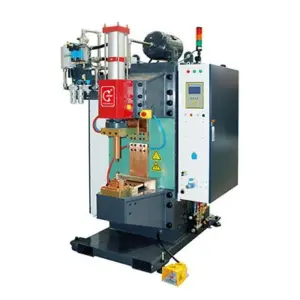
Modern resistance spot welding machines, such as Heron’s MFDC and servo-controlled spot welders, allow precise control over these parameters, ensuring repeatable, high-quality welds across large production runs.
Applications of Resistance Spot Welding
Resistance spot welding is widely used in industries that require efficient joining of sheet metals:
- Automotive Manufacturing: Welding body panels, chassis components, and brackets.
- Aerospace Components: Joining lightweight aluminum and steel alloys with precision.
- Appliance Production: Fabricating refrigerators, washing machines, and metal cabinets.
- Electrical Industry: Creating busbars, transformers, and battery assemblies.
Heron Welder provides tailored solutions for each sector, from manual spot welding guns for low-volume production to fully automated robotic spot welding cells for high-throughput assembly lines.
Resistance Spot Welding vs Other Welding Methods
When choosing a welding method, understanding the strengths of RSW compared to alternatives is essential:
| Feature | Resistance Spot Welding | MIG Welding | TIG Welding |
|---|---|---|---|
| Speed | Very high, ideal for mass production | Moderate | Slow, precise |
| Material Thickness | Thin sheets (0.5–6 mm) | Wide range | Thin to medium |
| Automation | Easily automated | Moderate | Difficult |
| Filler Material | Not required | Required | Required |
| Heat-Affected Zone | Minimal | Moderate | Low |
For factories aiming for high-speed, cost-effective production, resistance spot welding remains a preferred choice, especially when integrated into automated lines.
Best Practices for Resistance Spot Welding
Achieving consistent weld quality requires attention to several critical factors:
- Electrode Maintenance – Regular cleaning and shaping prevent poor heat transfer and weld defects.
- Material Preparation – Ensure sheet metals are free from coatings, rust, or oil to improve weld integrity.
- Parameter Optimization – Adjust current, pressure, and weld time according to material type and thickness.
- Automation Integration – Use servo-controlled or robotic systems for consistent electrode alignment and repeatable welds.
- Quality Monitoring – Employ real-time welding monitoring systems to detect deviations and reduce scrap.
Heron’s advanced resistance spot welding machines come with digital control systems and monitoring tools, allowing engineers to maintain precise parameters across thousands of welds.
Why Choose Heron Welder for Resistance Spot Welding
As a global manufacturer of industrial welding solutions, Heron Welder specializes in:
- Spot Welding Machines – Manual, semi-automatic, and fully automated systems for diverse applications.
- Advanced Controllers – MFDC technology for precise current, time, and pressure control.
- Integration Support – Robotic spot welding cells for high-volume automotive and industrial production.
- Customization – Tailored solutions for unique materials, geometries, and factory layouts.
Our expertise ensures manufacturers achieve consistent weld quality, improved efficiency, and reduced downtime, whether in OEM production or specialized metal fabrication.
Frequently Asked Questions (FAQs)
1. What materials can be welded with resistance spot welding?
RSW is ideal for ferrous and non-ferrous metals, including steel, stainless steel, and aluminum alloys, particularly in sheet form.
2. How thick can the metal sheets be for spot welding?
Typical thickness ranges from 0.5 mm to 6 mm, though advanced MFDC machines can handle thicker materials with precise control.
3. Is filler material required for resistance spot welding?
No. The process uses only pressure and electrical current to form a weld nugget, making it cost-effective and clean.
4. Can spot welding be automated?
Yes. Robotic and servo-controlled systems allow fully automated, high-speed production with minimal operator intervention.
5. How do I maintain consistent weld quality?
Regular electrode maintenance, proper material prep, and precise control of current, pressure, and time are essential for consistent welds.
Conclusion
Resistance spot welding remains a critical process for manufacturers seeking high-speed, reliable, and cost-efficient metal joining. By integrating advanced RSW machines and automation solutions, factories can achieve superior production quality while minimizing downtime and operational costs.
At Heron Welder, we combine industry-leading technology with expert support, helping OEMs, engineers, and automation integrators optimize their welding operations.
Request a quote or consult with Heron today to explore customized resistance spot welding and automated metal-joining solutions tailored to your factory’s needs.
Best Weight Loss Injection Options Available
Top-Rated Beirut Escorts Offering Sophisticated Experiences
Saving Time and Money with a Healthcare Virtual Assistant Today
What to Look for When Choosing a Trade Show Booth Manufacturer in the U.S.?
How Recreational Cannabis Stores Work: Rules and Regulations
About the Author