



What Are the Best Services for Accessing SERP Data in 2026?
Search engine results pages (SERPs) have become one of the most valuable sources of digital intelligence. From keyword rankings and competitor analysis to market research and content optimization, businesses increasingly rely on automated systems to collect and analyze SERP data. As search engines evolve with AI-powered summaries, richer result formats, and hyper-local targeting, the need for accurate and scalable access to this information continues to grow.
In 2026, companies no longer depend on manual checks or fragile scraping scripts. Instead, they turn to specialized platforms known as SERP data services. These tools provide structured, programmatic access to search results, making them essential for modern SEO and data-driven decision-making. This guide explores the best SERP data services, explains how they work, and compares leading providers to help you choose the right solution.
What Is SERP Data?
SERP data refers to all the information displayed on a search engine results page when a user submits a query. This includes:
- Organic search results (titles, URLs, descriptions, rankings)
- Paid advertisements
- Featured snippets and direct answers
- “People Also Ask” questions
- Local map results
- Images, videos, and shopping listings
Together, these elements reveal how search engines interpret user intent and which sources they prioritize. For businesses, this data is critical for tracking visibility, understanding competitors, and optimizing content strategies.
Why Businesses Need SERP Data Services
Manually checking rankings or copying results into spreadsheets is no longer practical. Modern SEO and analytics depend on automation and scale. Common use cases include:
- Continuous keyword rank tracking
- Competitor monitoring
- Market and price intelligence
- Content gap analysis
- Performance reporting for clients
To support these tasks, organizations use a search engine data API rather than direct scraping. APIs allow applications to request search results programmatically and receive them in structured formats such as JSON. This makes integration with dashboards, databases, and analytics tools far easier.
Challenges of Collecting SERP Data Without APIs
Attempting to gather SERP data without a dedicated service introduces several technical and operational risks:
- IP blocking and CAPTCHA challenges
- Frequent changes in page layout
- High maintenance and infrastructure costs
- Inconsistent or incomplete data
- Legal and compliance concerns
These issues are magnified when collecting large volumes of data. This is why most companies adopt SERP APIs that abstract away these complexities and deliver reliable results.
What Is a SERP API and How It Works
A SERP API is a service that retrieves search engine results on behalf of the user and returns them in a structured format. The typical workflow is:
- A client sends a request with parameters such as keyword, location, and device type.
- The service performs the search using browser emulation and proxy networks.
- The results are parsed into structured fields.
- The client receives a JSON response.
This design enables real-time SERP API access while avoiding the technical challenges of building and maintaining scrapers.
Key Features of the Best SERP Data Services
The best SERP data services in 2026 share several core capabilities:
- Real-time data retrieval
- Support for Google and other major search engines
- Global geo-targeting and language options
- Desktop and mobile SERP simulation
- Structured JSON output
- High scalability for large volumes
- Clear documentation and developer tools
- Reliable uptime and performance
These features determine how suitable a service is for enterprise use or long-term projects.
Criteria for SERP API Providers Comparison
To compare leading platforms, the following factors are essential:
- Data accuracy and freshness
- Speed and concurrency limits
- Pricing transparency
- Supported search engines and result types
- Integration simplicity
- Customer support and documentation
Using these criteria, we can evaluate the top options available today.
Top Services for Accessing SERP Data in 2026
Zenserp
Overview:
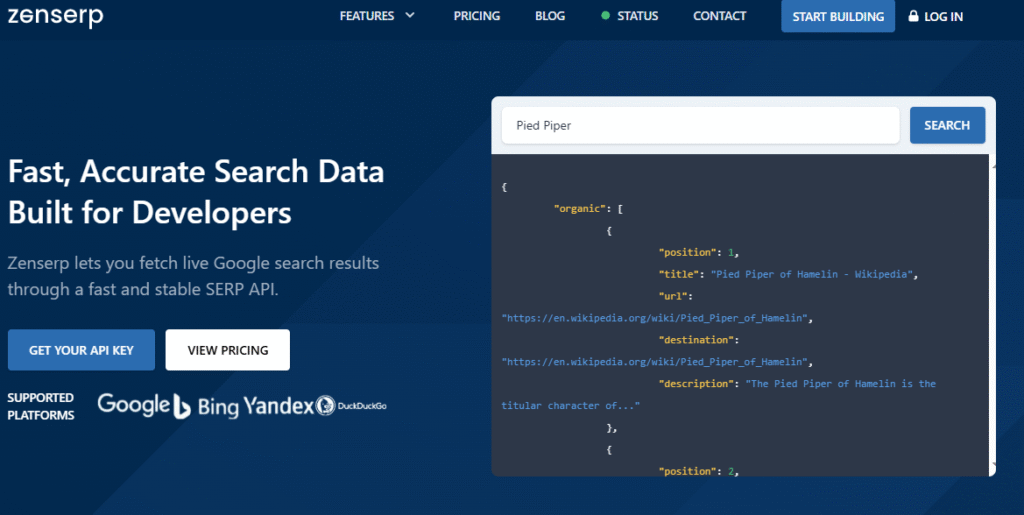
Zenserp is a SERP-focused API built for structured Google search data extraction.
Key Features:
- Real-time Google SERPs
- JSON output with rich result types
- Global location and language targeting
- High concurrency support
Pricing Model:
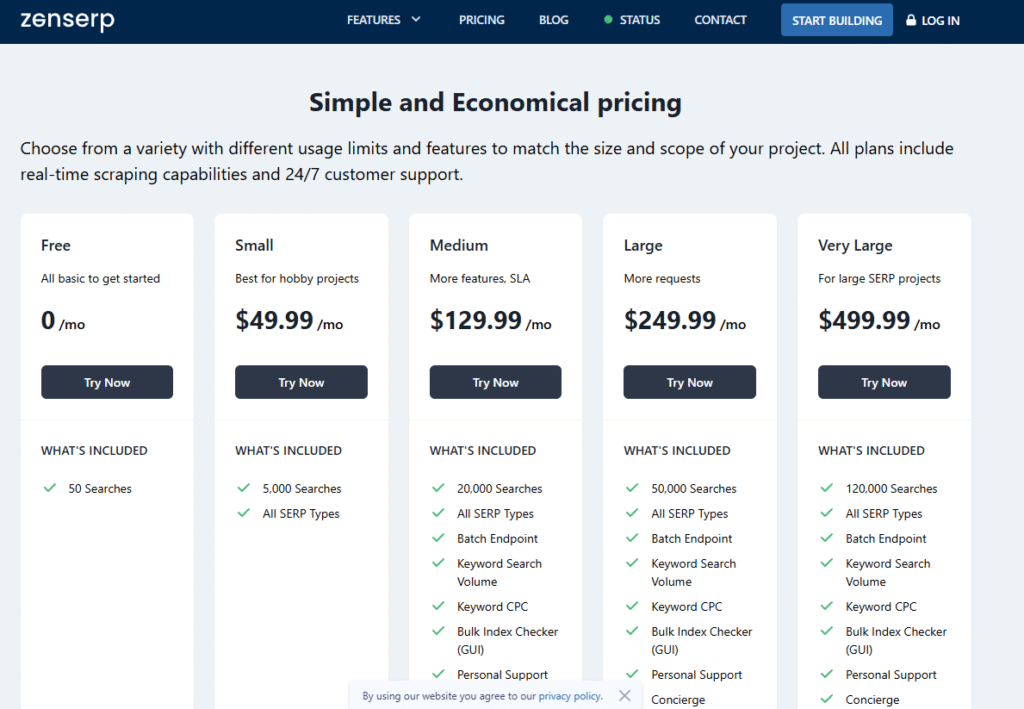
Tiered plans based on request volume.
Best For:
SEO tools and platforms that require scalable Google SERP access.
SerpApi
Overview:
SerpApi offers search results from Google, Bing, and other engines with detailed parsing.
Key Features:
- Multiple search engines
- Visual and structured SERP output
- Support for shopping and maps
Pricing Model:
Usage-based pricing.
Best For:
Developers needing multi-engine support.
DataForSEO
Overview:
DataForSEO provides a comprehensive SEO data suite, including SERP and keyword APIs.
Key Features:
- Bulk SERP queries
- Historical SERP data
- Keyword and backlink APIs
Pricing Model:
Pay-as-you-go.
Best For:
SEO analytics platforms and agencies.
Serpstack
Overview:
Serpstack is a lightweight API for Google SERP data.
Key Features:
- Simple REST endpoints
- JSON responses
- Affordable entry-level plans
Pricing Model:
Subscription-based.
Best For:
Small projects and startups.
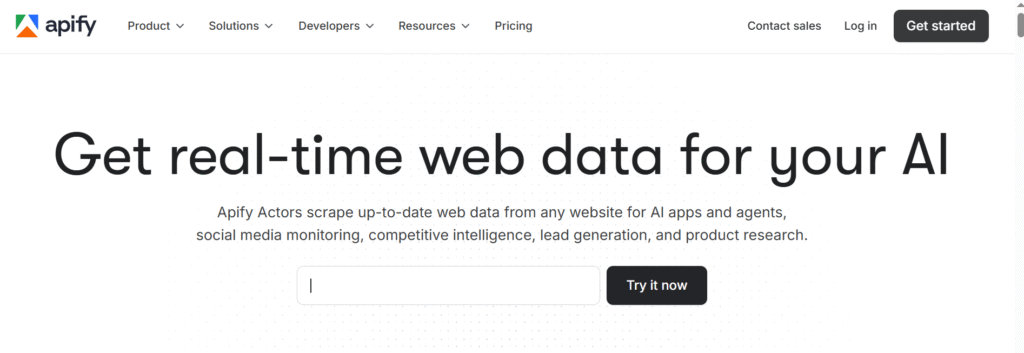
Apify
Overview:
Apify provides customizable scraping actors, including search result extractors.
Key Features:
- Scriptable workflows
- Cloud automation
- Data storage and exports
Pricing Model:
Usage-based.
Best For:
Custom scraping and automation projects.
How to Choose the Right SERP Data Service
When selecting a provider, consider:
- Scale: How many queries per day you need
- Accuracy: How closely results match real searches
- Integration: Availability of SDKs and examples
- Cost: Pricing relative to volume
- Compliance: Data usage policies and transparency
The right service should balance performance, cost, and reliability for your specific use case.
Future Trends in SERP Data Services (2026+)
Looking ahead, SERP data services are expected to evolve in several ways:
- Better tracking of AI-generated answers
- Support for voice and visual search results
- More detailed local and hyper-personalized SERPs
- Improved real-time monitoring
- Deeper analytics integrated into APIs
These trends will make SERP data even more central to digital strategy.
FAQs
1. What are SERP data services?
They are platforms that provide structured access to search engine results via APIs.
2. Are SERP APIs legal to use?
Most operate within data usage policies, but users should ensure compliance with local laws and provider terms.
3. What is the best real-time SERP API?
Several providers offer real-time access, with Zenserp, SerpApi, and DataForSEO among the most widely used.
4. How accurate is Google SERP data from APIs?
High-quality services deliver results that closely match real user searches, including location-based variations.
5. Which service is best for SEO agencies?
SEO-focused APIs such as Zenserp and DataForSEO are commonly preferred by agencies due to structured output and scalability.
Access to SERP data has become a foundation of modern SEO and market intelligence. As search engines grow more complex, businesses need dependable tools to retrieve and analyze results at scale. The best SERP data services in 2026 combine real-time access, structured output, and global coverage to meet these demands.
Through a careful SERP API providers comparison, it becomes clear that different services excel in different areas, some prioritize speed, others customization, and others enterprise reliability. Choosing the right provider depends on your scale, budget, and technical needs. With the right search engine data API, organizations can turn raw search results into actionable insights that drive smarter digital strategies.
Recommended Resources: Zenserp vs. Yandex Reverse Image Search: What’s The Best?
About the Author