




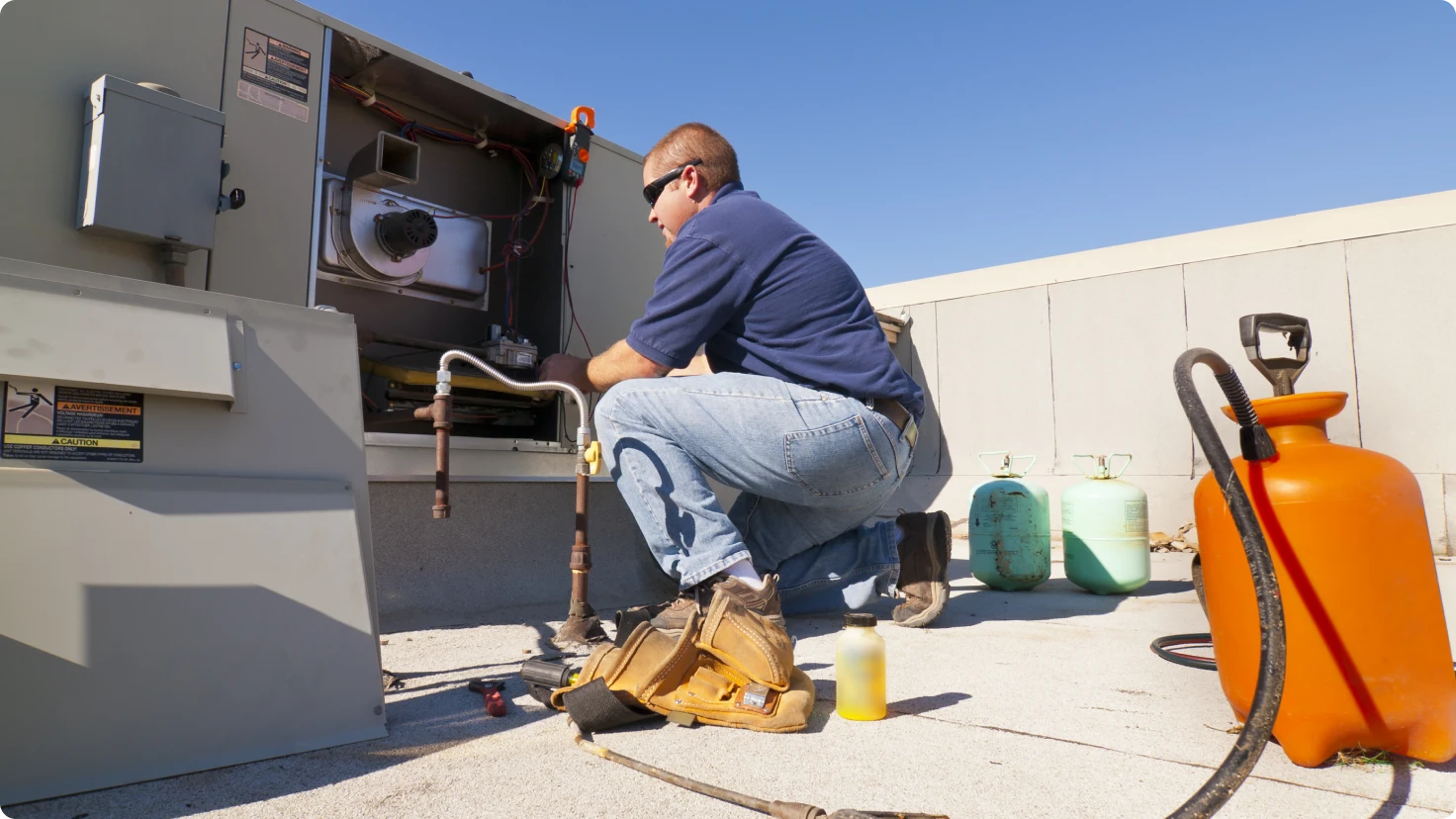
You’ve likely felt that subtle knot in your stomach when the outdoor unit makes a new, rhythmic “thwap” sound or when the hallway feels five degrees stickier than the bedroom. It’s the quiet anxiety of home ownership. You know that if the air conditioner gives out on a 98-degree Tuesday, it isn’t just a discomfort, it’s a four-figure emergency. We often ignore our HVAC systems because they’re tucked away in crawlspaces or behind bushes, but that “out of sight, out of mind” mentality is exactly how HVAC preventive maintenance transforms from a boring chore into a financial lifesaver.
Most homeowners view maintenance as an optional “tune-up,” like a car wash for their furnace. In reality, your HVAC system is a high-pressure thermal exchange machine that operates under brutal conditions. In the 2026 climate of extreme heat waves and unpredictable cold snaps, your system is likely running 20% more hours than it did a decade ago.
What is Preventive Maintenance?
HVAC Preventive Maintenance is a proactive service strategy designed to maintain system “Design Intent” by correcting minor mechanical deviations before they trigger catastrophic failure. It involves heat exchanger integrity testing, refrigerant charge calibration, and electrical load analysis to ensure the system meets its rated SEER2 or HSPF2 efficiency benchmarks.
Why “Standard” Advice Fails (The Information Gain Gap)
If you search for maintenance tips, most sites tell you to “change your filter.” While true, that’s like saying “don’t run out of gas” is the secret to car longevity. It’s the bare minimum.
Real-world failure happens in the “micro-layers.” For example, most people don’t realize that a fine layer of dust (just 1/16th of an inch) on an evaporator coil can reduce your system’s efficiency by 21%. That’s not just a statistic; that’s you paying for five days of cooling every month that you never actually receive.
The Contrarian Angle: Stop Closing Your Vents
Common “wisdom” suggests closing vents in unused rooms saves money. This is a myth that destroys compressors. Modern HVAC systems are “balanced” for the static pressure of your entire home. Closing vents increases the pressure in your ductwork, forcing the blower motor to work harder and potentially causing the cooling coil to freeze into a solid block of ice. If you want to save money, keep your vents open and let the system breathe as it was designed to do.
The 2026 Seasonal HVAC Maintenance Checklist
To stay ahead of the curve, you need to think like a technician. Use this checklist to bridge the gap between “it works” and “it’s optimized.”
1. The Airflow Audit (Preventive HVAC Care)
- The Filter Date Stamp: Don’t just change the filter; write the date of installation on the cardboard frame in Sharpie. It prevents the “I think I changed it last month” internal lie.
- The Two-Foot Rule: Clear any vegetation, “Mile High” dust, or debris within 24 inches of your outdoor condenser. If the fins are clogged, the heat has nowhere to go but back into your compressor.
2. The Professional Deep-Dive
While DIY is great for surface care, the heavy lifting requires specialized tools. If your furnace starts “short-cycling” (turning on and off every few minutes), it’s usually a sign of a dirty flame sensor or a compromised heat exchanger. This is when you need to call the furnace experts in Denver Co to perform a combustion analysis. They check for trace amounts of carbon monoxide that a standard home alarm might miss until it’s too late.
3. Electrical & Mechanical Integrity
- Capacitor Testing: These are the “batteries” that start your motors. They often fail slowly, losing their “mfd” rating over time. A pro can catch a failing capacitor before it kills a $3,000 compressor.
- Condensate Flush: Algae loves 2026 humidity. A simple vinegar flush once a season prevents the drain line from backing up and flooding your utility room.
System Comparison: Maintenance vs. Neglect
Pro-Tip: The “Amp Draw” Secret
Ask your technician to record the “Amp Draw” of your blower motor and compressor during every visit. If the motor is drawing more current than the manufacturer’s label (the “FLA” rating), it’s a smoking gun for an imminent electrical failure. This data is your best defense against unexpected downtime.
Step-by-Step Implementation for Homeowners
- Spring/Fall Reset: Set a recurring calendar alert for March 1st and September 1st.
- Visual Inspection: Walk around the unit while it’s running. Listen for “shrieking” (bearings) or “clattering” (loose fan blades).
- The Thermostat Check: Replace your thermostat batteries annually. It’s the most common “no-heat” service call, and it’s a $5 fix you can do in 30 seconds.
- Audit Your Insulation: Seasonal HVAC maintenance is useless if your attic is leaking air. Check your R-value; in 2026, you should aim for R-49 to R-60 to keep the load off your system.
Semantic Entity Integration: The Technical “Why”
To truly understand preventive HVAC care, you have to look at the physics. Your system relies on Refrigerant Subcooling and Superheat levels. When these aren’t calibrated, the liquid refrigerant can “slug” the compressor, which is like trying to compress water in a car engine, it shatters the internal valves.
Furthermore, your Indoor Air Quality (IAQ) is directly tied to the “Static Pressure” of your ducts. High pressure doesn’t just hurt the motor; it forces air through tiny gaps in your ductwork, sucking in dusty attic air and blowing it into your living room. Maintenance isn’t just about the machine; it’s about the air you breathe.
FAQ: Real Answers for 2026 Problems
Q: Is a maintenance plan really worth the $200 a year?
A: Yes, but not just for the cleaning. Most plans give you “Priority Service.” In a record-breaking heatwave, the wait for a repair can be two weeks. Maintenance members usually get moved to the front of the line, which is priceless when your house is 90 degrees.
Q: Can I use those high-MERV “Purple” filters from the big box stores?
A: Be careful. While MERV 13 filters catch more dust, they also act like a brick for your airflow. Unless your system was specifically designed for high-static filtration, a MERV 8 or 11 is usually the “sweet spot” for protection without killing the motor.
Q: My AC is brand new, do I still need a tune-up?
A: Check your warranty. Most major manufacturers (Carrier, Trane, Lennox) now require proof of annual professional maintenance to honor their 10-year parts warranty. If you skip a year and the compressor dies, they can and will deny your claim.
Q: What is the “smell” when I first turn on my heater in the fall?
A: That’s usually just “dust-off.” It’s the dust that settled on the heat exchanger burning away. However, if it smells like sulfur (rotten eggs) or ozone (electrical burning), shut the system down at the breaker immediately.
Final Thought: Your Home’s Heartbeat
Your HVAC system is the heartbeat of your home’s comfort. You don’t have to be a mechanical engineer to care for it, but you do have to be a consistent steward. By following a structured HVAC maintenance checklist and partnering with local experts for the technical deep-dives, you turn a complex machine into a reliable asset.
About the Author