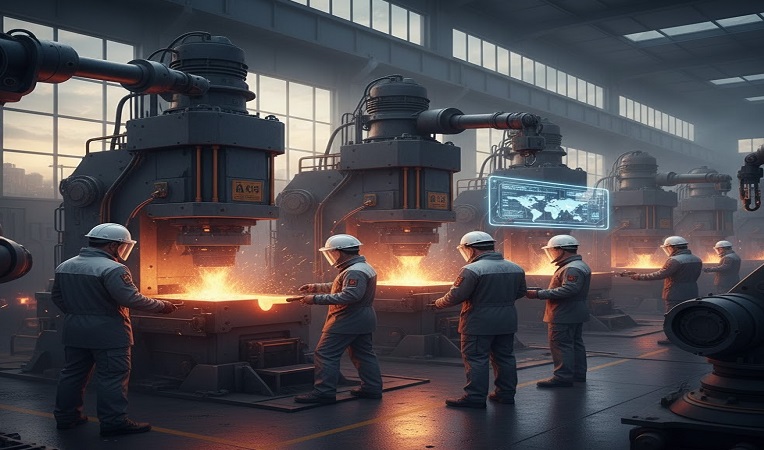
Historically, India’s forging sector has been an important player in the global manufacturing value chain as a supplier of high-strength parts for different industries including automotive, aerospace, infrastructure, energy and heavy engineering. The forging export industry in India is at the point of a major transformation driven by technology development, an increasing focus on sustainability and global technology transfer and the changing purchasing trends of international buyers. The outlook for the future of forging exports from India is good, due to a solid domestic manufacturing base and increased international market access whereby several trends will shape forging exports from India in the future.
1. Rising Demand for Lightweight and High-Performance Materials
The use of lightweight and high performance materials is all around the world to improve fuel economy and reduce emissions. Availability of stronger and lighter weight materials like aluminum, as well as newer steel alloys, are becoming more commonplace in some sectors of the industry (e.g. automotive and aerospace), establishing demand. To keep pace with this growing demand, many forging manufacturers in India will upgrade their design capabilities to manufacture high-strength, lightweight forged parts which will meet the needs of their customers around the globe.
In addition to keeping Indian manufacturers competitive, these changes provide additional opportunities for India’s forging manufacturers in markets seeking sustainable and energy-efficient solutions.
2. Emphasis on Industry 4.0 and Smart Manufacturing
Smart technologies are changing how things are made all over the globe, including in India’s forging industry. Manufacturing companies that implement Industry 4.0 technologies, like IoT-enabled monitoring, predictive maintenance, automation, big data analytics and digital twins to name a few, can improve efficiency, quality, and production output at their forging facilities. Developed innovations will decrease the amount of time required for forging manufacturers to produce products and decrease the amount of wasted material due to inefficient production. The new technologies created to assist in creating these products are also allowing manufacturers to produce products that regularly meet the requirements of industries worldwide.
3) An Increased Emphasis on Sustainability and Eco-Friendly Practices
As the effects of climate change continue to increase and as sustainability becomes a more critical issue for the global supply chain, sustainability is a more major issue for the global supply chain than ever before. International customers are requiring their suppliers to use sustainable manufacturing practices and thus, Indian forging exporters are being driven toward adopting energy-efficient processes, waste reduction systems and recycling initiatives. By implementing sustainable forging practices, not only will Indian forging exporters help reduce environmental impacts, they will increase their competitiveness in the global export marketplace by complying with global environmental regulations and CSR standards.
4. Expansion of Export Markets
Forging companies based in India are not only looking at their traditional export markets, but are now also expanding their operations to include new and developing regions such as Southeast Asia, the Middle East and Africa. These new emerging markets have been undergoing significant growth in industrial activity, and therefore, an increased demand for forged products used in the construction of infrastructure, mining, and manufacturing processes. In addition to creating diversified sources of revenue outside of India, developing new and different export markets provides forging companies with a measure of long term stability by reducing the overall impact that any one market could have on their business.
5. Investments in Advanced Forging Technologies
For Indian manufacturers to be competitive on the global market, they are investing in advanced fabrication technologies (e.g., precision fabrication, closed-die fabrication, automated piece fabrication). These advanced fabrication technologies improve the precision or dimensional accuracy of finished goods produced using these processes; minimize or reduce any scrap generated during fabrication; and ensure that all final products meet or exceed stringent global requirements. Such technological advances also assist Indian exporters in meeting or exceeding all required standards of quality required by global OEMs and Tier-1 suppliers.
6. Strategic Collaborations and Skill Development
As global demand for forged products rises, the need for qualified personnel to use new forging equipment and techniques, advanced study, and engineering capabilities is increasing. Therefore, India is increasing cooperation amongst manufacturers (both large and small), educational institutions, and research & development organisations to create a qualified workforce equipped to operate these advanced forging systems. Through training and certification programs, customers will receive improved quality and be able to produce products in a shorter period of time; thus, they will view Indian manufacturers as credible global partners for their business.
7. Digital Trade Facilitation and E-Commerce Channels
Cross-border transactions have been made easier due to the digitalisation of export documentation, customs procedures and other trade facilitation platforms. Digital marketplace and e-commerce platforms are helping Indian exporters of forged products connect with customers throughout the world, as digital trade gains in popularity through these platforms, which helps reduce the barriers to entry for Forging exporters India while speeding up the growth of their exports. Through the continued growth of digital trade, Indian forged products have more visibility and accessibility worldwide.
8. Compliance With International Standards
Meeting international Standards of quality and compliance, including internationally recognized certification organizations such as ISO, and regulatory bodies that establish guidelines for specific industries including the aerospace industry (AS), automotive industry (IATF 16949), and oil and gas industry (API), are becoming necessary requirements for exporters to be successful in the global marketplace. Indian forging exporter companies have started to obtain various certifications to provide assurance to their international customers of consistent quality, traceability and reliability of their manufacturing processes. The ability to achieve compliance, therefore enhances the credibility of those companies as exporters and allows them to access higher value markets.
Conclusion
The upcoming years for India’s forging export sector will see innovations, diversifications, sustainability improvements, increases in the demand from other countries around the world for lightweight, high-performing forged products, increasing use of advanced manufacturing techniques, emphasis on eco-friendly manufacturing processes, and entering into new markets by Indian exporters. Therefore, by making targeted investments in innovative technologies, skill development, quality standards and digital trading capabilities, the Indian forging exports sector is poised to expand its global presence in the years to come as an important player within the global supply chain of forged products.
