Digital products are no longer limited to one country or one currency. Modern apps, SaaS tools, and fintech platforms serve users from multiple regions, making accurate currency conversion an essential feature. Businesses that operate globally need reliable financial data to maintain correct pricing, enable international transactions, and provide a seamless experience for users. An exchange rates api allows developers to integrate real-time currency data directly into their applications, ensuring that exchange values remain accurate and up to date.
Instead of manually updating currency values or relying on outdated financial information, developers can automate the entire process using APIs that fetch currency data instantly. This helps businesses build scalable global products while maintaining financial accuracy.
This article explains how multi-currency exchange rate APIs work, why they are essential for modern platforms, and how developers can use them to build reliable and user-friendly applications.
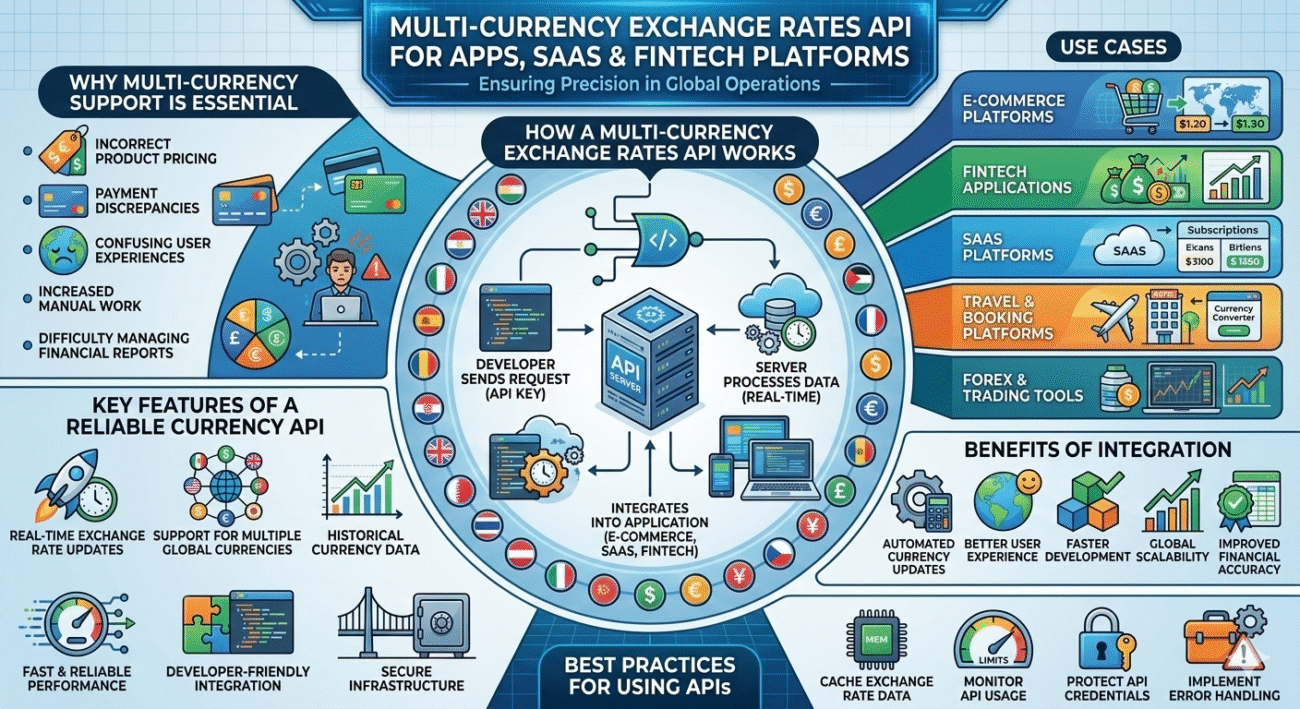
Why Multi-Currency Support Is Essential for Modern Platforms
As digital services expand globally, applications often deal with users from different countries. Each region operates with its own currency, and exchange rates fluctuate frequently based on economic activity, political events, and market conditions.
Without automated currency conversion, businesses may face several challenges:
- Incorrect product pricing across regions
- Payment discrepancies in international transactions
- Confusing user experiences for global customers
- Increased manual work for developers and finance teams
- Difficulty managing financial reports across currencies
By integrating a multi-currency API, applications can automatically update exchange rates and convert currencies in real time. This ensures accuracy and consistency across the entire platform.
What Is a Multi-Currency Exchange Rates API?
A multi-currency exchange rate API is a web-based service that provides real-time currency data through a simple interface. Developers send a request to the API server, and the system responds with updated exchange rates for multiple currencies.
The data is usually delivered in structured formats such as JSON or XML, making it easy to integrate with websites, mobile apps, and backend systems.
For example, a developer can request exchange rates for several currencies relative to USD. The API returns the current conversion values, which the application can use to display accurate prices or perform currency calculations.
This entire process happens within milliseconds, allowing apps to display real-time financial information to users.
How Currency APIs Power Global Applications
Currency APIs play a critical role in powering many digital services that rely on financial accuracy. By automating exchange rate retrieval, these APIs ensure that applications always operate using current market data.
When integrated into an application, the API can perform tasks such as:
- Fetching real-time currency values
- Converting prices between multiple currencies
- Updating financial dashboards
- Supporting international payment systems
Because currency APIs automate these processes, developers can focus on building core features rather than managing financial data manually.
Key Features of a Reliable Currency API
Choosing the right currency API is important for ensuring reliable and accurate data. Developers should evaluate several factors before integrating an API into their projects.
Real-Time Exchange Rate Updates
Exchange rates change frequently throughout the day. Real-time updates ensure that applications always display accurate currency values.
Support for Multiple Global Currencies
A strong API should support dozens or even hundreds of currencies so businesses can operate internationally without limitations.
Historical Currency Data
Access to past exchange rates helps businesses analyze financial trends, generate reports, and build forecasting tools.
Fast and Reliable Performance
Applications that rely on real-time financial data need an API that can respond quickly and consistently.
Developer-Friendly Integration
Clear documentation, simple endpoints, and strong developer support make the integration process easier.
Secure Infrastructure
Secure API access ensures that data requests remain protected and reliable.
Use Cases for Multi-Currency APIs
Multi-currency APIs are widely used across industries that require accurate currency conversions.
eCommerce Platforms
Online stores that sell products internationally must display prices in different currencies. A currency API automatically converts prices based on the latest exchange rates.
Fintech Applications
Financial platforms use currency APIs to support international payments, currency tracking, and financial dashboards.
SaaS Platforms
Software companies serving global customers often display subscription plans in local currencies to improve transparency and user experience.
Travel and Booking Platforms
Travel websites convert prices for flights, hotels, and travel packages so users can understand costs in their preferred currency.
Forex and Trading Tools
Trading platforms rely on accurate exchange rate data to monitor market movements and support financial analysis.
Benefits of Using a Currency Exchange Rates API
Integrating a currency API into an application offers several advantages for both developers and businesses.
Automated Currency Updates
Exchange rate data is updated automatically, eliminating the need for manual maintenance.
Better User Experience
Displaying prices in local currencies helps users make faster and more confident purchasing decisions.
Faster Development
Developers can integrate currency functionality without building complex financial data systems from scratch.
Global Scalability
Applications can easily support international markets by handling multiple currencies efficiently.
Improved Financial Accuracy
Using reliable exchange rate data reduces errors in transactions and financial calculations.
How Developers Integrate Currency APIs
Integrating a currency API is typically straightforward and requires only a few steps.
First, developers register with an API provider and obtain an API key. This key allows their application to access the API endpoints.
Next, the application sends a request to the API server requesting exchange rate data. The server processes the request and returns the latest currency values.
Finally, the application uses that data to perform currency conversions or display converted prices to users.
Most currency APIs support multiple programming languages, including:
- JavaScript
- Python
- PHP
- Java
- Ruby
This flexibility allows developers to integrate the API into many types of digital platforms.
Best Practices for Using Currency APIs
To get the best results from a currency API, developers should follow several best practices.
Cache Exchange Rate Data
Caching frequently requested data reduces the number of API calls and improves application performance.
Monitor API Usage
Keeping track of API request limits helps prevent service interruptions.
Protect API Credentials
API keys should always be stored securely to prevent unauthorized access.
Implement Error Handling
Applications should include backup logic in case the API temporarily becomes unavailable.
Future of Currency APIs in Global Digital Services
As businesses expand internationally, the need for accurate financial data will continue to grow. Currency APIs are evolving to provide more advanced features that support modern digital platforms.
Some emerging developments include:
- Real-time currency analytics
- Automated financial insights
- Integration with global payment gateways
- Advanced currency trend analysis
These innovations will allow businesses to build more intelligent financial applications while providing users with deeper insights into global markets.
For developers building global platforms, integrating a reliable Live currency exchange rates api provides the foundation for accurate financial operations and scalable international services.
Global applications must handle multiple currencies efficiently to support international users. Accurate exchange rate data ensures that pricing, payments, and financial calculations remain reliable across different markets.
Currency APIs simplify this process by providing real-time access to global exchange rate data. Developers can integrate these APIs into their applications to automate currency conversions, improve user experience, and build scalable global platforms.
From eCommerce and SaaS tools to fintech and travel platforms, multi-currency exchange rate APIs play a crucial role in modern digital products. By using reliable currency data services, businesses can deliver accurate financial information and confidently serve users around the world.
FAQs
1. What is a multi-currency exchange rates API?
A multi-currency exchange rates API is a service that provides real-time currency conversion data for multiple global currencies. Developers use it to integrate currency conversion features into apps, websites, and financial platforms.
2. Why do SaaS and fintech platforms need currency APIs?
SaaS and fintech platforms often serve users from different countries. Currency APIs help these platforms display accurate prices, process international payments, and manage financial data across multiple currencies.
3. How frequently are exchange rates updated in currency APIs?
Most reliable currency APIs update exchange rate data frequently depending on the provider. Some APIs provide real-time updates, while others refresh data every few minutes or hourly to ensure accuracy.
Recommended Resources:-
