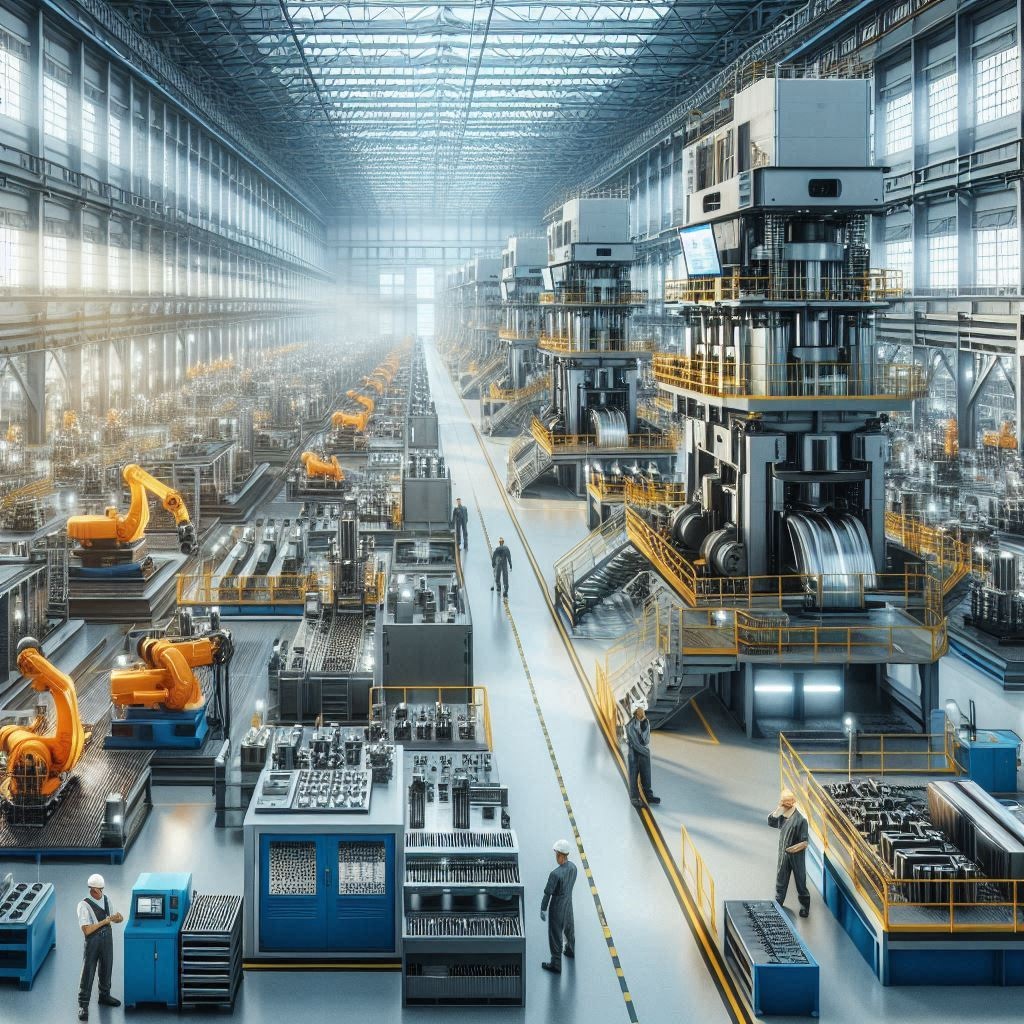
A typical modern forging manufacturer India runs combination of heavy-duty presses, induction heaters, robotic arms and CNC machining lines under one roof. The aim stays simple — turn steel billets or alloy bars into finished or near-finished parts that need little extra work before assembly. Crankshafts for trucks, gear blanks for gearboxes, flanges for pipelines, yoke forgings for railways, and turbine discs for power plants come out of these shops regularly.
Twenty years back, the majority of forging manufacturers India operated steam hammers, gas furnaces, and manual die setting. Now the larger and medium-sized forging manufacturers India have moved to hydraulic presses ranging from 2000 to 12 000 tonnes capacity, electric screw presses, automated billet handling systems, and flow simulation before cutting the first piece of steel.
Main Forging Methods Employed
Different part families call for different forging approaches.
- Closed-die hot forging
This remains the workhorse process. Billet heated to 1100–1250 °C for carbon steels or 950–1050 °C for stainless grades goes into multi-cavity dies. Hydraulic press squeezes metal to fill every corner. Flash kept thin — usually 1–3 mm — so trimming stays quick. Many plants run 2500–8000 tonne presses for medium to large automotive and engineering components.
- Open-die or smith forging
Used for big shafts above 300 mm diameter, rings up to 2–3 metres OD, or one-off heavy pieces. Flat dies or simple saddles shape the stock through repeated strokes. Some units add manipulator arms to turn and position heavy billets safely.
- Precision forging / flashless forging
Here the target is ±0.3 mm tolerance or better with flash almost eliminated. Dies machined to very close limits, billet weight controlled within 50–100 grams, and press stroke programmed precisely. Aerospace connectors, medical instrument handles and select defence parts often go this route.
- Warm and cold forging
Warm forging done at 600–900 °C suits parts needing good surface finish and moderate strength gain. Cold forging at ambient temperature produces small high-precision items — bolts, nuts, CV joint components — on high-speed knuckle-joint or mechanical presses.
Billet Heating Arrangements
Heating quality decides whether forging defects appear or not.
Induction heaters installed in lines since early 2010s. Single-shot or walking-barrel types bring billets to forging temperature in 60–180 seconds depending on size. Minimal scale forms compared with coal or oil furnaces used earlier. Temperature scanned by pyrometers and logged for every heat.
Traditional walking-beam or pusher-type gas furnaces still handle very large billets or when volume justifies lower capital cost. Modern burners and recuperators keep fuel consumption down.
Press and Hammer Equipment
Press choice depends on part size, production rate and precision needed.
- Hydraulic presses (most common today) — slow but very high force, good for deep cavities and large area reductions.
- Electric screw presses — rising fast because of lower electricity cost per stroke, precise energy control and no hydraulic leaks.
- Mechanical crank presses — fast for smaller forgings up to about 400–500 kg.
- Pneumatic or counterblow hammers — still used in smaller shops or for open-die work.
Many plants keep mix of 2–3 types so they can match job requirements without overloading one machine.
Automation Level in Modern Plants
Robots handle almost everything that involves heat or heavy lifting.
Six-axis robots pick hot billets from conveyor after induction, place them in die, remove forgings after press stroke, and drop them into quench tanks or trim presses. Some lines run completely lights-out for long runs.
Transfer systems move parts between multi-stage dies without human touch. PLCs and SCADA monitor whole sequence — temperature drop, press force curve, cycle time — and stop line if anything drifts outside set band.
Die Design and Tool Room Practices
Most serious forging manufacturer India maintains own tool room.
Dies cut from H13, 1.2344 or similar hot-work tool steels on CNC vertical machining centres and wire-cut EDM. Shrinkage allowance, draft correction and fillet radii adjusted using forging simulation software before steel ordered.
Simulation packages show metal flow, fold lines, die stress and expected forging load. This step avoids 3–4 trial dies that were normal earlier.
Heat Treatment and Finishing Lines
Forging usually followed by:
- Normalising or isothermal annealing in continuous furnaces
- Quench and temper lines with polymer or oil tanks
- Shot blasting or wheelabrator for scale removal
- CNC turning, milling or grinding when customer wants ready-to-assemble parts
Some plants add in-house magnetic particle, ultrasonic and hardness testing stations.
Supporting Systems That Make Difference
- Billet weighing and sorting stations with ±0.1 % accuracy
- Die pre-heating ovens kept at 200–350 °C
- Centralised lubrication and coolant systems
- Dust and fume extraction to meet factory norms
- ERP linked with shop-floor terminals for job tracking
Heat Treatment and Post-Forging Operations in Modern Setups
Most forgings leave the press in a condition that needs controlled cooling or heat treatment to reach final mechanical properties. Modern forging manufacturer India treats this stage as critical as the forging itself.
Normalising often done first — parts air-cooled or fan-cooled after forging to refine grain and relieve stresses. Continuous roller-hearth furnaces or batch bogie furnaces handle this for medium to large volumes. Temperature uniformity kept within ±10 °C across load.
Quenching and tempering lines follow for higher strength grades. Polymer quenchants preferred over oil in many plants because they give more uniform hardness with less distortion and lower fire risk. Some units run polymer tanks with agitation pumps and heat exchangers to hold quench severity steady.
Induction hardening applied selectively on wear surfaces like gear teeth or journal areas. Robot-loaded induction scanners harden only required zones while leaving rest tough and ductile. Depth control stays precise — typically 2–5 mm case depth depending on part.
Shot peening or surface rolling added where fatigue life matters most. Peening machines use steel shot or glass beads at controlled intensity to introduce compressive stresses on surface. Railway axles, crankshaft fillets and connecting rod big ends almost always get this treatment.
Trimming, coining and calibration happen right after forging or after heat treatment. Hydraulic trim presses remove flash cleanly. Sizing dies then correct any slight distortion from quenching — especially useful for thin-wall rings or precision flanges.
Many plants keep in-house CNC machining cells for finish turning, milling or drilling when customer wants ready-to-fit parts. This avoids sending semi-finished forgings outside and shortens overall delivery.
These post-forging steps decide whether part meets hardness, tensile, impact and fatigue specs consistently. Units that control heating rates, quench media and peening parameters tightly see far fewer rejections at customer end.
Common Challenges Tackled by Technology
Raw material cost swings → precise billet cutting and weight control reduce scrap Power cost → electric screw presses and induction heating lower kWh per tonne Labour availability → robots cut dependency on skilled hammer operators Quality rejections → real-time monitoring and simulation bring first-time yield above 95 %
Conclusion
The current generation forging manufacturing facility in India combines traditional forging knowhow with modern technologies such as induction heating, high tonnage hydraulic and screw presses, robotic solutions, flow simulation, and quality control. These technologies enable the production of quality forgings for the global automotive, railway, oil & gas, power, and defense industries while being cost competitive. Only plants that upgrade their equipment and control technologies continue to win repeat exports and long-term orders.
