Choosing the right rug sounds simple — until you actually try doing it.
You scroll through endless designs, visit stores, compare textures, and still feel unsure. Will that beige rug match your sofa? Will the bold pattern overpower your space? And most importantly, will it actually look good in your room?
This uncertainty is exactly what slows down buying decisions.
That’s where a rug visualizer changes everything.
Instead of imagining how a rug might look, you can now see it in your own space before making a purchase. It’s practical, fast, and removes guesswork completely. For both customers and brands, this shift is redefining how rugs are discovered and sold.
What Is a Rug Visualizer?
A rug visualizer is a digital tool that allows users to preview rugs in a real room setting.
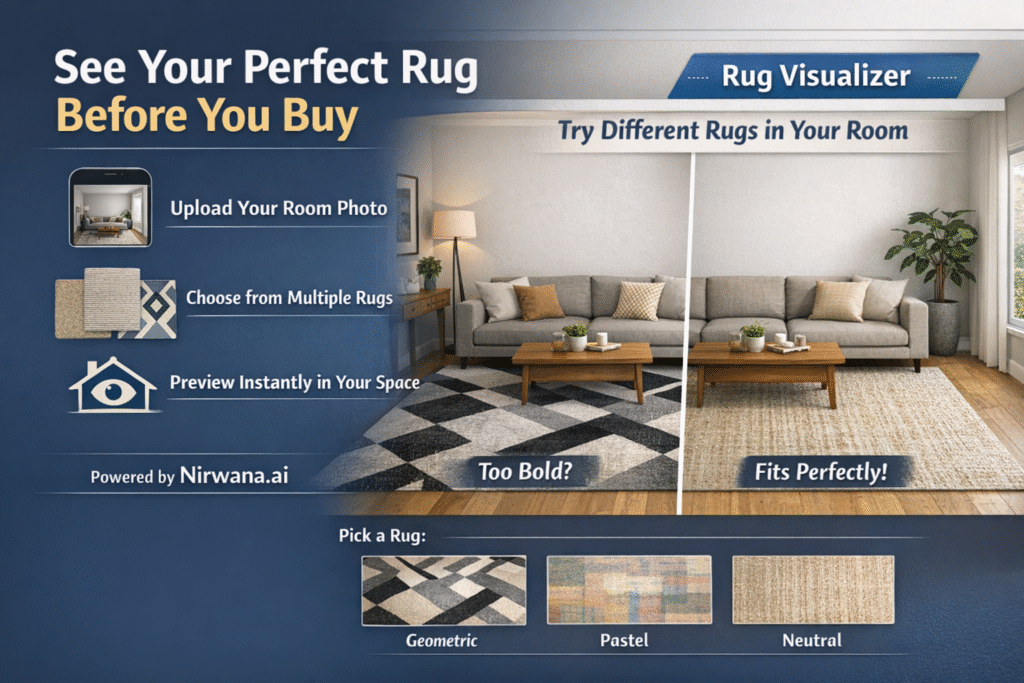
Instead of relying on static images or showroom samples, users can:
- Upload a photo of their own room
- Choose from multiple rug styles, colors, and sizes
- Instantly see how each option looks in real scale
The experience is interactive and highly realistic. You’re not just browsing — you’re actually designing your space in real time.
Why Traditional Rug Shopping Falls Short
Lack of Visualization
Most customers struggle to imagine how a rug will look once placed in their room. A product photo doesn’t reflect lighting, space, or surrounding furniture.
Decision Fatigue
With hundreds of options available, choosing the right rug becomes overwhelming. Without clarity, customers delay decisions or abandon the purchase altogether.
Mismatch Risks
Even after buying, many customers end up returning rugs because the size, color, or pattern doesn’t match expectations.
This is where a rug visualizer provides immediate value — by eliminating uncertainty at every stage.
How a Rug Visualizer Improves the Buying Experience
1. Real-World Context
Instead of guessing, customers see the rug in their actual room. This makes the decision feel more confident and informed.
2. Faster Decisions
When customers can instantly compare multiple designs, they move from browsing to buying much faster.
3. Better Size Understanding
Size is one of the biggest challenges in rug buying. A rug visualizer helps users understand proportions accurately — whether it’s for a living room, bedroom, or office.
4. Reduced Returns
When customers know exactly what they’re getting, the chances of dissatisfaction drop significantly.
Real-Life Example: From Confusion to Clarity
Imagine someone redecorating their living room.
They shortlist three rugs online:
- A neutral textured rug
- A bold geometric pattern
- A soft pastel design
Without a rug visualizer, they’re stuck choosing based on guesswork.
With a rug visualizer, they upload a photo of their room and test all three options within minutes. Suddenly, the decision becomes obvious — the geometric rug feels too loud, the pastel one fades, and the neutral textured rug fits perfectly.
That moment of clarity is what drives conversions.
Why Rug Brands Are Adopting Visualizers
The shift isn’t just happening on the customer side — brands are rapidly adopting visualization tools as well.
Higher Conversion Rates
When customers can visualize products, they are far more likely to complete a purchase.
Premium Positioning
Brands that offer advanced experiences like a rug visualizer are perceived as more modern and customer-focused.
Better Engagement
Users spend more time interacting with products when they can experiment with designs in real spaces.
Scalable Sales Tool
A rug visualizer works across multiple channels:
- E-commerce websites
- In-store kiosks
- Sales presentations
- Social media campaigns
This makes it a powerful asset for both online and offline sales.
How Nirwana.ai Enhances the Rug Visualization Experience
Platforms like Nirwana.ai are pushing the boundaries of what a rug visualizer can do.
Instead of basic overlays, advanced systems focus on:
- Realistic lighting and shadow adaptation
- Accurate scaling based on room dimensions
- Seamless blending with existing furniture
- High-quality rendering that feels natural
This level of realism builds trust instantly. Customers don’t feel like they’re looking at a mockup — they feel like they’re seeing their actual space.
For brands, this translates into stronger buying confidence and higher-value purchases.
Key Features to Look for in a Rug Visualizer
Not all tools are created equal. If you’re evaluating a rug visualizer, here are the features that matter most:
1. Realistic Rendering
The rug should look natural within the room — not pasted or artificial.
2. Easy Upload Process
Users should be able to upload their room image quickly without technical steps.
3. Multiple Rug Variations
The ability to switch between designs instantly is crucial for comparison.
4. Accurate Scaling
The tool should maintain real proportions so users can trust what they see.
5. Mobile Compatibility
Most users browse on mobile, so the experience should be smooth across devices.
The Future of Rug Shopping
The way people shop for home products is evolving rapidly.
Customers no longer rely on imagination — they expect clarity. They want to see exactly how a product fits into their life before committing to it.
A rug visualizer is not just a “nice-to-have” feature anymore. It’s becoming a standard expectation, especially for brands targeting modern, design-conscious customers.
As technology continues to improve, we’ll see even more immersive experiences:
- AI-powered room suggestions
- Style recommendations based on furniture
- Full room redesign simulations
And at the center of all this innovation is one simple idea: helping customers make better decisions.
Conclusion
Buying a rug shouldn’t feel like a risk.
With the help of a rug visualizer, customers can move from uncertainty to confidence in seconds. They can explore, experiment, and choose what truly fits their space — without second-guessing.
For brands, it’s an opportunity to deliver a better experience, stand out in a competitive market, and ultimately drive more sales.
If you’re looking to modernize how rugs are presented and sold, tools like Nirwana.ai are a strong place to start.
The future of home design is visual, interactive, and customer-first — and it’s already here.
Discovering the Best Perfume Store in Ajman: A Complete Guide for Fragrance Lovers
Why China Factory Audits Are Critical for Quality Control and Risk Reduction in 2026
How Often Should You Get Botox in Dubai for Best Results?
Bis Approval for Insect Killers in India: IS 302-2-59 Certification Process
Top 10 Reasons to Choose a Golden Retriever Sticker for Car Decoration
