


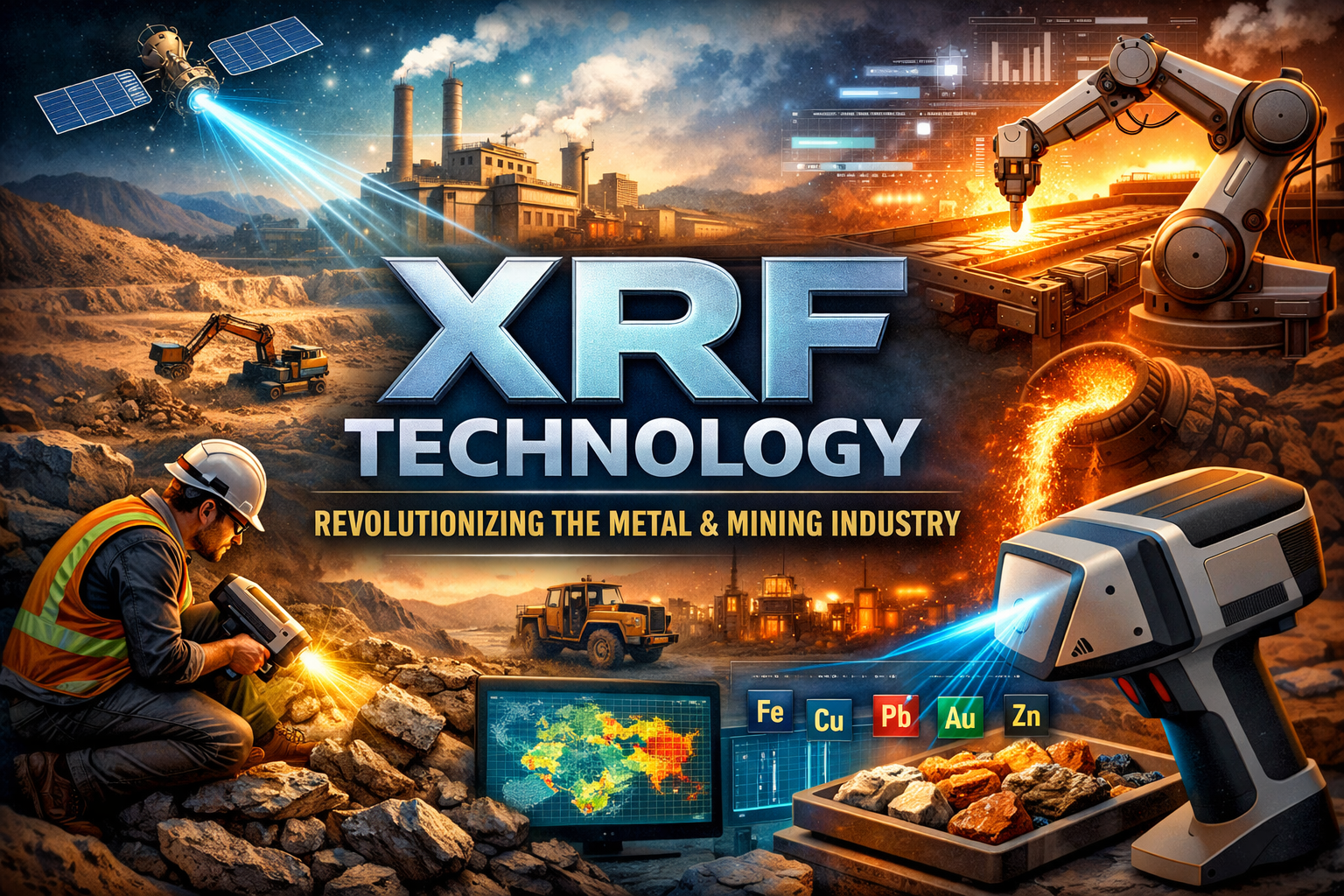
The metal and mining industry is undergoing a major transformation driven by the need for faster decision-making, higher efficiency, and sustainable operations. One technology that has become central to this evolution is X-ray Fluorescence (XRF).
From early-stage exploration to final metal production, XRF is helping mining companies reduce costs, improve accuracy, and operate in real time. In this detailed blog, we’ll explore how XRF is reshaping the entire mining value chain.
Understanding XRF: A Quick Overview
XRF is a non-destructive analytical technique used to determine the elemental composition of materials. When high-energy X-rays hit a sample, atoms within the material emit secondary (fluorescent) X-rays. Each element emits a unique energy signature, allowing precise identification and quantification.
Key Features of XRF:
- Multi-element detection (from sodium to uranium)
- Minimal or no sample preparation
- Rapid results (seconds to minutes)
- Non-destructive analysis
- Applicable to solids, powders, and liquids
Transforming the Mining Value Chain with XRF
1. Exploration: Faster and Smarter Discovery
In traditional exploration, samples are collected and sent to laboratories, often taking days or weeks for results. XRF eliminates this delay.
How XRF helps:
- On-site analysis of soil, rock, and drill cores
- Immediate identification of mineral-rich zones
- Real-time geochemical mapping
- Reduced drilling costs through better targeting
Impact: Geologists can make instant decisions in the field, significantly improving exploration efficiency and success rates.
2. Ore Grade Control: Maximizing Resource Utilization
Ore grade control is critical in determining the economic viability of mining operations. Even small variations in grade can impact profitability.
With XRF:
- Continuous monitoring of ore composition
- Real-time differentiation between high-grade and low-grade ore
- Reduction of ore dilution and loss
Example: In iron ore mining, XRF can quickly determine Fe content, silica levels, and impurities, enabling precise sorting.
Impact: Higher recovery rates and optimized use of resources.
3. Mining Operations: Real-Time Process Optimization
Once extraction begins, maintaining efficiency in processing plants is crucial. XRF plays a key role in optimizing these operations.
Applications include:
- Feed material analysis before processing
- Monitoring grinding and beneficiation stages
- Adjusting flotation and separation parameters
- Evaluating concentrate quality
Impact:
- Improved metal recovery
- Reduced energy consumption
- Lower operational costs
4. Portable XRF: Revolutionizing Field Analysis
The introduction of handheld XRF analyzers has been a game-changer.
Benefits of Portable XRF:
- Instant results at mining sites
- Lightweight and easy to use
- Eliminates need for lab transport
- Supports high-frequency sampling
Use cases:
- Drill core analysis
- Scrap metal sorting
- On-site environmental checks
Impact: Field teams can analyze hundreds of samples per day, dramatically increasing productivity.
5. Environmental Monitoring and Sustainability
Mining operations must comply with strict environmental regulations, especially regarding heavy metal contamination.
XRF supports:
- Detection of toxic elements like lead (Pb), arsenic (As), and mercury (Hg)
- Soil and water contamination assessment
- Monitoring tailings and waste materials
Impact:
- Ensures regulatory compliance
- Promotes sustainable mining practices
- Reduces environmental risks
6. Metal Production and Refining: Ensuring Quality
In downstream processes like smelting and refining, precise control of composition is essential.
XRF is used for:
- Alloy composition verification
- Impurity detection
- Quality assurance in metals like steel, aluminum, and copper
Impact:
- Consistent product quality
- Reduced rework and rejection rates
- Faster production cycles
XRF vs Traditional Analytical Techniques
| Feature | XRF | Traditional Methods (ICP-OES, AAS) |
| Speed | Seconds to minutes | Hours to days |
| Sample Preparation | Minimal | Extensive |
| Portability | Handheld options available | Lab-based only |
| Cost Efficiency | High over time | High operational cost |
| Destructive Testing | No | Often destructive |
| Sensitivity | Moderate (ppm level) | Very high (ppb level) |
While techniques like ICP-OES offer higher sensitivity, XRF dominates in speed, convenience, and real-time analysis.
Emerging Trends in XRF Technology
The future of XRF in mining is being shaped by innovation and digital integration:
1. AI and Machine Learning
- Automated data interpretation
- Predictive analytics for ore quality
2. Cloud-Based Data Systems
- Real-time sharing of analysis results
- Centralized monitoring of multiple mining sites
3. Automation and Industry 4.0
- Integration with conveyor belts for continuous monitoring
- Robotic sample handling systems
4. Improved Detection Capabilities
- Enhanced sensitivity for trace elements
- Better calibration techniques
Key Benefits of XRF in Metal and Mining
- Faster Decision-Making: Instant results enable quick operational changes
- Cost Reduction: Less reliance on laboratory testing
- Improved Accuracy: Reliable multi-element analysis
- Operational Efficiency: Streamlined workflows across mining stages
- Sustainability: Better environmental monitoring and compliance
Conclusion
X-ray Fluorescence (XRF) has become a cornerstone technology in modern metal and mining analysis. Its ability to deliver rapid, non-destructive, and on-site elemental analysis is transforming how mining companies operate.From exploration and ore grading to production and environmental monitoring, XRF empowers organizations to make data-driven decisions in real time. As advancements like AI and automation continue to evolve, XRF will play an even bigger role in shaping the future of smart, efficient, and sustainable mining.
About the Author