


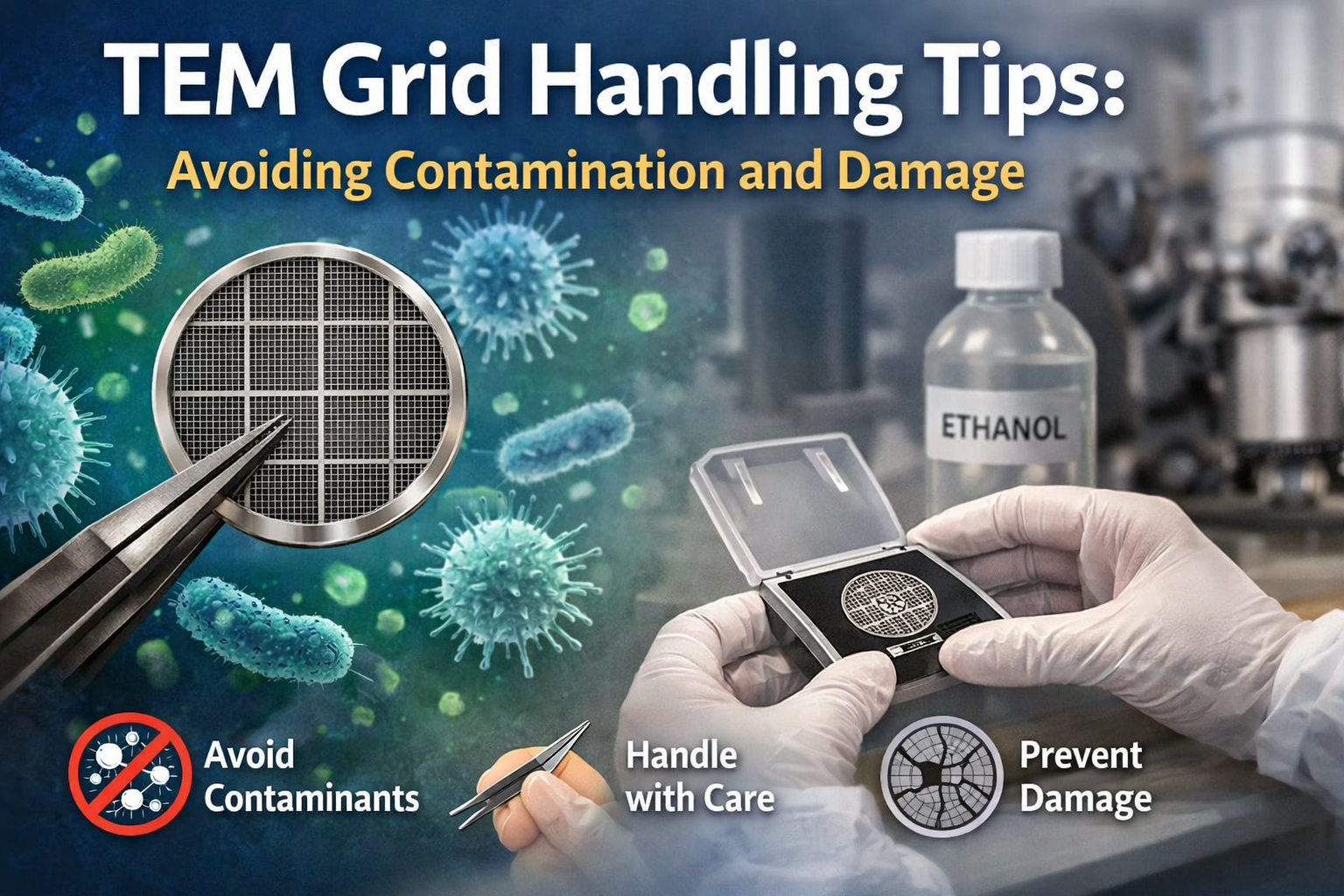
Transmission Electron Microscopy (TEM) enables visualization at the nanoscale – but the accuracy and clarity of your results depend heavily on one critical factor: how well you handle your TEM grids. These grids are not just sample holders; they are precision-engineered supports with ultra-thin films that can be easily damaged or contaminated.
In this in-depth guide, we’ll explore every aspect of TEM grid handling, from workspace preparation to advanced cleaning techniques, so you can achieve consistent, high-quality imaging.
Understanding TEM Grids and Their Sensitivity
A typical TEM grid consists of:
- A metal mesh (commonly copper, gold, or nickel)
- A support film (carbon, holey carbon, lacey carbon, or formvar)
These components are extremely delicate:
- The support film can be just a few nanometers thick
- The grid can bend under minimal pressure
- The surface can attract dust, hydrocarbons, and moisture
Because TEM operates at very high magnifications, even the smallest contamination can appear as major artifacts in images.
1. Preparing a Clean and Controlled Workspace
A clean environment is the first line of defense against contamination.
Ideal Working Conditions:
- Cleanroom (Class 1000 or better) for critical applications
- Laminar airflow hood to reduce airborne particles
- Anti-static environment to prevent particle attraction
Practical Steps:
- Wipe down surfaces with lint-free cloths and isopropanol
- Avoid paper tissues or fabrics that shed fibers
- Keep unnecessary items away from the workspace
- Turn off fans or air conditioners that disturb airflow
Pro Tip: Dust particles as small as 1–10 microns can completely obscure nanoscale features in TEM.
2. Using the Right Tools for Handling
Handling TEM grids without proper tools is one of the most common causes of damage.
Essential Tools:
- Fine-tip, anti-magnetic tweezers (preferably stainless steel or titanium)
- Vacuum pickup pens (for advanced or automated labs)
- Grid handling platforms or holders
Best Practices:
- Always grip the grid at the outer rim
- Never touch the central film area
- Maintain a steady hand to avoid slipping
Tool Maintenance:
- Clean tweezers regularly using solvents like ethanol
- Inspect tips for alignment—misaligned tips can crush grids
- Store tools in clean, dust-free containers
A slight slip of tweezers can tear the support film instantly.
3. Personal Handling Precautions
Human contact is a major contamination source.
Why It Matters:
Skin releases:
- Oils
- Sweat (salts)
- Microscopic debris
These contaminants can:
- Interfere with sample adhesion
- Create imaging artifacts
- Affect electron transparency
Safety Measures:
- Wear powder-free nitrile gloves
- Avoid latex gloves (can leave residues)
- Use finger cots for extra precision
- Replace gloves frequently
4. Techniques for Safe Grid Handling
TEM grids require a gentle and controlled approach.
Step-by-Step Handling:
- Open the grid box carefully
- Use tweezers to gently pick the grid from the edge
- Keep the grid horizontal to prevent sample loss
- Place it gently onto the working surface or holder
Key Tips:
- Avoid sudden movements
- Do not stack grids on top of each other
- Never apply force when picking or placing
Even slight mechanical stress can distort the grid geometry, affecting imaging results.
5. Proper Storage Practices
Incorrect storage can lead to contamination even before use.
Storage Solutions:
- Grid storage boxes with individual slots
- Desiccators to control humidity
- Vacuum-sealed containers for sensitive grids
Environmental Conditions:
- Low humidity (to prevent oxidation)
- Dust-free environment
- Away from chemical vapors
Labeling:
- Clearly label grid types and sample details
- Avoid excessive handling during identification
Well-organized storage reduces both contamination and handling errors.
6. Cleaning TEM Grids: Methods and Considerations
Cleaning is often essential, especially for high-resolution work.
Common Contaminants:
- Hydrocarbons
- Organic residues
- Dust particles
Cleaning Techniques:
1. Plasma Cleaning
- Uses ionized gas to remove organic contamination
- Improves surface wettability
- Widely used before cryo-TEM and biological studies
2. UV-Ozone Cleaning
- Breaks down hydrocarbons using UV radiation
- Gentle and effective for delicate films
3. Solvent Cleaning
- Uses ethanol, acetone, or distilled water
- Suitable for robust grids (not all coatings are compatible)
Over-cleaning or using the wrong method can damage the support film.
7. Minimizing Exposure to Contaminants
Exposure time directly correlates with contamination risk.
Best Practices:
- Prepare all materials before removing grids from storage
- Handle grids quickly but carefully
- Avoid leaving grids exposed to open air
Hydrocarbon contamination can accumulate within seconds in unclean environments.
8. Preventing Cross-Contamination
Cross-contamination can compromise experimental integrity.
Prevention Strategies:
- Use dedicated tools for different samples
- Clean tweezers between uses
- Avoid placing grids on shared or unclean surfaces
- Handle one sample at a time
9. Inspecting TEM Grids
Inspection ensures only high-quality grids are used.
When to Inspect:
- Before sample preparation
- After sample deposition
- Before TEM imaging
What to Check:
- Bent or warped grid
- Broken mesh
- Torn or uneven support film
- Visible contamination
Tools for Inspection:
- Optical microscope
- Low-magnification TEM imaging
Early detection of defects prevents wasted time and resources.
10. Transportation of TEM Grids
Moving grids between labs or instruments requires care.
Transport Tips:
- Use sealed grid boxes
- Avoid vibrations and shocks
- Transport in padded containers
- Maintain dry conditions
11. Advanced Handling Considerations
For Cryo-TEM:
- Work in temperature-controlled environments
- Avoid condensation
- Use specialized cryo-holders
For Nanoparticle Samples:
- Ensure even distribution on the grid
- Avoid aggregation during drying
For Biological Samples:
- Maintain sterility
- Prevent dehydration or structural damage
Common Mistakes to Avoid
- Handling grids with bare hands
- Using dirty or damaged tweezers
- Exposing grids to air for too long
- Storing grids in humid or open environments
- Skipping inspection steps
- Applying excessive force during handling
Final Thoughts
TEM grid handling is a critical skill that directly impacts the success of your microscopy work. Even with the most advanced TEM instruments, poor handling practices can lead to contamination, artifacts, and unreliable results.
By following these detailed guidelines – maintaining cleanliness, using proper tools, minimizing exposure, and adopting careful handling techniques – you can ensure:
- High-resolution, artifact-free imaging
- Better reproducibility
- Reduced sample loss and experiment failure
In fields like nanotechnology, materials science, and life sciences, mastering TEM grid handling is not optional – it’s essential.
Why Is a Police Duty Belt Radio Holder Essential Gear?
How Soon Will You See Results From PRP Hair Treatment
Car Accident Lawyer Near Me: How to Find the Best Car Accident Attorney in Maryland
هل جراحة الغمازات مُجدية للحصول على ابتسامة أجمل؟
How to Install LVP Over Concrete Without Ruining Your Underlayment
About the Author