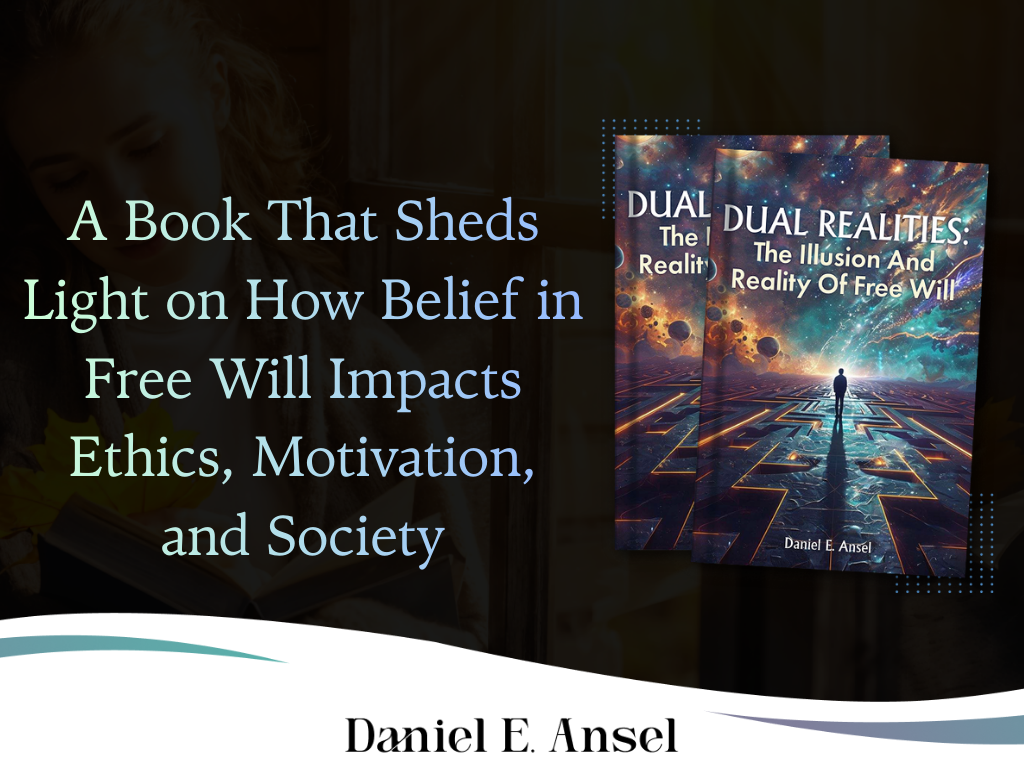
There is a new powerful work which is changing the ways the readers are thinking about the responsibility, morality and human behavior. Dual Realities: The Illusion and Reality of Free Will is a book by Daniel E. Ansel, which provides a unique look at the way that the belief in free will, whether it actually exists or not, has a significant impact on ethics, motivation, and the structure of society. Incorporating neuroscience, psychology, philosophy, religion, and social science, Ansel discloses that the sense of autonomy can be even more important than such a notion.
The question that Ansel poses through the course of this book is what happens to people and communities when they reverse the belief in free will? In this book, the author explains that centuries of ethical systems, lawful frameworks and cultures have been constructed upon the premise that humans make a conscious choice regarding their actions. Moral responsibility is based on this belief. In its absence, it will be hard to define praise, blame, justice and accountability. Ansel states that the belief in free will is very essential in sustaining morality even when science is slowly trying to disprove the fact that human beings make free choice.
This book brings out the research results that people with strong belief in free will were found to have a higher degree of self-control, endurance and motivation. Such individuals have a higher chance of accepting accountability towards their actions, aim at achieving long-term objectives and make decisions that are in line with their values. This psychological effect, according to Ansel, manifests the motivational strength behind thinking you have a choice even when neuroscience tells you that lots of choices are made unconsciously.
Simultaneously, this book is about the consequences of the decline in faith in free will. Research demonstrates that individuals with the self-perception of behavioral predetermination can feel less responsible about their behaviors and more likely to attribute their causes to external circumstances instead of scrutinizing personal decisions. This change can affect decision making, moral judgment and social behavior. Ansel states that people are not motivated as agents of change once they cease to see themselves as being agents of change.
The question of ethics can only get complicated when it is considered in the light of neuroscience. In this book, Daniel has presented the scientific findings that the brain makes decisions even before the conscious mind acts, so questions arise about the extent to which people have control. However, he points out that when these unconscious influences are understood it does not mean the responsibility is removed, it is just changed. With the acknowledgement of the invisible forces that influence behavior, the society will be able to implement more humane and productive methods toward judgment, rehabilitation and support. The free will is also essential, but it is enlightened by a better understanding of how the inner processes of the mind work.
The other culture and religious traditions that are discussed in the book are the beliefs of free will and moral duty. Whether it is the teaching of the divine judgment, karma, fate, or individual responsibility, societies have long applied this to support good morals. Ansel demonstrates that these stories whether they are true or false give moral order, reinforce social cohesion, and determine the ways in which individuals comprehend their place in the world. This book asserts that the conception of free will is not just a philosophical concept but a cultural instrument that dictates the way the societies operate.
Ansel presents the concept that wisdom may widen realistic free will by learning to recognize biases, emotions, and unconscious patterns, people will be able to regain more of their agency. By doing so, faith in free will turns into an attitude that legalizes moral behavior, individual development, and interpersonal peace.
Dual Realities: The illusion and Reality of Free Will is a very welcome and revolutionary addition to contemporary debates of autonomy, justice, and human behavior. Daniel E. Ansel presents an interesting description of how faith in free will affects morality, motivation and culture, and why the study of this faith has never been more critical.
Contact:
Author: Daniel E. Ansel
Website: https://danieleansel.com/
Amazon: DUAL REALITIES: THE ILLUSION AND REALITY OF FREE WILL
Email: anseldan@gmail.com
FaceBook: https://www.facebook.com/profile.php?id=61581907173422
Instagram: https://www.instagram.com/danieleansel.author/
