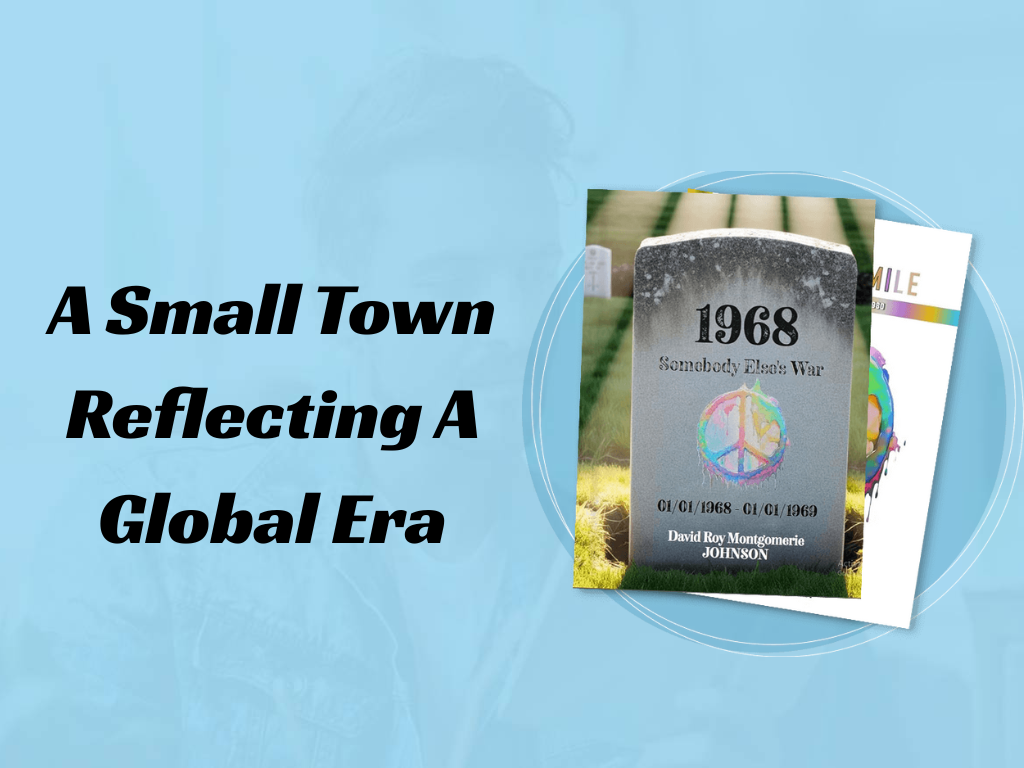
In 1968, the world was in chaos due to the war that started in Vietnam. Everywhere, one could see there were protests and bloodshed. A time that was filled with only heartbreak, loss, and trauma, but still, the people living in the town hoped for things to get better and still tried to laugh about it. It was an era that changed everything once and for all. In all this chaos, the people living in a small town carried on with quite resilience. The era of the 1960s is portrayed fictionally and beautifully in David Roy Montgomerie Johnson’s book 1968 -Somebody Else’s War.
This novel takes its readers to the small town, Newport-on-the-Lake, where disorder in the rest of the world trickles into the daily lives. The town consists of many strange persons, including a police captain with his war scars, a mayor with his reputation and ego, and townsfolk who have their own traits that make them unbelievable and, at the same time, charming. These are not superheroes or the great characters of history; they are just people who are trying to find their way in their chaotic lives.
The author, in his book, shows how his characters boldly face everything despite what is happening around them. In his eyes, it is surviving. The comic scenes are not slapstick jokes but silent successes, the type that makes readers remember that laughter is a protective and therapeutic power.
The novel is set against the backdrop of the Vietnam War and the cultural transformation of North Americans, as it examines the experiences of a police officer and a veteran, Captain Sammy Enfield, who cannot rid himself of the memories of the war, which continue to haunt him in World War II and Vietnam.
His personal struggle is a reflection of the world conflict that is dividing the world into fragments, which makes this personal struggle and the world war a very strong analogy. The town Sammy is visiting, Newport-on-the-Lake, appears to be a utopia at first sight, with diners, gossip, old war veterans, and young vigor as represented by such characters as April, May, and June. But behind the beauty is a simmering that is the same disturbance as that outside its borders.
The town itself, being unwilling to face the truth as typified by the leaders of the town in their constant insistence that all was under control, reflects the wider culture of avoidance that characterized so much of the late 1960s. But it is not only the violence that makes the novel so powerful, but it is also the compassion that the author has towards the people who were trapped in the circle of history.
During the crisis, the young waitress Chrissy, the utopian June, and the guilty Becky all depict the emotional richness of the times in the midst of fear of losing, to the need to feel attached and included in an unraveling world. Their voices show that common people who are often put on the back burner in historical narratives have the same burden of world events that un-informed people do, and that they bear it as well.
1968 – Somebody Else’s War gives the readers a peephole view of a town that thinks it is far away from troubles, only to find that the world war is knocking at its door. When Sammy Enfield finally comes to face the last reckoning with reality, it becomes obvious in the novel that the conflict of the time was never far away at all, but it was inside every home, every family, and every small hope of peace.
Contact:
Author: David Johnson
Website: https://davessillybooks.com/
Amazon: 1968 – SOMEBODY ELSE’S WAR
Email: 19olemiss55@gmail.com
https://www.facebook.com/profile.php?id=61577351333355
https://www.instagram.com/davidroymontgomeriejohnson/
