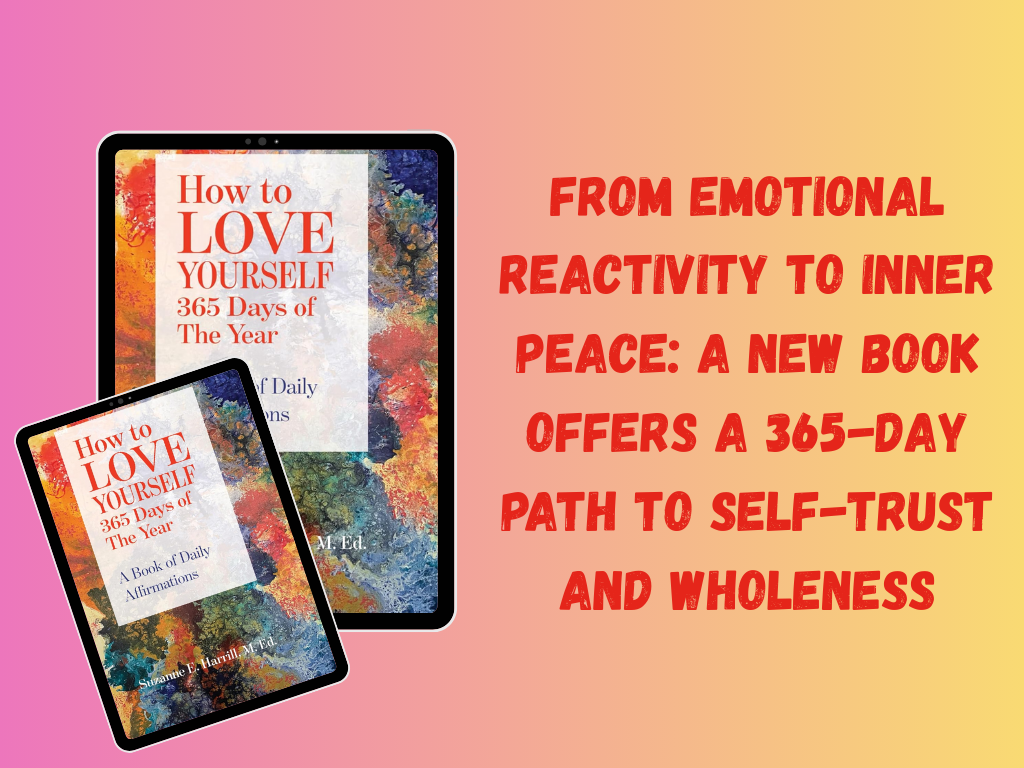
In a world where stress, self-criticism, and emotional overwhelm have become everyday experiences, a new book is offering readers a gentle yet powerful alternative: a daily return to self-trust, awareness, and inner peace. How to Love Yourself 365 Days of the Year by Suzanne E. Harrill, M.Ed., presents a year-long journey designed to help individuals move beyond emotional reactivity and cultivate lasting self-love for one conscious day at a time.
Rather than promising quick fixes or dramatic transformations, Harrill’s work is rooted in a simple but radical idea: self-esteem and inner peace are not rewards to be earned through achievement, approval, or perfection. They are skills that can be learned, practiced, and strengthened through daily awareness. By combining psychology, spirituality, and practical self-inquiry, the book reframes self-love as an ongoing relationship with oneself rather than a destination to reach.
At the heart of the book is the understanding that many emotional reactions, such as anger, guilt, anxiety, shame, or self-doubt, are not caused by present circumstances alone. Instead, they are often rooted in unconscious beliefs formed through childhood conditioning, unresolved experiences, and habitual self-talk. Harrill invites readers to see emotional triggers not as failures or weaknesses, but as doorways into deeper self-understanding and healing.
Structured as a daily companion, How to Love Yourself 365 Days of the Year offers a short reflective passage and affirmation for each day of the year. Each entry centers on a specific theme, such as worthiness, responsibility, forgiveness, boundaries, intuition, gratitude, or emotional choice. Together, these themes guide readers through a gradual process of unlearning fear-based patterns and reconnecting with their authentic selves.
One of the book’s core metaphors, the garden of the mind, illustrates how thoughts function as seeds. When negative beliefs such as unworthiness, comparison, or self-blame are repeatedly planted, they shape emotional reactions and behaviors. When consciously replaced with compassionate, truthful thoughts, they create the conditions for emotional balance and self-trust to grow. The daily affirmations act as intentional “seed thoughts,” helping readers gently repattern their inner dialogue over time.
Before the daily readings begin, Harrill introduces two foundational tools that set the tone for the year-long journey. The Harrill Self-Esteem Awareness Inventory helps readers identify beliefs and behaviors influencing their sense of self-worth, while an adapted version of the Twelve Steps focuses on healing the perceived split between the conditioned ego and the true, spiritual Self. These tools emphasize responsibility without self-blame, offering clarity without judgment.
Unlike many self-help books that rely heavily on motivation or willpower, Harrill’s approach emphasizes emotional responsibility and compassion. Readers are encouraged to recognize the difference between reacting automatically and responding consciously. Emotional awareness, the book teaches, allows individuals to pause, reflect, and choose their responses rather than remaining trapped in old patterns of defensiveness or self-criticism.
Spirituality is woven throughout the book in an inclusive, non-dogmatic way. References to inner knowing, Higher Power, and spiritual nourishment are framed as inner resources available to all, regardless of belief system. The emphasis is not on adopting new beliefs, but on reconnecting with an innate sense of wholeness that exists beneath fear, conditioning, and self-judgment.
Over the course of 365 days, readers are guided to release blame, soften perfectionism, establish healthy boundaries, forgive themselves and others, and develop trust in their inner guidance. Progress is intentionally presented as non-linear. The book reassures readers that growth unfolds in cycles, with periods of insight, integration, and rest all equally valuable.
Ultimately, How to Love Yourself 365 Days of the Year offers a quiet yet profound shift in perspective: inner peace is not found by controlling life or fixing oneself, but by developing awareness, compassion, and responsibility for one’s inner world. As self-trust grows, emotional reactivity naturally gives way to clarity, resilience, and a deeper sense of belonging within oneself.
Serving as both a daily guide and a long-term roadmap, the book invites readers into a year of conscious living, one that transforms the way they relate to their emotions, their thoughts, and ultimately to themselves.
Contact Us:
Author: Suzanne E. Harrill
Amazon: How to LOVE YOURSELF 365 Days of The Year: A Book of Daily Affirmations
Email: seharrill@gmail.com
