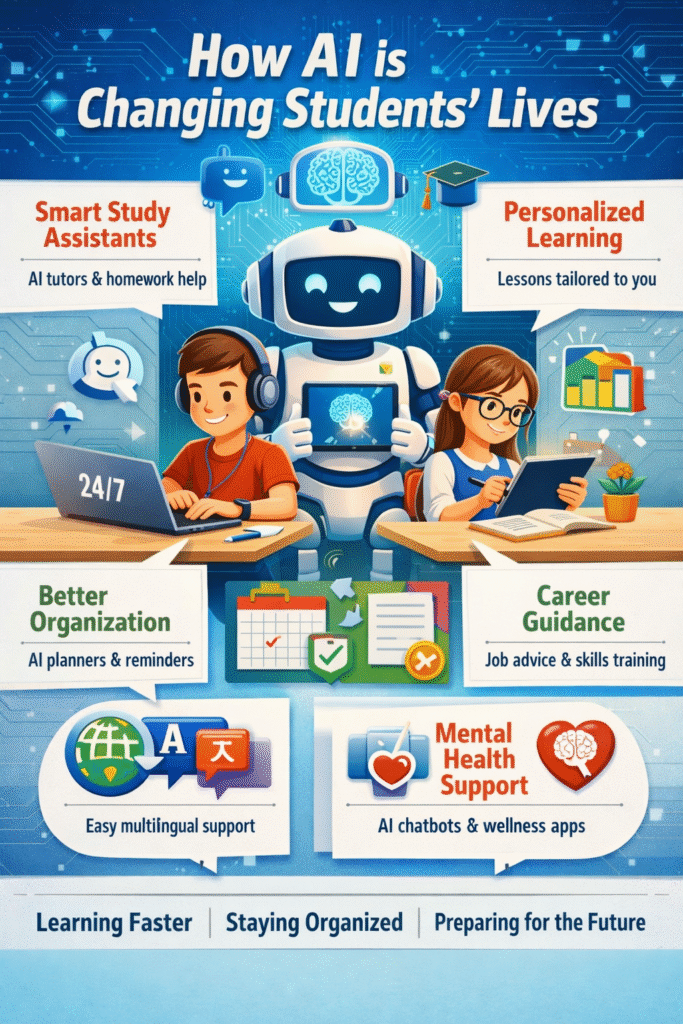
1. Introduction
Hook: How student life has changed in the digital era
Student life today looks very different from what it was even a decade ago. Earlier, students relied mostly on textbooks, handwritten notes, and classroom lectures to learn new concepts. Research meant spending hours in libraries, and skill development required expensive courses or personal mentorship. In the modern digital era, however, technology has transformed education completely, and artificial intelligence has become one of the biggest drivers of this transformation.
Brief explanation of Artificial Intelligence (AI) in simple words
Artificial Intelligence, or AI, refers to computer systems that can think, learn, and solve problems in ways similar to humans. These systems analyze information, recognize patterns, and generate responses or solutions quickly. Today, AI tools help students write essays, understand difficult topics, organize schedules, and even start online work opportunities.
Why AI matters for modern students
Understanding how AI is changing education is essential because students are now learning in an environment shaped by intelligent technology. AI influences not only academic performance but also productivity, creativity, and career preparation. It allows students to access knowledge instantly while also reshaping expectations about learning and work.
How AI affects learning, productivity, career choices, and side hustles
AI affects nearly every aspect of student life. It improves learning through personalized explanations, boosts productivity through automation, influences career choices by introducing new digital skills, and creates side-hustle opportunities that allow students to earn while studying. Many students are discovering how AI is changing the way students approach both education and income generation.
Thesis statement
Although AI offers powerful opportunities for growth and success, it also brings challenges such as dependency, ethical concerns, and skill imbalance. Students must understand both sides to benefit responsibly from this technological shift.
2. What Is AI? (Quick Beginner-Friendly Explanation)
2.1 Definition of AI
Artificial Intelligence involves machines performing human-like thinking tasks such as understanding language, analyzing data, solving problems, and generating creative content. Instead of simply following instructions, AI systems learn from patterns and improve responses over time.
Students already experience how AI is helping students through everyday digital tools without always realizing it.
Examples students already use daily
- Smart search suggestions
- Writing assistants
- Translation tools
- Recommendation systems
- Study and productivity apps
These tools demonstrate how AI supports modern learning environments.
2.2 Common AI Tools Students Use
Students interact with AI through multiple platforms, including:
Writing assistants
Help generate ideas, improve grammar, and structure essays.
Study planners
Create schedules and reminders to manage deadlines effectively.
Research helpers
Summarize long articles and explain complex academic concepts.
Design and video tools
Assist in creating presentations, graphics, and multimedia content quickly.
These tools clearly show how AI is changing education by making learning more efficient and accessible.
2.3 Why AI Adoption Is Growing in Education
Accessibility
AI tools are available globally, often free or affordable.
Speed
Students receive instant answers instead of waiting hours or days.
Cost efficiency
AI reduces the need for expensive tutoring or software, making quality learning resources available to more students.
3. How AI Is Transforming Student Learning
3.1 Personalized Learning Experience
AI adapts to individual learning styles and pace. Instead of one teaching method for all students, AI systems provide customized explanations.
- AI adjusts learning difficulty based on performance.
- Students receive step-by-step guidance tailored to their needs.
This personalization highlights how AI is changing the way students understand complex subjects.
3.2 Faster Research & Information Access
AI enables students to:
- Generate instant summaries
- Simplify complicated theories
- Organize information efficiently
Research that once required hours can now be completed within minutes. This demonstrates how AI is helping students learn faster while saving time for deeper understanding.
3.3 Improved Productivity & Time Management
AI improves efficiency through:
- Smart scheduling tools
- Automatic note organization
- Assignment assistance
Students can manage academics and extracurricular activities more effectively, showing how AI enhances productivity alongside education.
3.4 Skill Development Through AI
AI tools support learning new skills such as:
- Coding with guided assistance
- Writing improvement through feedback
- Graphic design experimentation
- Language learning with real-time corrections
These opportunities clearly illustrate how AI is changing education beyond traditional classroom learning.
4. AI and Student Side Hustles (Main Focus Section)
AI has opened entirely new earning opportunities for students. Understanding how AI is changing the way students work outside academics is essential because side hustles are becoming a major part of student life.
4.1 How AI Created New Side Hustle Opportunities
Students now explore income opportunities such as:
- Freelance content writing supported by AI research tools
- Graphic design using AI image generators
- Video editing and social media content creation
- Affiliate marketing and blogging
- Online tutoring enhanced by AI explanations
- Automation-based micro businesses
These opportunities show how AI lowers barriers to entering digital careers.
4.2 Positive Impact of AI on Student Side Hustles
a) Low Entry Barrier
Beginners can start earning even without advanced technical skills.
b) Increased Productivity
Faster work completion allows students to handle multiple projects.
c) Cost Reduction
AI tools reduce spending on software, training, and equipment.
d) Learning While Earning
Students develop practical skills while managing academic responsibilities.
e) Global Opportunities
Online platforms connect students to international clients.
f) Creativity Enhancement
AI assists brainstorming, helping students overcome creative blocks.
These benefits highlight how AI is helping students become financially independent earlier than before.
4.3 Negative Impact of AI on Student Side Hustles
a) Skill Dependency on AI
Students may rely too heavily on automation instead of improving real abilities.
b) Market Saturation
More people entering freelancing increases competition.
c) Lower Earnings Pressure
Clients may expect cheaper work because AI speeds up production.
d) Ethical Concerns
Issues like plagiarism and originality arise when AI is misused.
e) Accuracy & Reliability Problems
AI-generated errors can harm credibility and reputation.
f) Over-reliance and Reduced Critical Thinking
Students may trust AI outputs without verification.
These challenges show that while AI creates opportunities, it also requires responsible usage.
4.4 Realistic Balance: AI as a Tool, Not a Replacement
Human creativity remains essential. Students should:
- Combine AI assistance with personal skills
- Add original thinking to AI-generated work
- Focus on developing expertise beyond automation
Understanding this balance is key to benefiting from how AI is changing education without losing individuality.
5. Academic Advantages of AI for Students
AI provides several academic benefits:
- Better exam preparation through practice explanations
- Instant doubt solving anytime
- Language translation for global learning
- Accessibility for diverse learning styles
These advantages demonstrate how AI expands educational opportunities for students worldwide.
6. Academic Risks and Challenges
Despite benefits, risks exist:
- Increased cheating concerns
- Reduced deep understanding
- Dependence on shortcuts
- Difficulty identifying reliable information
Students must critically evaluate information to avoid misunderstanding concepts.
7. Mental & Lifestyle Impact of AI on Students
Positive Effects
- Reduced stress through automated organization
- Improved planning and efficiency
Negative Effects
- Increased screen dependency
- Information overload
- Constant productivity pressure
Balancing technology use with healthy routines is essential.
8. Future of Students in an AI-Driven World
Students should prepare for careers involving technology, creativity, and problem-solving. While AI automates tasks, certain human skills remain irreplaceable:
- Critical thinking
- Communication
- Emotional intelligence
- Creativity
These abilities will define success in an AI-driven future.
9. Practical Tips: How Students Should Use AI Responsibly
Students can benefit safely by:
- Using AI for assistance rather than replacement
- Always verifying information
- Developing real-world skills alongside AI usage
- Maintaining academic honesty
- Balancing independent learning with technology support
Responsible usage ensures long-term growth.
10. Conclusion
Artificial Intelligence is reshaping student life in powerful ways. From personalized learning and improved productivity to new side-hustle opportunities, AI is transforming education and career preparation. At the same time, challenges such as dependency, ethical concerns, and increased competition cannot be ignored.
Understanding how AI is changing education helps students use technology wisely. The future belongs to learners who recognize both opportunities and risks while developing essential human skills.
Ultimately, students who learn to work with AI — rather than depend entirely on it — will be best prepared for success in the evolving digital world.
