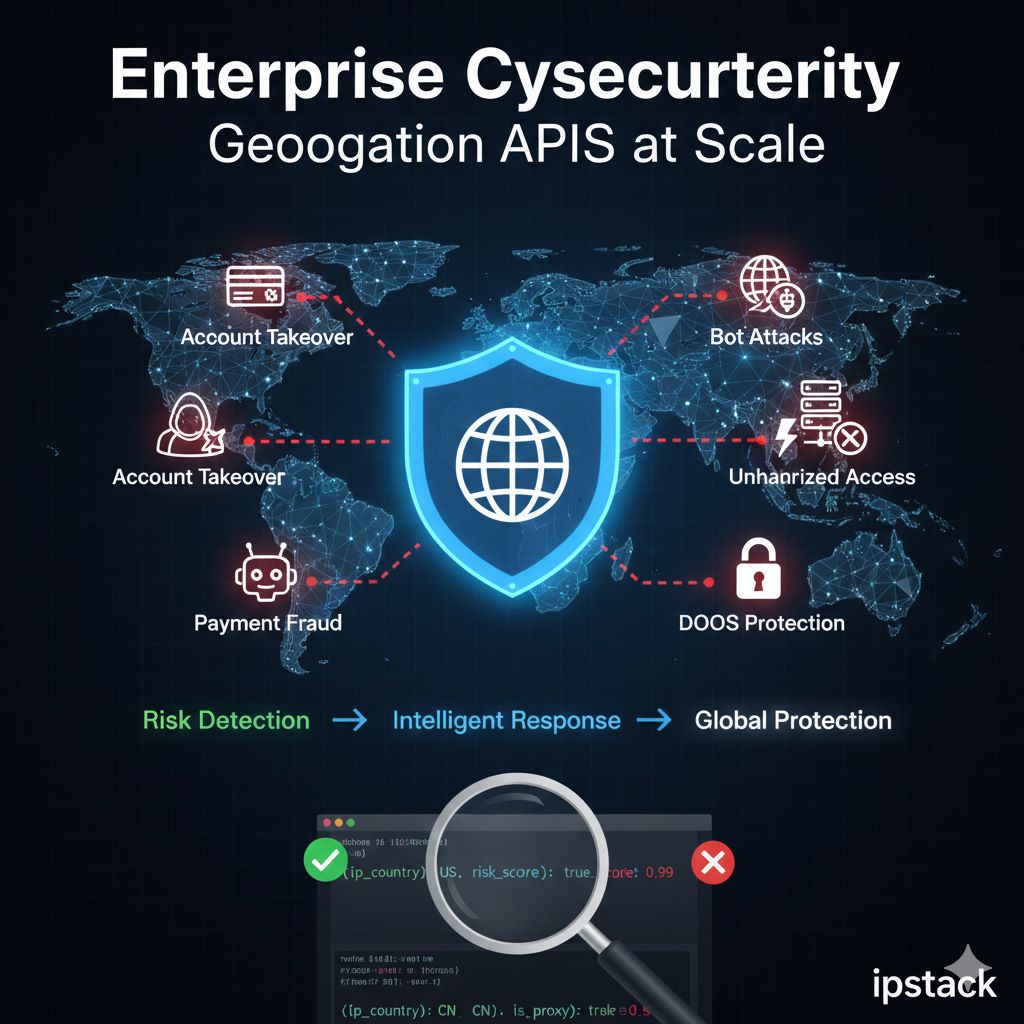
Enterprise cybersecurity has changed dramatically over the last few years. Distributed workforces, global customers, cloud-native applications, and third-party integrations have expanded the attack surface beyond traditional network perimeters.
For large organizations, the challenge is no longer just stopping attacks, it’s detecting risk early, responding intelligently, and doing so at scale.
One increasingly important layer in enterprise security architecture is location intelligence. By understanding where traffic originates, enterprises can add powerful context to access decisions, fraud detection, and threat response. This is why many global organizations now rely on an api for geolocation as part of their security and risk management strategy.
Why Geolocation Matters for Enterprise Security
Enterprises deal with massive volumes of traffic, employees, partners, customers, and automated systems accessing applications from around the world. Traditional security controls often struggle to distinguish between legitimate global usage and malicious activity.
Geolocation data adds a critical signal that helps enterprises:
- Identify abnormal access behavior
- Reduce fraud and account abuse
- Enforce regional compliance policies
- Improve incident response accuracy
A scalable geolocation api service allows enterprises to apply these controls in real time, without disrupting operations or user experience.
Enterprise Security Challenges in a Global Environment
Large organizations face unique risks that smaller teams rarely encounter:
- Global login attempts across multiple regions
- Sophisticated fraud campaigns targeting high-value accounts
- Abuse of internal APIs and partner integrations
- Compliance requirements tied to geography
- Large-scale bot traffic impacting performance and costs
Geolocation intelligence helps enterprises address these challenges with precision rather than blanket restrictions.
1. Strengthening Identity and Access Management (IAM)
Identity is the foundation of enterprise security, but identity alone is no longer enough.
How enterprises use geolocation:
- Detect employee logins from unexpected countries
- Enforce conditional access based on location
- Trigger step-up authentication for high-risk regions
By integrating an api for geolocation into IAM workflows, enterprises can reduce account takeovers while supporting global teams and remote access.
2. Enterprise Fraud Prevention and Risk Scoring
Fraud attacks targeting enterprises are often highly organized and geographically distributed. Location data plays a key role in identifying risky behavior early.
Enterprise use cases:
- Flag transactions originating from high-risk regions
- Detect mismatches between customer profiles and access locations
- Feed geolocation data into enterprise fraud engines
When combined with behavioral analytics, geolocation improves fraud detection accuracy without increasing false positives.
3. Protecting Enterprise APIs and Digital Platforms
APIs power modern enterprises, connecting mobile apps, partners, internal systems, and third-party services. They are also prime targets for abuse.
How geolocation improves API security:
- Identify abnormal traffic patterns by region
- Block or throttle requests from risky locations
- Detect API abuse originating from cloud providers
A reliable geolocation api service helps enterprises maintain API availability while protecting against large-scale abuse.
4. Enforcing Geographic Compliance and Data Access Policies
Many enterprises operate under strict regulatory requirements tied to geography, including data residency and regional access controls.
Examples:
- Restricting access to sensitive systems by country
- Enforcing region-specific application behavior
- Supporting audits with location-based access logs
Geolocation allows enterprises to enforce these policies dynamically, without hardcoding rules or managing complex IP allowlists.
5. Improving Incident Response and Threat Intelligence
When a security incident occurs, speed and accuracy matter. Location data provides immediate context that helps security teams act decisively.
Enterprise benefits:
- Quickly identify attack origin regions
- Prioritize incidents based on geographic risk
- Apply temporary geo-blocking during active threats
For Security Operations Centers (SOCs), geolocation data improves visibility and shortens response times.
Why Enterprises Choose IP-Based Geolocation
From an enterprise architecture perspective, IP-based geolocation offers key advantages:
- Scales easily across global traffic
- Integrates with SIEM, IAM, and fraud systems
- Works in real time with minimal latency
- Requires no user interaction
- Fits well into zero-trust security models
Solutions like IPstack allow enterprises to access accurate location intelligence without maintaining complex datasets or infrastructure.
Enterprise Implementation Best Practices
To maximize value from geolocation data, enterprises should:
- Combine location with identity and behavior signals
- Avoid hard blocks unless risk thresholds are met
- Log location data for audit and compliance needs
- Use geolocation as part of layered security
- Regularly review geo-based rules as business expands
Geolocation works best as an adaptive control, not a static rule set.
FAQs: Geolocation APIs for Enterprises
1. Is geolocation reliable enough for enterprise security decisions?
Yes. Country and region-level accuracy is highly reliable and widely used by global enterprises.
2. Can geolocation APIs handle enterprise-scale traffic?
Absolutely. Enterprise-grade solutions like IPstack are built for high-volume, low-latency use cases.
3. Does geolocation data support compliance requirements?
Yes. It helps enforce geographic access rules and provides audit-friendly location logs.
4. Can attackers bypass geolocation using VPNs?
Some attempts exist, but many VPNs and proxies can be detected through network and ISP data, especially when combined with other signals.
5. Is geolocation data privacy-compliant?
Yes. IP-based geolocation does not rely on personal user data and can be used responsibly within global privacy frameworks.
Enterprise security is no longer about locking everything down, it’s about making intelligent, context-aware decisions at scale. Location intelligence provides one of the most valuable contextual signals available today.
By integrating a trusted api for geolocation, enterprises can reduce risk, improve visibility, and strengthen defenses without compromising performance or user experience.
If your organization operates globally and needs reliable location intelligence for security, compliance, and risk management, IPstack offers an enterprise-ready solution.
👉 Discover how IPstack helps enterprises:
- Secure global access
- Reduce fraud and abuse
- Strengthen API and identity security
Visit https://IPstack.com/ and see how geolocation intelligence can support your enterprise security strategy.
Recommended Resources:
- How to expose APIs to LLMs without breaking security
- OpenAI Function Calling: How to Connect LLMs to The Best Free APIs (2025)
- 12 Best Financial Market APIs for Real-Time Data in 2025
- Geofencing vs. Geolocation: Key Differences and Top APIs for Each
- 10 Free & Affordable APIs Every Startup Developer in 2025 Should Know About
