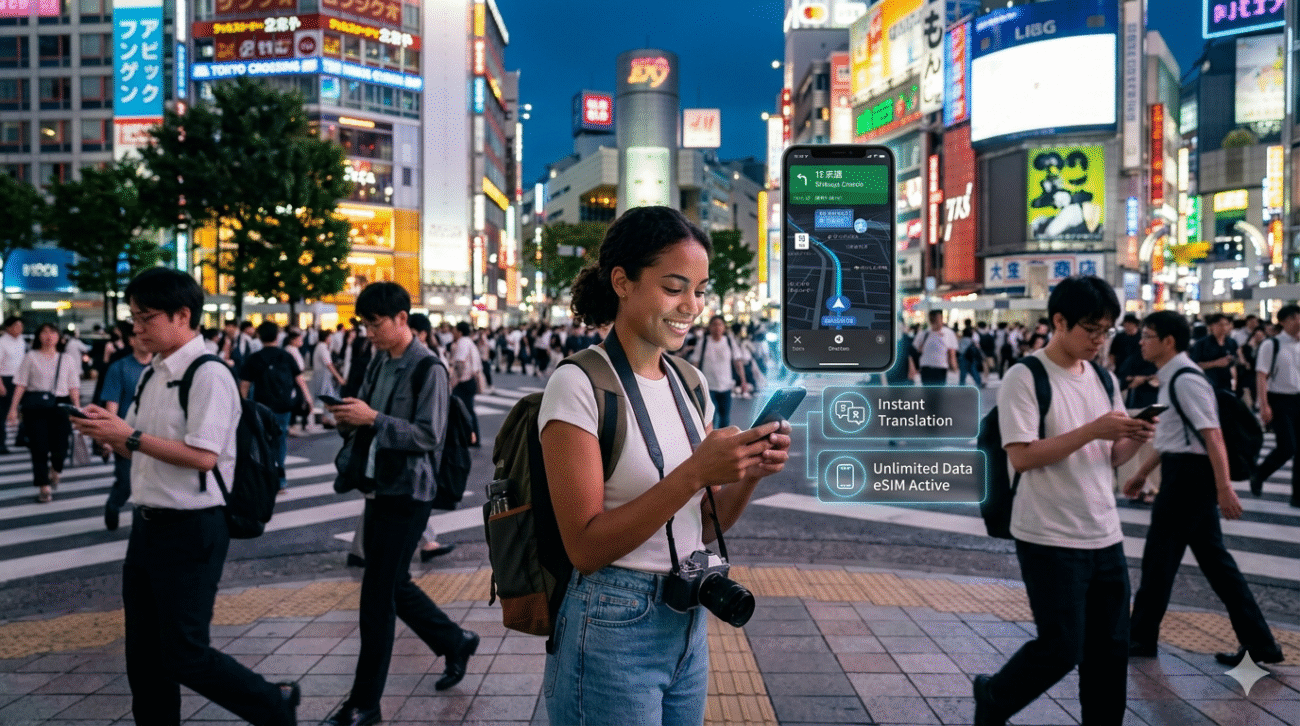
Japan has a reputation in travel circles that works against it: the country is assumed to be technologically advanced but somehow hostile to foreign visitors, a maze of Japanese-only interfaces, cash-only restaurants, and transport systems that require insider knowledge. That reputation is nine years out of date. Technology has quietly dismantled almost every barrier that once made Japan intimidating for first-time visitors. This guest post walks through exactly what has changed, what still requires preparation, and why the single most important technology decision you make before visiting Japan is one most travelers overlook entirely.
The technology that has genuinely transformed Japan travel
Not all technology improvements are equally significant for tourists. Some are convenience upgrades. Others are fundamental changes to what is even possible in Japan as a foreign visitor. Here are the breakthroughs that actually matter.
- Real-time camera translation: Google Translate’s camera mode with the Japanese language pack downloaded offline transforms any phone into an instant reading device. Point at a ramen menu, a train schedule, a shrine notice, or a medicine packet, and the text overlays in English in real time. This single tool has removed the biggest barrier to deep Japan travel: the inability to read the language.
- Digital IC card wallets: Adding a Suica or ICOCA card directly to Apple Pay or Google Pay before departure means tap-to-ride on every train, subway, bus, and most taxis in Japan without ever buying a paper ticket. The same card is paid at convenience stores, vending machines, and many restaurants.
- Multimodal navigation: Google Maps now handles Japan’s entire transit network trains, subways, buses, and walking with real-time delay information, fare estimates, and platform numbers. Navigating Tokyo’s 30-line subway system is no more difficult than navigating London or New York.
- QR code payments: PayPay Japan’s dominant QR payment platform with over 6 million acceptance points, now accepts foreign Visa and Mastercard for registration. The cash-only Japan of ten years ago is giving way to a country where you can eat, shop, and travel for days without touching physical currency in any major city.
- eSIM technology: Perhaps the most underrated travel technology improvement of the past five years. A travel eSIM eliminates the physical SIM process, no airport queues, no card swapping, no language barrier at the telecom counter. You install a Japan data plan before you board the flight and land already connected.
- AI-assisted restaurant discovery: Tabelog Japan’s most trusted restaurant-review platform now has a functional English-language interface. Combined with Google Maps reviews and Instagram geolocation, a tourist can find a highly-rated neighbourhood ramen shop, check opening hours, and navigate there in under three minutes.
The connectivity layer: why everything starts with data
Every technology listed above shares one dependency: mobile data. Camera translation requires a connection. Google Maps requires live data for real-time transit updates. PayPay requires data to generate QR codes. Tabelog requires data to load reviews. Without reliable mobile connectivity in Japan, none of these tools work — and a visitor reverts to the 2010 experience almost immediately.
This is why, despite all the apps and platforms that have transformed Japan travel, the most consequential decision a visitor makes before their trip is still the most basic one: how they will stay connected.
| The connectivity decision that shapes everything elseA travel eSIM installed before departure means your translation app, your maps, your payment platforms, and your booking tools are live the moment you clear immigration. A weak or absent data connection means none of the technology described in this article is available when you need it most — in the first disorienting hours after landing. |
Travel eSIM vs Japan SIM card: what actually matters
When visitors research connectivity options for Japan, they encounter two broadly reliable paths: a physical Japan SIM card purchased at the airport or in advance, and a travel eSIM installed digitally before departure. Both provide genuine data access in Japan. The differences are operational and for technology-forward travelers, those operational differences matter significantly.
A physical Japan SIM card for tourist use requires either a stop at an airport kiosk on arrival, typically 20 to 40 minutes including queue time, or advance ordering and postal delivery. It involves removing your home SIM or placing it in a separate pocket, which disables your home number for calls and SMS, including two-factor authentication messages. When the physical card runs out of data, you need to find a store or machine to top up.
A travel eSIM resolves all of these friction points by moving the entire process to software. You browse providers, compare plans, purchase, and receive a QR code all from wherever you are, days before departure. You scan the QR code at home over Wi-Fi, the eSIM profile installs, and your phone is ready to connect to Japan’s network the moment it detects a Japanese carrier. Your home SIM stays active on dual-SIM devices, so your home number, incoming calls, and SMS verification codes continue working throughout the trip.
| Why the best eSIM for Japan matters on the first day: The first two hours in Japan involve more connectivity demands than almost any other point in the trip — navigating from the airport, finding your hotel on Google Maps, setting up your Suica on Apple Pay, checking in, and making your first restaurant booking. Visitors who land with the best eSIM for Japan already active handle all of this smoothly. Visitors spending that time at an airport SIM kiosk handle it after a stressful queue. |
The essential technology stack for Japan travel in 2025
For visitors who want to travel Japan with the full benefit of available technology, here is the minimum viable toolkit organised by the problem each tool solves.
| Category | Tool or service | What it replaces | Connectivity needed |
|---|---|---|---|
| Connectivity | Travel eSIM (Docomo or SoftBank) | Airport SIM kiosk queue, physical card management | — the foundation |
| Navigation | Google Maps + offline regions downloaded | Printed maps, tourist transport guides, station staff | Live + offline backup |
| Translation | Google Translate + Japanese offline pack | Phrasebooks, translation services, picture menus | Offline capable |
| Payments | Suica on Apple/Google Pay + PayPay | Cash, currency exchange, ticket machines | Live data required |
| Rail planning | Hyperdia or Japan Transit Planner | Physical Shinkansen timetables, JR staff | Live data required |
| Food discovery | Tabelog (English) + Google Maps reviews | Guidebook restaurant lists, TripAdvisor | Live data required |
| Safety | Safety Tips (JNTO) + NHK World | Hotel noticeboards, Japanese-language news | Live for alerts |
What technology still cannot fully solve in Japan
Honest tech journalism requires noting the limits. Not everything in Japan bends to an app. Cash remains required in a significant number of situations: rural temples and shrines, traditional onsen resorts, small ramen shops with vending-machine ordering, and local festivals where yatai food stalls accept only coins and notes. The best preparation is a Suica card for cashless urban transit, paired with ¥10,000–20,000 in notes for the situations where nothing digital works.
Language technology also has meaningful limits at the edges. Camera translation handles printed text well but struggles with handwritten characters, artistic script, and some traditional signage. Voice translation lags noticeably in noisy environments like train stations during rush hour. A small phrasebook or a practiced few sentences still earns more goodwill than a fumbled real-time AI translation at a traditional restaurant counter.
And connectivity remains the non-negotiable prerequisite for everything else. The japan sim card for tourist or travel eSIM you choose needs to be on a strong network NTT Docomo or SoftBank — and have sufficient data for the way you actually travel. A visitor using maps, translation, and booking tools continuously in a city like Osaka may consume 2 to 3 GB per day. A plan that throttles to unusable speeds after 1 GB leaves you with the technology but without the connectivity to run it.
The traveler who benefits most from Japan’s tech revolution
Technology has lowered the floor for Japan travel significantly. A visitor who would have found Japan impenetrable without Japanese language skills in 2010 can now navigate confidently using translation apps, digital payments, and English-language navigation. That is a genuine and meaningful change.
But technology raises the ceiling for experienced independent travelers even more dramatically. The visitor who arrives with the right setup a quality travel eSIM active before landing, Suica loaded on their phone, Tabelog bookmarked, offline maps downloaded, and Google Translate’s camera mode tested at home has access to a Japan that the most determined independent traveler of fifteen years ago could not have reached. The hidden ramen shop in Shimokitazawa with a 4.1 Tabelog rating and no English sign. The mountain trail in Nikko whose trailhead is unmarked but pinned on Google Maps. These discoveries require data, and the best eSIM for Japan is what puts that data in your pocket from the moment you clear customs.
The technology traveler’s Japan checklist
- Buy and activate your travel eSIM or Japan SIM card at least 3 days before departure. Install the eSIM at home over Wi-Fi and set it as your primary data line. Choose a plan on Docomo or SoftBank for reliable coverage everywhere including rural areas.
- Add Suica to Apple Pay or Google Pay before you board. Fund it with ¥5,000–10,000 initially. It covers virtually all urban transport and most convenience store purchases the moment you land.
- Download Google Translate’s Japanese offline pack. Camera translation works offline once the pack is installed, useful in tunnels, basements, and anywhere signal is temporarily absent.
- Download Google Maps offline regions for Tokyo, Kyoto, Osaka, and any regional destinations. Offline maps work even when your Japan SIM card or eSIM loses signal in long Shinkansen tunnels.
- Register PayPay with a foreign credit card before arrival. Adds QR payment access at over 6 million locations that don’t accept foreign card terminals.
- Install the Safety Tips app from JNTO. Japan sits on the Pacific Ring of Fire — earthquake alerts and emergency guidance in English all depend on your data connection being active.
- Carry ¥10,000–20,000 cash regardless of your digital setup. Technology solves most things in 2025 Japan. It does not solve a cash-only yatai stall at a summer festival or a rural temple with a donation box.
The bottom line
Japan is not the technologically intimidating destination it once was. The tools available to a foreign visitor in 2025 are genuinely extraordinary real-time translation, seamless payment, perfect navigation, instant food discovery. The infrastructure is there. The apps are ready. The only question is whether your phone has the data connection to run them, and that question has a clean answer: arrange your travel eSIM or your Japan SIM card before you leave home, choose a plan with enough data and a strong network behind it, and land ready to use every tool Japan’s remarkable technological moment makes available. The country will take care of everything else.
