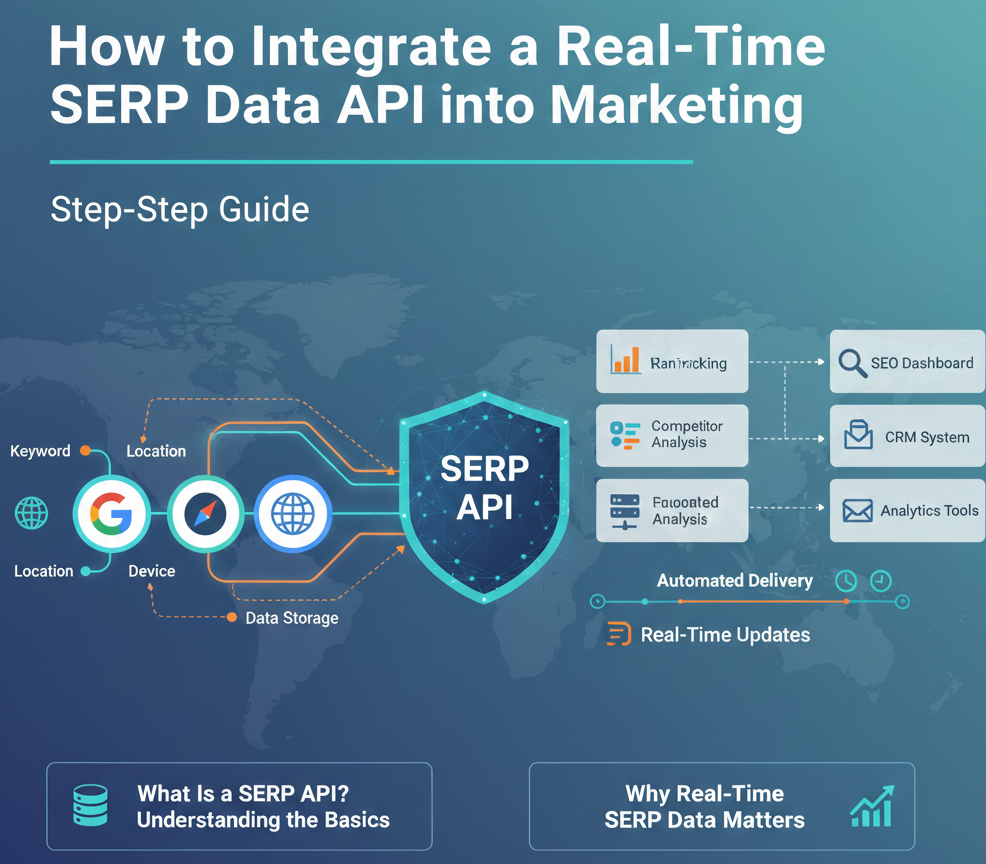
Modern digital marketing strategies are increasingly being powered by automation and data intelligence. Search engine rankings change constantly, competitors publish new content daily, and advertising performance fluctuates across regions and devices. Because of this fast-moving environment, manual keyword tracking has gradually been replaced by automated workflows.
Real-time SERP data APIs are now being adopted by agencies, SaaS platforms, and enterprise marketing teams to collect search engine insights at scale. Through proper SERP API integration, ranking intelligence can be delivered directly into dashboards, analytics tools, or campaign automation systems.
In this complete SEO API integration tutorial, the process will be explained step by step so that developers, marketers, and SEO professionals can understand how real-time data can be integrated into modern marketing workflows using a marketing automation API approach.
What Is a Real-Time SERP Data API?
A real-time SERP data API can be described as a system through which search engine results are automatically collected and delivered in structured formats such as JSON. Instead of manually searching keywords on platforms like Google, automated requests are submitted programmatically.
Search results including:
- Organic rankings
- Paid advertisements
- Featured snippets
- Local pack listings
- Knowledge panels
are extracted automatically and returned through API responses.
Traditional scraping scripts were previously used for similar purposes. However, these systems were frequently blocked due to CAPTCHA challenges or IP restrictions. Modern APIs solve these problems by managing proxy networks, browser simulation, and parsing systems internally.
Because infrastructure complexity is handled externally, SEO teams are allowed to focus on insights rather than technical maintenance.
Why Businesses Need SERP API Integration
Automation has become essential as marketing campaigns expand across multiple locations and search engines.
Several benefits are achieved when SERP API integration is implemented:
- Keyword rankings can be monitored automatically.
- Competitor movements can be tracked in real time.
- SEO dashboards can be updated without manual data entry.
- Campaign performance can be analyzed continuously.
Marketing agencies managing dozens of clients particularly benefit because thousands of keyword queries can be processed simultaneously.
Additionally, SaaS SEO platforms rely heavily on APIs to deliver accurate ranking updates to users. Without automation, scaling such services would be extremely difficult.
Understanding API Integration Basics (Before You Start)
Before integration begins, several technical concepts should be understood. In this SEO API integration tutorial, these basics are simplified for non-developers as well.
API Requests and Responses
Most SERP APIs operate using REST architecture. A request is sent to an endpoint containing parameters such as:
- Keyword
- Location
- Device type
- Language
A structured response is then returned containing SERP data.
Authentication Methods
Authentication is typically handled through API keys or tokens. Access credentials are generated after account creation and must be included in every request.
JSON Data Structure
Responses are delivered as structured JSON files. Each ranking result contains elements such as URL, title, description, and ranking position.
Developer Requirements
Integration can usually be completed using common programming languages including:
- Python
- JavaScript
- PHP
- Java
Basic backend hosting environments are generally required for automation workflows.
Step-by-Step SERP API Integration Guide
The technical process behind SERP API integration may appear complex initially, but it can be simplified into clear stages.
Step 1 , Choose the Right SERP API Provider
Accuracy and speed should be evaluated carefully before selecting a provider. Features such as geo-targeting, documentation quality, and scalability should be compared.
Platforms such as Zenserp are often chosen because proxy management and structured parsing systems are handled automatically, reducing development effort.
Step 2 , Obtain API Credentials
After registration, an API key is generated. This credential is used to authenticate every request sent to the server.
API keys should always be stored securely.
Step 3 , Set Up Your Development Environment
A backend environment is usually configured first.
Typical setup includes:
- Server hosting
- Programming framework installation
- Database configuration
Testing tools such as Postman may also be used to validate requests.
Step 4 , Send Your First API Request
Once configuration has been completed, a request is submitted containing keyword parameters.
Example parameters include:
- Keyword phrase
- Country or city targeting
- Mobile or desktop device selection
The API retrieves results automatically using localized proxies.
Step 5 , Parse the Response Data
The returned JSON response must be parsed within the application.
Important elements extracted usually include:
- Ranking position
- Website URL
- SERP feature presence
Libraries available in most programming languages simplify this process significantly.
Step 6 , Store Data in a Database
Collected data is typically stored for historical analysis.
Databases allow:
- Ranking trend tracking
- Competitor comparisons
- Reporting automation
Automation workflows are often scheduled hourly or daily depending on campaign requirements.
Step 7 , Display SERP Data in Dashboards
Finally, insights are visualized through dashboards or reports.
Charts, alerts, and ranking tables allow marketing teams to respond quickly when visibility changes occur.
Integrating SERP APIs into Marketing Automation Platforms
A marketing automation API strategy allows SERP insights to influence campaigns automatically rather than manually.
Several integrations are commonly implemented.
Campaign Monitoring
Ranking drops can trigger alerts automatically so corrective actions can be taken quickly.
Lead Generation Optimization
Keyword trends may be analyzed to identify new traffic opportunities.
CRM Integration
SERP data can be connected to customer relationship management platforms to align SEO insights with sales performance.
Performance Alerts
Automated notifications can be triggered when competitors outrank targeted keywords.
When integrated correctly, SEO data becomes part of a broader marketing intelligence system.
Common Use Cases for SEO and Marketing Platforms
SERP API integrations are being adopted across multiple industries.
SaaS SEO Platforms
Customer dashboards rely on automated ranking updates.
Agency Reporting Tools
Monthly reports are generated automatically using stored ranking data.
Ecommerce Intelligence
Product visibility across shopping results can be monitored.
Content Optimization Software
Featured snippet opportunities can be identified through SERP layout analysis.
Because automation reduces manual effort, operational efficiency is significantly improved.
Best Practices for SEO API Integration
Several best practices should be followed to ensure stable performance.
Optimize API Requests
Only necessary parameters should be requested to reduce usage costs.
Handle Rate Limits
API request limits must be respected to avoid interruptions.
Implement Error Handling
Retry logic should be added for failed requests.
Cache Frequently Used Data
Caching reduces redundant requests and improves performance.
Many providers, including Zenserp, offer documentation and SDKs that simplify implementation when best practices are followed.
Common Challenges and How to Solve Them
Although integration is straightforward, certain challenges may be encountered.
API Downtime
Backup retry systems should be implemented.
Cost Management
Query volumes should be monitored carefully to prevent unexpected expenses.
Data Overload
Large datasets require filtering and prioritization.
Localization Complexity
Multiple countries may require separate targeting parameters.
Planning workflows early helps prevent these issues.
Security Considerations During API Integration
Security should always be prioritized during integration.
Recommended practices include:
- API keys should never be exposed publicly.
- Server-side requests should be used instead of browser requests.
- Access permissions should be restricted internally.
Secure environments reduce risks associated with unauthorized usage.
Future of Marketing Automation Using SERP APIs
Marketing automation is expected to become increasingly data-driven.
Artificial intelligence is already being integrated into SEO workflows to predict ranking opportunities. Real-time alerts, automated reporting, and predictive keyword analysis are becoming standard features.
As search behavior evolves, businesses capable of responding quickly to SERP changes will maintain competitive advantages.
Real-time API integrations will therefore continue to play a central role in digital marketing infrastructure.
FAQs
1. Do I need coding experience for SERP API integration?
Basic programming knowledge is helpful, although many providers offer ready-to-use integrations and documentation.
2. Which programming language is best for SEO API integration?
Python and JavaScript are commonly used due to strong library support.
3. Can SERP APIs integrate with CRM tools?
Yes. Many marketing automation systems allow API data connections through middleware or webhooks.
4. How often should SERP data be refreshed?
Highly competitive industries often refresh rankings daily or hourly.
5. Are SERP APIs scalable for enterprise businesses?
Yes. Enterprise providers support large keyword volumes across multiple countries.
Automation has become essential in modern SEO and digital marketing environments where rankings shift continuously. Manual tracking methods are increasingly being replaced by structured data workflows powered by APIs.
Through proper SERP API integration, marketing teams are enabled to collect accurate insights, automate reporting, and respond faster to competitor movements. As demonstrated in this SEO API integration tutorial, the process can be implemented step by step using reliable infrastructure and secure development practices.
When combined with a strong marketing automation API strategy, real-time SERP data transforms SEO from reactive monitoring into proactive decision-making , allowing businesses to scale campaigns confidently in an increasingly competitive search landscape.
Recommended resources: SERP API vs Proxy-Based Web Scraping: Real Cost, Reliability, and ROI (2026 Buyer’s Guide)
