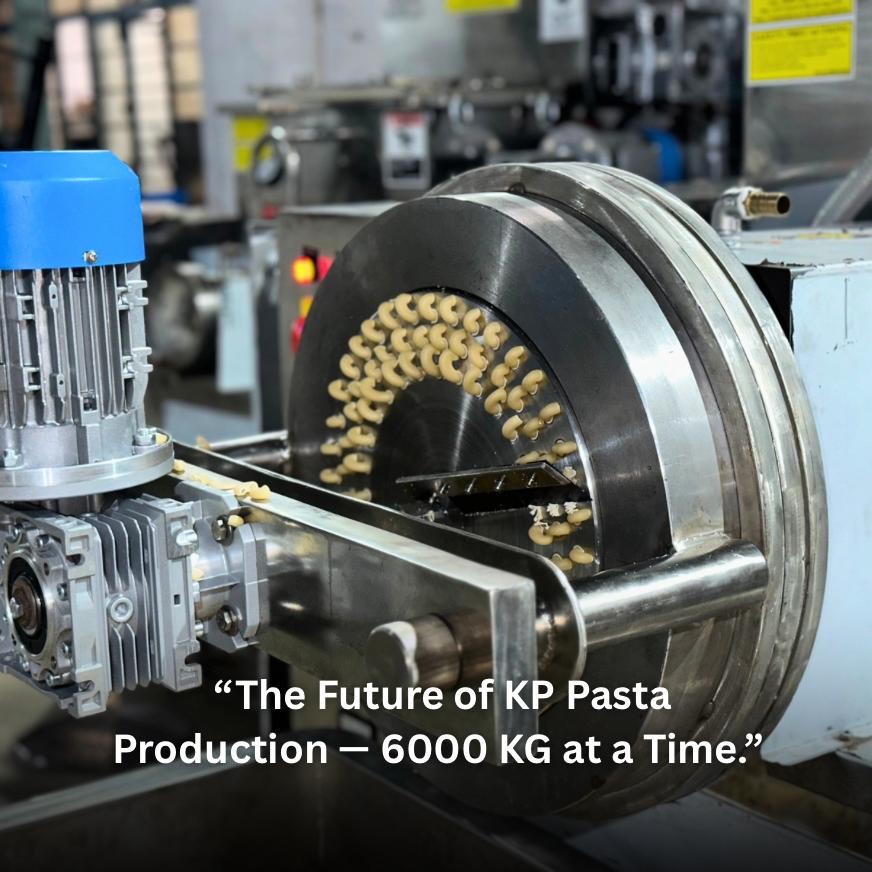
The global demand for pasta products has grown significantly over the last two decades. Pasta is now consumed across Asia, the Middle East, Africa, and many emerging food markets where ready-to-cook meals are becoming increasingly popular. This growing demand has pushed food manufacturers to modernize their production processes using advanced pasta machines and automated food processing technology. Industrial automation allows manufacturers to produce consistent, high-quality pasta while maintaining efficiency, hygiene, and scalability.
In today’s competitive food manufacturing environment, companies rely on advanced pasta production lines that combine dough mixing, extrusion, drying, and packaging into a continuous process. These systems integrate modern automation, energy-efficient pasta drying systems, and intelligent production controls. Manufacturers that adopt these technologies are better positioned to meet market demand while maintaining product consistency and operational efficiency.
Industrial trends in pasta manufacturing and automation
The pasta manufacturing industry has evolved from small mechanical equipment to fully integrated automated production plants. Traditional pasta machines required significant manual handling and labor during mixing, extrusion, drying, and packaging stages. Modern industrial pasta making machines now use PLC and PC based control systems that automate every stage of production.
Automation improves product consistency, reduces operational costs, and increases production capacity. Food factories can now install a fully automatic pasta making machine that performs mixing, extrusion, cutting, drying, cooling, and packing in a streamlined production process.
Many pasta machine manufacturers in India have developed advanced engineering capabilities to meet global demand. These manufacturers design complete pasta production lines capable of producing both long cut pasta and short cut pasta varieties. The integration of smart control systems allows operators to manage temperature, pressure, and production parameters with precision.
Production capacity is another important factor in modern food processing plants. Industrial pasta making machines are available with production capacities ranging from 50 kg per hour for small manufacturing units to more than 5000 kg per hour for large-scale factories. These scalable solutions allow companies to start with moderate capacity and expand their production capabilities as demand grows.
How industrial pasta machines work in modern food factories
A complete pasta production line typically begins with the dough preparation process. Flour and water are mixed in a high-efficiency mixing system that ensures consistent dough quality. Many modern automatic pasta machines incorporate vacuum mixing technology, which removes air pockets from the dough. This improves the texture, color, and structural integrity of the final pasta product.
After mixing, the dough moves into the extrusion section where it is processed through compression screws and shaping dies. This is the stage where pasta machine parts play a crucial role. High-precision extrusion systems ensure that the dough is shaped accurately while maintaining uniform density and surface quality.
Manufacturers can produce a wide range of pasta varieties using different extrusion dies. Short cut pasta products such as macaroni, penne, and fusilli are produced using specialized die plates. For products like spaghetti, vermicelli, and linguine, manufacturers rely on a long cut pasta making machine or a commercial long pasta production line.
Extruder technology has become increasingly sophisticated in recent years. High-performance extrusion systems use controlled pressure and temperature conditions to maintain product consistency. These machines are engineered to handle continuous production without compromising quality.
Advanced industrial pasta drying systems
Once pasta is shaped, it contains a relatively high moisture content. Drying is therefore a critical stage in the manufacturing process. Without proper drying, pasta may crack, deform, or develop an unstable shelf life.
Industrial pasta drying systems are designed to gradually remove moisture from the product while preserving its structural integrity. These systems include industrial pasta dryers, pasta belt dryers, pasta conveyor dryers, and pasta continuous dryers.
Modern drying technology uses carefully controlled airflow, temperature, and humidity conditions to achieve uniform drying results. A pasta belt dryer allows pasta to move slowly through different drying zones where moisture is removed in a controlled manner.
Pasta conveyor dryers are widely used in high-capacity production lines because they enable continuous product flow. Meanwhile, a pasta continuous dryer provides precise climate control for large-scale manufacturing environments.
Energy efficiency has become a major focus for modern food processing facilities. Manufacturers now invest in automatic pasta dryers that reduce energy consumption while maintaining optimal drying conditions. Efficient pasta drying systems not only lower operational costs but also improve the consistency of the final product.
Automated pasta packaging and industrial packing lines
After the drying stage is completed, the pasta must be cooled before packaging. This cooling process stabilizes the product and prepares it for final packaging.
Packaging automation plays a critical role in large food manufacturing operations. An automatic pasta packing machine is designed to weigh, fill, seal, and label pasta products with high accuracy and speed. These machines ensure consistent packaging quality and maintain strict hygiene standards required in food processing facilities.
Many factories install a complete industrial pasta packing line that integrates multiple machines within the packaging process. These systems can handle different package sizes and formats depending on market requirements.
The best pasta packing machine solutions are capable of high-speed operations while minimizing product damage and waste. Automated packaging also reduces labor costs and improves overall production efficiency.
Engineering expertise of K.P. Automations in pasta machinery manufacturing
India has become an important manufacturing hub for industrial food processing machinery. Companies such as K.P. Automations have developed strong expertise in designing and manufacturing advanced pasta machines for domestic and international markets.
As a pasta machine manufacturer and pasta machine exporter, K.P. Automations focuses on building reliable and technologically advanced production systems. The company manufactures a wide range of pasta machines including industrial pasta making machines, pasta dryers, extrusion systems, and automatic pasta packing machines.
The engineering team focuses on integrating automation technologies, energy-efficient drying systems, and durable pasta machine parts that ensure long operational life. Manufacturing infrastructure and technical expertise allow the company to develop scalable production lines suitable for both small food manufacturers and large industrial plants.
Industrial buyers often evaluate several factors when investing in new equipment. Production capacity, automation level, energy consumption, and pasta making machine price are among the most important considerations. By offering flexible machine configurations, manufacturers can help businesses select equipment that meets their production and budget requirements.
Growing market demand for automated pasta production systems
The global pasta market continues to expand as consumers look for convenient and affordable food products. Urbanization, changing lifestyles, and increased demand for packaged foods have accelerated the growth of pasta consumption worldwide.
Countries across Asia, Africa, and the Middle East are experiencing rapid growth in pasta consumption. Food manufacturers in these regions are investing in modern pasta production lines to meet growing demand.
Automated pasta production systems enable manufacturers to scale operations quickly while maintaining product quality. These systems reduce reliance on manual labor, improve operational efficiency, and allow companies to produce consistent products for both domestic and export markets.
Businesses that invest in modern automatic pasta machines, industrial pasta dryers, and automated packaging systems are better equipped to compete in the global food industry.
Conclusion
The transformation of the pasta manufacturing industry is being driven by automation, advanced engineering, and energy-efficient production technologies. Modern pasta production lines integrate mixing, extrusion, drying, and packaging into a seamless manufacturing process that improves productivity and ensures product consistency.
Industrial pasta making machines with capacities ranging from 50 kg per hour to 5000 kg per hour allow manufacturers to scale their production according to market demand. Combined with industrial pasta drying systems, conveyor dryers, and automatic pasta packing machines, these technologies create a highly efficient food processing environment.
Companies seeking to expand or modernize their production facilities increasingly rely on trusted equipment manufacturers. With strong engineering expertise and advanced manufacturing capabilities, K.P. Automations continues to support food manufacturers with reliable pasta machines, industrial drying systems, and complete automated pasta production lines.
Corporate Address
G.B D – 372, D Block, Sector 10, Noida, Uttar Pradesh 201301
+91 – 9310738142
kpautomations372@gmail.com
Manufacturing Unit
E -55, SITE B, Block E, UPSIDC Site B, Surajpur, Greater Noida, Uttar Pradesh – 201306
+91 – 9310738142, +91 – 8130577322
kpautomations372@gmail.com
Stylish Shipping Container Homes with Modern Design
Bangkok Tailor for Stylish Custom Suits
The Unified Institutional Brain: Mastering Structural Alpha in the 2026 Swiss Investment Landscape
Heat Cool Unit Repair & Installation for Pool Systems
Best Gastroenterologist in Vashi, Navi Mumbai: Advanced Care for Digestive Disorders
