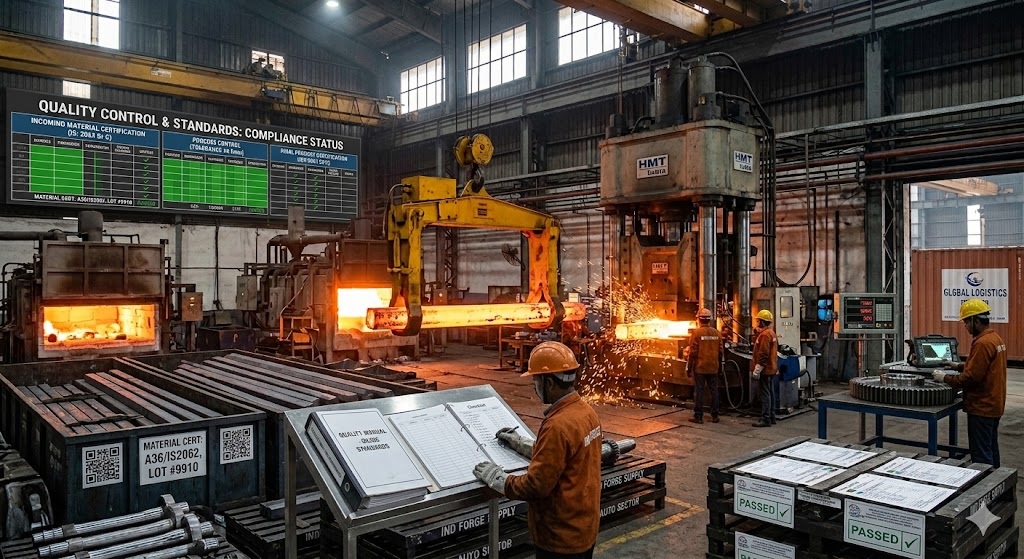
Manufacturers of forged products in India generally use the same international standards for production as do manufacturers of similar products in other countries, in order to ensure that their products are consistent with industry standards for quality and precision. This includes verifying the raw materials prior to beginning the manufacturing process; monitoring the temperature of the material during manufacture; verifying the dimension of the product; and performing non-destructive tests on the completed forged product; such as ultrasonic and magnetic particle inspection.
Advanced measurement equipment (e.g., coordinate measuring machines (CMM), process monitoring (real time), etc.) is used to further enhance measurement accuracy. Forging manufacturers that implement the proper quality control processes will reduce the occurrence of product defects, ensure compliance with relevant international quality standards, and deliver quality products to various industries including: automotive, aerospace, and heavy engineering.
Supply Chain Management in Forging Manufacturing
In the forging industry’s supply chain management is essential to producing products on time, controlling costs and ensuring quality. Supply chain management involves procuring raw materials, controlling inventory, planning production and distributing finished forged parts. The forging sector has a good connection with the suppliers of raw materials such as steel, as well as those relationships extend to those responsible for logistics and OEM. If a forging company has these good relationships, they are able to maintain a steady and smooth-flowing supply chain, along with a free-flow of materials and information with those companies. For manufacturers of forged parts and products, technologically advanced ERP systems, along with digital tracking technology, help to manage your inventory levels, to accurately forecast future production needs, and reduce lead-time on any parts/products you may require. Additionally, if manufacturers of forged parts/products put supply chain management strategies into practice, then they will be able to not only reduce the number of delays to their own supply chain processes but also completely utilize the total resource capacity of their business, enabling them to adapt to market changes without sacrificing deadlines or being able to compete both within the United States and globally.
Challenges Faced by Forging Companies in India
The forging companies India are facing a number of difficulties which are limiting their development and competitiveness in both their domestic and international marketplaces.
The major issue at the moment is the high price of the raw materials, e.g., steel and the volatile pricing for those materials makes it more difficult to plan production and set margins for the finished product.
Many of the forging companies also face the problems of old equipment, little use of automation, and therefore limited efficiency and consistency in their finished products.
The other major challenge for forging companies is the surging cost of energy, particularly for energy-intensive processes of forging products.
Furthermore, finding sufficient numbers of highly skilled workers that can operate modern machinery and produce products that meet quality standards is a significant challenge for the industry.
Furthermore, compliance with stricter regulations regarding environmental compliance and obtaining international quality standards now add increased complexity to the operations of Indian forging companies.
To survive their long-term growth potential the Indian forging companies must continue to innovate, reduce costs, and update equipment due to the enormous competition they are facing from global competitors and their pricing pressures from the Original Equipment Manufacturers (OEMs).
Conclusion
Ultimately, effective quality control is a critical success factor that all forging organizations need to apply in order to develop consistency in their products, fulfil international standards/requirements, and achieve ongoing viability (i.e., developing a stable business exists long-term). By implementing supply chain processes that are efficient, manufacturers will have the opportunity to consistently supply the same quality products while minimizing costs and producing on very tight time-frames. Forging manufacturers are being challenged by more raw materials and labour, skill shortages within the workforce, and increasing competition as such they need to continually adapt. To give forging manufacturers in India the opportunity for domestic and global growth, companies need to focus their efforts on improving their product quality, operational efficiencies (to become more competitive), and innovations that will enable them to create or maintain an advantage over their competitors. In addition, UK forgers should have a strong commitment to continuing to produce high-quality products, become more efficient in their processes and continually innovate.
