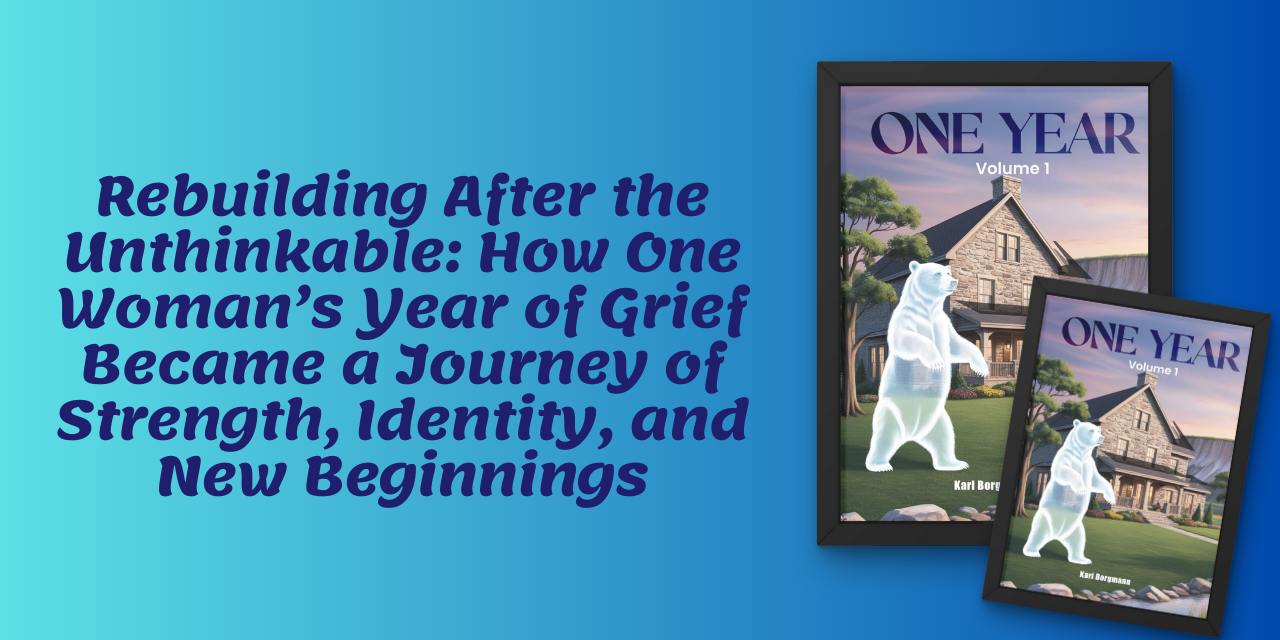
An Account Of Grief, Pain, Adjustment And Resilience Of A Woman Whose Life Turned Upside Down.
The Call That Changed Everything
The impossible usually comes on an average day, at any given time, without any notice, without forgiveness. In the case of Sydnie, in One Year – Volume I, everything in her life went upside down when she received a call informing her of the sudden death of her husband of thirty-eight years. Along with her family, she lost her entire life, stability, and peace that she once knew.
Sydnie’s husband and the center of her world, Adam, became a victim of a heart attack and was thrown into a ditch just a few miles away from his workplace. Her friend, her partner, her whole world became shattered in a minute. What followed the year after the incident turned out to be not only a process of grieving but also a path towards self-discovery, strength, and reconstruction of a life she never imagined to have after losing the life she had known.
Moving Through the Immediate Aftermath
The death of a loved one is by far one of the most traumatic and upsetting situations one can go through, people who go through such pain dive into a sort of “autopilot mode” where we become a numb machine trying their best to perform the last “funeral rites” of their loved one. Kari very beautifully explains the immediate aftermath of a loved one passing away, the denial, the anger and the disbelief. The author makes you feel like as if you are going through the same ordeal Sydnie is going through. The readers witness how realistically the grief of Sydnie is conveyed through the prose of Kari, how Sydnie just moves on and tries her best to be rational and calm.
Underneath her apparent calmness was the truth she could not get rid of: half of her world was suddenly gone, as the man with whom she had spent almost half of her life had been taken away from her.
Confronting a New Reality
As time went on, Sydnie would slowly realize that she was not well equipped to deal with the chores of life without her husband. Through rigorous trial and error, and a broken finger, she suddenly came to terms with the fact that she may not be ready to do things alone. Even simple chores such as mowing the lawn became incredibly painful. As she sat down in the emergency room, waiting for a doctor to take care of her dislocated finger, she realized that she was all alone, with chores, with repairs and decisions that she once expected Adam to help out with.
Throughout her ordeals, her most unsuspecting injury would come from her loved ones and family. Dr Kari here subtly explains through her writing the pain and misery a woman is forced to go through after losing her partner. A single woman, no matter how close she is, will always be viewed in a negative manner. Through the experiences of Sydnie, we see the ugly side of society that consistently brings women down. In a society that is always blaming women for every wrongdoing, how can one distraught woman survive? How can Sydnie ensure that her family endures through this loss?
Finding Structure in the Midst of Loss
But unexpectedly, the suffering became a part of self-transformation for her. Each defeat, each betrayal, each solitude, cut its path to a better comprehension of herself. She realized she needed a plan to get through the winter, and the months of January, February, and March had to be endured. She needed purpose something that would keep her going.
The Transformation Of Pain Through Time
As the story progresses, pain gradually transforms into something quieter but more purposeful. Dr Kari Borgman, beautifully describes how the pain of immense loss slowly succumbs and transforms into a steady, but more deliberate version. Sydnie’s attempt to impose a sense of structure towards her life slowly unravels. There is a subtle but powerful shift here: suffering is no longer only endured, it begins to shape self-understanding. The writing excels in these transitional moments, capturing how survival often starts not with hope, but with routine.
The handling of the holiday season is especially poignant. Rather than leaning into sentimentality, the author presents these moments as emotionally uneven heavy with memory, tension, and longing. What stands out is the refusal to idealize family or healing. Warmth exists alongside discomfort, love alongside exhaustion. The empty spaces are never filled, only acknowledged, and that honesty gives the narrative its emotional weight.
Major Decisions and Family Tensions
During a difficult period, she made one of the hardest choices: selling the house. She was exhausted by the space she had shared with Adam, filled with memories and responsibilities she now faced alone. Downsizing became a necessity as she considered a future shaped by change.
By the time the account reaches the stage of quiet reflections and closing, the writing becomes calm, meditative and soothing. Grief is no longer portrayed as something to be overcome, but something to be carried differently. The writing does not offer closure in the traditional sense, and that choice feels deliberate and deeply human. What remains is not peace, exactly but acceptance shaped by endurance.
The author does a great job in creating an unflinching, intimate account where the reader is entangled with the worries of Sydnie, this unique ability to ensure that the reader feels as if they are the ones in the front seat adds a fresh experience and makes the book an emotional experience for whoever that decides to read it.
A Year of Transformation
The first year marked by physical injury, altered relationships, and disrupted routines became a crucible through which Sydnie discovered her own strength. She learned that grief is not linear and that recovery does not follow a fixed timeline. Identity, she realized, can continue to evolve even through pain.
Sydnie’s experience demonstrates that moving forward is not betrayal, but courage. It is the choice to continue engaging with life, even when its form has permanently changed. As readers turn the pages of One Year – Volume I, they witness not only a story of loss, but a quiet, sustained process of rebuilding.
