




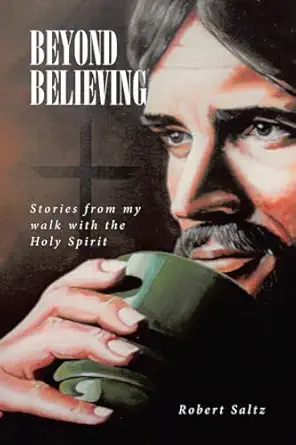
Robert Saltz spent decades as a shoe merchant, a veteran, and a lay church leader. Then he wrote a book that may quietly change the way you think about faith, the Holy Spirit, and what it means to truly listen.
There is a moment in Robert Saltz’s memoir when the Holy Spirit says, “You’re welcome.”
Saltz had just thanked God out loud for his morning coffee. He wasn’t expecting a response. But the reply came anyway, audible, unhurried, unmistakable. It stopped him cold.
That single exchange captures everything Beyond Believing is about. Not theology. Not doctrine. Not the kind of faith that lives quietly in the pew and never causes a scene. What Saltz is describing and has been living for more than 50 years is far more demanding than a two-way relationship with the Holy Spirit, conducted daily, in the language of ordinary life.
He is 86 years old. He was married for 64 years. He’s a Florida State graduate, an Army veteran, a former shoe merchant, and a man who once spent 18 years loading up groups of 15 people on weekends and driving them into churches and private homes across Florida to tell strangers about what God had done in their lives.
And now, prompted by grief after the death of his wife Karen in 2023, he has written it all down.
Beyond Believing did not begin as a publishing ambition. It began as an instruction.
“After my wife died,” Saltz writes, “the Holy Spirit asked me to write a book of our relationship.” So he did. The result reads less like a Christian memoir and more like a field dispatch from the front lines of lived faith; specific, personal, frequently astonishing, and entirely devoid of the soft-focus sentimentality that makes so much inspirational writing easy to set down.
Saltz is not writing for a general audience. He is writing for people who already believe but have settled for a faith that is smaller than it should be. His target is the Christian who recites scripture but doesn’t expect God to actually show up — who prays but doesn’t wait for an answer. He calls this “nominal faith,” and he spent years living it himself before that men’s retreat in Leesburg, Florida, changed everything.
“I always believed in God,” he admits. “But I didn’t have a personal relationship with Him.”
What followed that retreat is the substance of this book: five decades of stories about what happens when that changes.
The Nine Ways God Speaks to Us
Embedded within the memoir is what may be its most enduring contribution: a 2008 article Saltz wrote called “The Nine Ways the Lord Speaks to Us.”
Originally published as a standalone pamphlet and now included in the book, it is a practical, experience-tested guide to spiritual discernment that cuts through decades of vague Christian language about “hearing from God” and gets specific. The nine channels Saltz identifies are:
- The Bible — the foundation against which everything else is measured
- The Inner Voice — a thought or impression that carries unmistakable weight
- Visions — mental images with meaning beyond the imagination
- Intuition — a knowing in the spirit before the mind catches up
- Open and Closed Doors — circumstances that confirm or block a direction
- Dreams — nighttime communication with daytime implications
- The Words of Others — when someone else speaks exactly what you needed to hear
- Telescoping — when a scripture seems to leap off the page directly into your situation
- Fleeces — asking God for a confirming sign, as the biblical figure Gideon did
What gives this framework authority is its origin. These are not categories derived from a Bible commentary. They are categories Saltz developed by paying attention, over fifty-plus years, to how the Spirit actually moved in his actual life. For anyone who has felt the frustration of wanting a more real, responsive faith and not knowing how to get there, this section functions as a legitimate road map.
The Grief That Became a Gift
You cannot read this book without feeling the weight of Karen Saltz’s absence. Sixty-four years of marriage. Three children. Eight grandchildren. Nine great-grandchildren. She passed in 2023, and in the months that followed, her husband — then 85 — sat down to write.
The grief is present in the book without being the subject of it. What Saltz chose to document was not his loss but his witness: the record of everything God did across a shared lifetime, offered now to anyone willing to receive it.
The first reader to receive it, in the most transformative sense, was his own daughter. After reading the manuscript, she joined a church. She joined a Bible study. She called her father to tell him the book had changed her life — and described her own experience of hearing God speak in precisely the way he had written about.
For a man who spent 18 years driving into strangers’ churches to share his testimony, there is a kind of poetic justice in the fact that the most powerful testimony he ever delivered went straight to his own family.
Why This Book Matters Right Now
American Christianity is in a complicated moment. Church attendance is declining. Institutional trust is fraying. An entire generation is walking away from faith, not because they don’t believe in God but because the version of faith they were offered felt hollow. It felt performed rather than lived, inherited rather than encountered.
Robert Saltz is not a theologian or a celebrity pastor. He is an 86-year-old man from Florida with a Bible degree from a correspondence school and a lifetime of stories nobody could have made up. And what he is offering, in this slim, unassuming book, is a direct challenge to the idea that Christianity has to be that hollow.
“We all have a full-time Holy Spirit by invitation,” he writes. “He is Awesome.”
It is, in its way, a radical claim. And in his hands, after everything he has seen, it reads less like a slogan than like a report.
To read Beyond Believing by Robert Saltz visit www.robertsaltz.com to learn more.
About the Author