Leading Sandstones Exporters from India: Quality, Craft & Global Trust
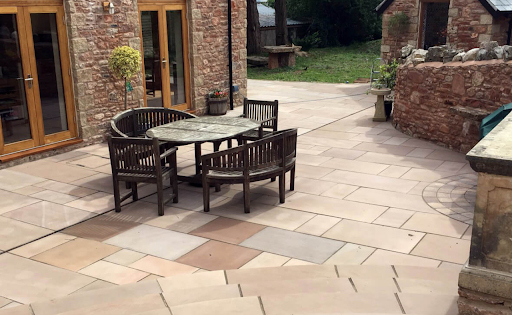
Walk into any modern villa in Dubai, a landscaped garden in Sydney, or even a calm patio somewhere in the English countryside, and you’ll often find the same thing under your feet—Indian sandstone. Warm. Textured. Almost comforting in the way it holds the sun.
It’s strange how a stone that’s millions of years old can still feel so alive.
Behind that stone, though, there’s a long, intricate journey. And at the center of that journey are the sandstones exporters from India—a group of businesses and families who’ve taken one of the oldest natural resources and turned it into a global architectural language.
This article isn’t about throwing generic facts at you. It’s a human-grounded look into how India became the world’s most trusted source for sandstone, what exporters actually do behind the scenes, and why the demand keeps growing even in a world obsessed with engineered materials.
Let’s pull back the curtain.
India’s Sandstone Belt: Where the Story Begins
If you’ve ever driven through Rajasthan’s stone clusters—Jodhpur, Bundi, Dholpur, Barmer—you notice something before anything else: dust.
Not the unpleasant kind, but a soft golden haze that floats around freshly cut blocks. A smell of hot earth lingers in the air. Workers talk with a rhythm. Chisels hit stone in patterns that almost sound like a song.
This is where most Indian sandstone starts its journey.
And while Rajasthan is the heart, states like Madhya Pradesh, Andhra Pradesh, and Karnataka also contribute in smaller but steady volumes.
The reason India leads the global sandstone market goes far deeper than quantity. It lies in variety, texture, color diversity, artisan skill, and naturally durable geology.
Why the World Prefers Indian Sandstone
Ask any importer, contractor, or architect why they choose India, and they’ll rarely give a single answer. It’s always a combination.
1. Natural Beauty That Doesn’t Try Too Hard
Indian sandstone has this raw, honest charm. It doesn’t look overly “processed.”
Whether it’s:
- Jodhpur’s iconic red
- Dholpur’s classic beige
- Kandla’s cool grey
- Mandana’s deep red
- Teakwood’s wavy golden lines
- Rainbow sandstone’s soft, swirling hues
…each slab feels like a painting made by time.
2. Exceptional Durability
Sandstone is one of the few stones that performs well in:
- extreme heat
- frost-heavy regions
- salt-rich air
- rain-prone climates
That’s why you see it everywhere: driveways, wall cladding, pool decks, garden pathways, even heritage reconstructions.
3. Skilled Indian Craftsmanship
Exporters rely on something machines can’t replicate: human hands that understand the stone.
Decades of instinct. Generational knowledge.
A worker in Rajasthan can tap a stone once and tell if it’s good or if it will chip later. That precision gives exporters a reputation for consistency.
4. Competitive Pricing Without Compromising Quality
This is India’s biggest advantage.
A perfect balance of:
- affordable labor
- mature quarrying systems
- high-volume production capability
Exporters can supply both small custom orders and massive 50–100 container projects.
5. Smooth Logistics & Global Reach
Most shipments leave via:
- Mundra Port
- Kandla Port
- Mumbai Port
…making freight costs far more reasonable for buyers across the Middle East, Europe, Australia, and the US.
What Sandstone Exporters from India Actually Do (The Real Workflow)
People outside the industry often assume it’s simple: cut stone, load it, ship it.
But exporters operate in a far more complex and delicate ecosystem.
Let’s break down the workflow the way an insider would explain it.
1. Quarry Coordination
Exporters must build trust with quarry owners—often decades old relationships.
They scout for:
- consistent color batches
- minimal natural cracks
- uniform grain
- high-density blocks
One bad quarry decision can ruin an entire shipment.
2. Processing & Finishing
This is where precision matters.
Common finishes include:
- Natural cleft
- Honed
- Polished
- Shot-blasted
- Bush-hammered
- Flamed
- Sandblasted
- Tumbled
Different markets have different tastes.
A UK buyer may want natural riven paving.
A Dubai buyer may demand mirror-polished slabs.
An Australian landscaper wants anti-slip surfaces.
Exporters must adapt with absolute accuracy.
3. Calibration & Dimensioning
Every millimeter counts.
If even 5% of the tiles are off-thickness, a contractor abroad loses time, money, and patience.
Exporters use:
- calibration machines
- edge cutters
- waterjets
- gangsaws
…but they always finish with human inspection.
4. Quality Control
This is where Indian exporters build their reputation.
QC checks include:
- thickness
- flatness
- shade uniformity
- moisture content
- edge accuracy
- finish quality
- packaging strength
Good exporters reject more material than they accept.
5. Packaging That Survives Oceans
Containers face humidity, vibration, loading pressure, and rough handling.
So exporters use:
- Fumigated wooden crates
- Waterproof inner sheets
- Styrofoam separators
- Steel strapping
- Corner guards
Every crate is labeled with batch codes, dimensions, finish type, and quantity.
6. Documentation & Compliance
To avoid port delays, exporters prepare:
- commercial invoices
- packing lists
- certificate of origin
- fumigation certificates
- SGS/CE reports (if needed)
A single small error can delay a shipment for weeks.
7. Shipment & Tracking
Exporters coordinate with CHA agents, shipping liners, and freight forwarders.
Sometimes containers get rolled over. Sometimes a vessel gets delayed.
A smart exporter stays ahead of these issues.
Major International Markets For Indian Sandstone
1. United Kingdom
The UK is India’s largest sandstone importer.
Their market loves:
- natural riven paving
- calibrated slabs
- tumbled cobbles
Old English architecture pairs beautifully with Indian stone.
2. UAE & Middle East
They want:
- smooth, polished slabs
- façade cladding
- custom thickness
- large-format stone
Indian exporters serve massive hotel, villa, and resort projects here.
3. Australia
Demand revolves around:
- outdoor paving
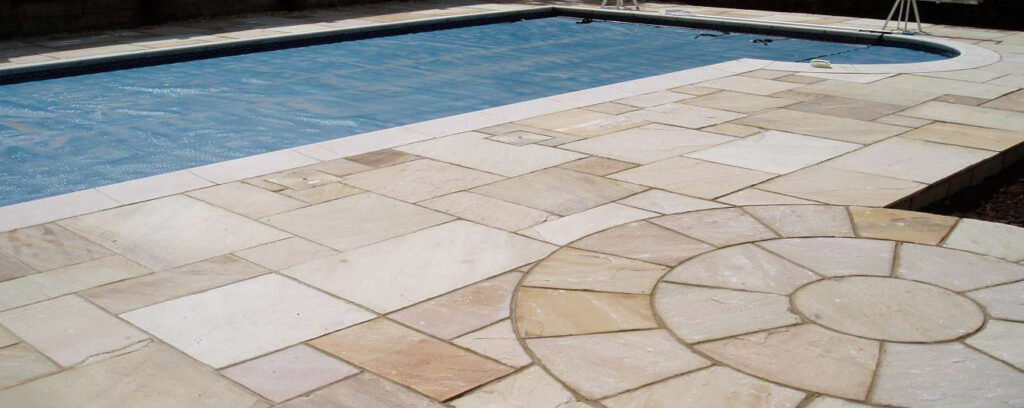
- pool surrounds
- garden pathways
- anti-slip textures
Australian climates pair well with Indian sandstone durability.
4. United States
The US market is strict but profitable:
- exact calibration needed
- color consistency essential
- custom packaging required
Exporters who crack the US market rarely leave it.
5. Europe
Germany, France, Spain, Italy—each country has unique needs.
But all appreciate natural sandstone aesthetics.
The Human Challenges Exporters Face (Rarely Talked About)
Behind glossy brochures and polished websites, there’s a reality exporters quietly manage.
1. Natural Variation
Sandstone is a natural material.
Color variation is inevitable.
Buyers sometimes expect “uniform printing-machine consistency.”
Exporters then spend hours explaining geology to impatient clients.
2. Weather Delays
Monsoon floods quarries.
Summer heat cracks blocks.
Winters slow production.
And exporters take the blame for things nature decides.
3. Buyer Psychology
Some overseas buyers nitpick minor imperfections.
Others delay payments.
Some negotiate until margins disappear.
Exporters learn human psychology almost as much as geology.
4. Rising Operational Costs
- diesel
- labor wages
- blade replacements
- container freight
- compliance costs
Margins shrink, but exporters keep going because the market is rewarding long-term.
5. Skilled Labor Shortage
Young workers prefer easier jobs.
Stone cutting is tough.
Exporters struggle to keep experienced artisans.
Why the World Trusts Indian Sandstone Exporters (The Psychological Factors)
It’s not only the stone.
It’s the people behind it.
Here’s why foreign buyers stick to Indian suppliers for decades:
1. Reliability
Exporters know what a contractor feels when a shipment goes wrong.
They try to avoid that at all costs.
2. Problem-Solving Mindset
If something breaks, exporters replace it.
If a buyer complains, they respond quickly.
This builds trust.
3. Relationship First, Business Later
In India, exporters don’t say “client.”
They say “partner.”
It shows in their communication—warm, patient, human.
4. Adaptability
Indian exporters learn fast.
They adjust to trends, finishes, sizes, and buyer tastes quickly.
5. Long-Term Commitment
Some exporters have worked with the same UK buyers for over 15 years.
That speaks louder than marketing.
Future of Sandstone Exports from India
The demand curve is rising, not falling.
Here’s why:
1. Eco-Friendly Architecture Trend
Natural materials are replacing synthetic ones.
Architects prefer sustainable sandstone.
2. Global Shift Toward Natural Textures
Minimalism is fading.
Earthy textures are returning.
3. Expansion Into Digital & Customized Production
- CNC carving
- waterjet patterns
- engraved stone panels
- bookmatched sandstone
- large-format tiles
These upgrades elevate India’s export capabilities.
4. Rising Indian Reputation in Global Construction
Buyers trust “Indian quality.”
It took decades, but exporters earned it.
5. Government Support for Export Zones
Improved infrastructure will further reduce freight costs.
The future looks strong—maybe stronger than ever.
How Buyers Choose Genuine Sandstone Exporters From India
A practical checklist importers often follow:
- Review past international projects.
- Request full-size samples (not small chips).
- Check factory presence.
- Verify communication clarity.
- Look for calibrated accuracy.
- Ask about after-sales support.
- Check consistency through repeat orders.
Experienced exporters always pass this checklist.
Final Words: The Human Story Behind Every Shipment
It’s easy to look at sandstone and see it as just… rock.
But the truth is softer.
Every slab that leaves India carries a bit of its land, its heat, its people, its rhythm.
The exporters who manage this process aren’t just running a business—they’re carrying forward a legacy older than any nation on earth.
They deal with:
- unpredictable weather
- demanding global standards
- rising costs
- tight deadlines
- natural variations
…yet they continue because the world genuinely loves Indian sandstone.
When someone abroad steps on a beautifully textured patio or touches a warm sandstone wall, they feel comfort. A sense of earth. A connection to something timeless.
And that’s what the sandstones exporters from India are really exporting.
Not just stone.
But a feeling.
A story.
A heritage carved in layers of sediment and human effort.
