




How a Stone Visualiser Tool Is Changing the Way People Buy Natural Stone
Let’s be honest — buying marble, granite, or any natural stone has always been a bit of a gamble.
You walk into a showroom, look at a slab, maybe a small sample, and try to imagine how it will look across your entire space. Will the veins align well? Will the color feel too dark? Will it match your furniture?
Most of the time, you’re guessing.
That’s exactly where a stone visualiser tool changes everything.
Today, customers don’t want to imagine anymore — they want to see. They want clarity, confidence, and control before making a purchase. And brands that are enabling this shift are not just improving experience — they are closing sales faster.
What Is a Stone Visualiser Tool?
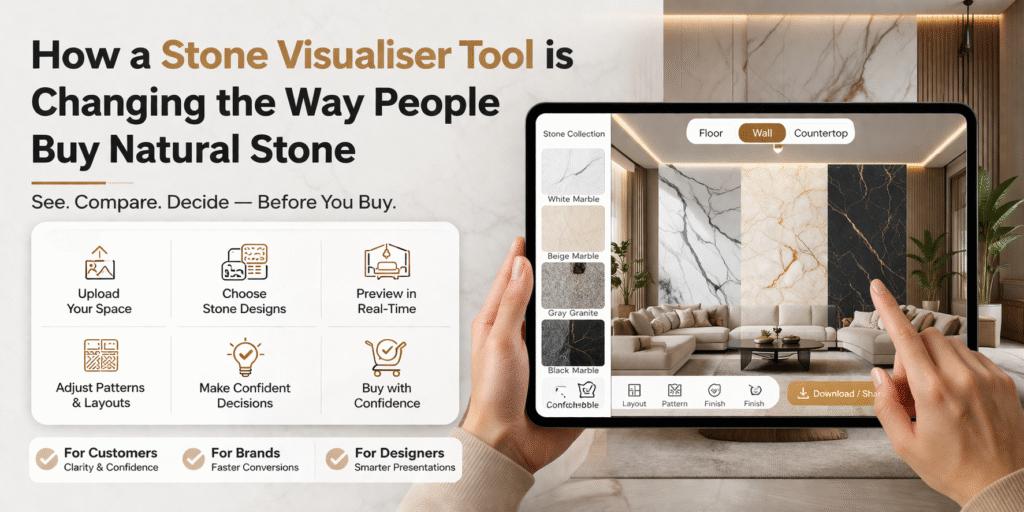
A stone visualiser tool is a digital solution that allows users to see how different stone materials — like marble, granite, quartz, or tiles — will look inside real spaces.
Instead of relying on imagination, users can:
- Upload their own room image
- Choose from pre-designed rooms
- Apply different stone designs instantly
- Adjust patterns, layouts, and finishes
The result? A near-realistic preview of how the final installation will actually look.
Why Traditional Buying Methods No Longer Work
1. Samples Don’t Tell the Full Story
A 2×2 sample piece cannot represent a full wall or floor. Natural stone has variations, veins, and textures that only become visible at scale.
2. Customers Fear Making the Wrong Choice
Stone is expensive. Once installed, changing it is not easy. This creates hesitation and delays decision-making.
3. Sales Teams Spend Too Much Time Explaining
Without visuals, sales teams rely on descriptions, past images, or references — which slows down the process.
How a Stone Visualiser Tool Solves These Problems
Real-World Visualization
A good stone visualiser tool doesn’t just overlay textures — it adapts to lighting, angles, and perspective to create a realistic preview.
True Scale Representation
Customers can see how large slabs will look across a full wall or floor — including vein flow and alignment.
Pattern & Layout Accuracy
From bookmatch to grid layouts, users can preview patterns exactly as they would appear after installation.
Instant Decision-Making
When customers see the final look instantly, hesitation disappears — and decisions happen faster.
Real Example: From Confusion to Conversion
Let’s say a customer is choosing marble for their living room floor.
Without a visualiser:
- They look at 5–6 slabs
- They feel unsure
- They delay the purchase
With a stone visualiser tool:
- They upload a photo of their living room
- Apply different marble options instantly
- Compare finishes side-by-side
- Finalize within minutes
That’s the difference between browsing and buying.
Key Features That Make a Great Stone Visualiser Tool
1. High-Quality Rendering
The visual output should feel real — not like a flat overlay. Reflections, lighting, and textures should match actual environments.
2. Multiple Surface Applications
Walls, floors, countertops, staircases — the tool should support all major applications.
3. Easy Product Selection
A well-organized digital catalog allows users to filter stones by color, finish, size, or category.
4. Branded Output & Sharing
Users should be able to generate PDFs or images they can share with family, designers, or decision-makers.
5. Website Integration
For brands, the tool should integrate directly into their website, making it part of the buying journey.
How Brands Are Using Stone Visualiser Tools Today
Showroom Experience Upgrade
Retailers are installing large screens or kiosks where customers can visualize stones in real-time.
Website Conversion Boost
Brands are embedding a stone visualiser tool into their website, allowing visitors to interact before contacting sales.
Sales Team Enablement
Sales representatives use the tool during meetings to present options instantly instead of explaining verbally.
Faster Project Approvals
For architects and designers, visual previews help get quicker client approvals.
The Role of AI in Modern Stone Visualization
Modern tools are no longer just static visualizers — they are powered by AI.
AI enables:
- Automatic surface detection (walls, floors, etc.)
- Realistic lighting adjustments
- Smart texture placement
- Quick rendering without manual editing
Platforms like Nirwana.ai are pushing this further by combining AI with high-quality rendering, making the experience seamless for both customers and brands.
Benefits of Using a Stone Visualiser Tool
For Customers
- Better clarity before purchase
- Reduced risk of wrong decisions
- Faster selection process
For Brands
- Higher conversion rates
- Reduced back-and-forth with clients
- Stronger digital presence
For Designers & Architects
- Easy presentation of concepts
- Improved communication with clients
- Faster approvals
Why This Is No Longer Optional
The buying behavior has changed.
Customers today are used to:
- Trying furniture in their room (AR tools)
- Visualizing paint colors before applying
- Seeing clothing virtually before buying
Natural stone is following the same path.
If a brand is still relying only on catalogs and samples, they are already behind.
A stone visualiser tool is not just a “nice-to-have” — it’s becoming a core part of the sales process.
Choosing the Right Stone Visualiser Tool
Before selecting a tool, brands should consider:
- Quality of visuals – Does it look realistic or artificial?
- Ease of use – Can customers use it without guidance?
- Integration capability – Can it be added to your website easily?
- Catalog management – Can you upload and manage products efficiently?
- Support & scalability – Will it work as your business grows?
Solutions like Nirwana.ai are designed specifically for home improvement brands, ensuring that both the visual quality and business use cases are aligned.
Conclusion: The Future of Stone Buying Is Visual
At the end of the day, people don’t buy stone — they buy how it looks in their space.
And when you give them the ability to see that instantly, everything changes.
A stone visualiser tool removes guesswork, builds confidence, and speeds up decisions — for customers and brands alike.
If you’re in the stone industry and want to stay ahead, this is one shift you cannot ignore.
Start small, test it, and see how your customers respond.
Because once they experience it, they won’t want to go back.
About the Author