Nuclear Magnetic Resonance (NMR) spectroscopy is one of the most advanced and reliable analytical techniques used across industries today. Whether it’s pharmaceuticals, chemicals, food testing, or academic research, NMR testing labs use this technology to uncover detailed molecular information that other methods often cannot provide.
Among the many techniques available, 1D (one-dimensional) and 2D (two-dimensional) NMR analysis are the most fundamental and widely used. While both serve the same ultimate purpose—understanding molecular structure—they differ significantly in how they collect, present, and interpret data.
This detailed guide will help you understand how 1D and 2D NMR work, their differences, advantages, limitations, and when each method is used in professional NMR testing labs.
What Is NMR Analysis?
NMR spectroscopy is based on the interaction of atomic nuclei with a strong magnetic field and radiofrequency radiation. Certain nuclei, such as hydrogen (¹H) and carbon (¹³C), behave like tiny magnets. When placed in a magnetic field, they absorb and re-emit energy at specific frequencies.
These frequencies depend on the chemical environment of the nuclei, allowing scientists to:
- Identify molecular structures
- Determine compound purity
- Study molecular dynamics
- Analyze mixtures
NMR testing labs use this data to produce spectra, which act like a molecular fingerprint of a sample.
Deep Dive into 1D NMR Analysis
What Is 1D NMR?
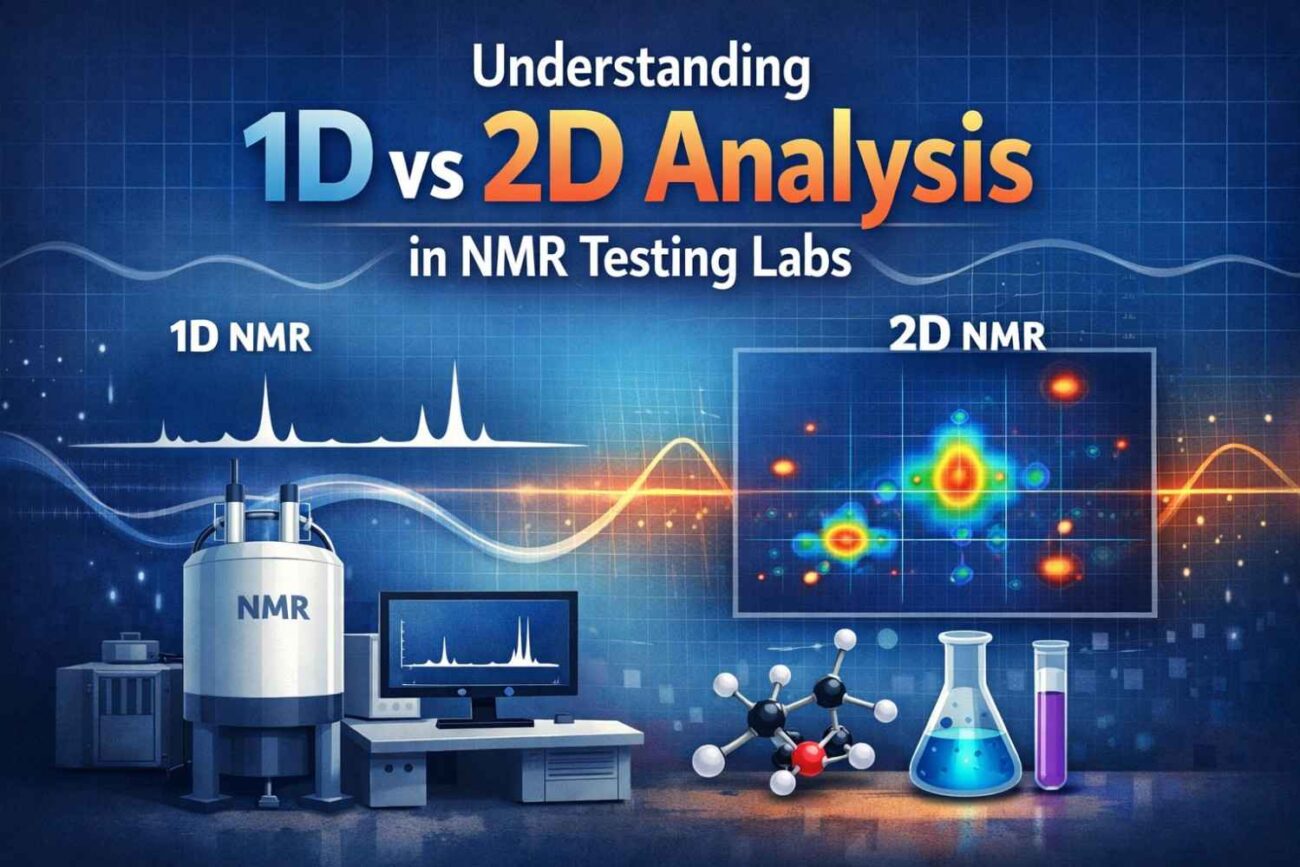
1D NMR (One-Dimensional NMR) is the simplest form of NMR spectroscopy. It plots signal intensity against a single frequency axis (chemical shift), producing a spectrum with peaks that correspond to different atomic environments.
Common Types of 1D NMR
- ¹H NMR (Proton NMR):
The most widely used technique, providing information about hydrogen atoms in a molecule. - ¹³C NMR (Carbon NMR):
Offers insight into the carbon backbone of a compound. - Other nuclei (less common): ¹⁹F, ³¹P, etc.
How 1D NMR Works
- The sample is placed in a strong magnetic field
- Radiofrequency pulses excite the nuclei
- Nuclei emit signals as they relax
- The signals are converted into a spectrum
Each peak in the spectrum provides key information:
- Chemical shift: Position of the peak (environment of atom)
- Integration: Number of atoms contributing to the signal
- Splitting pattern: Interaction with neighboring atoms
Advantages of 1D NMR
- Fast analysis: Results can be obtained quickly
- Cost-effective: Lower operational complexity
- Simple interpretation: Ideal for straightforward molecules
- Routine use: Common in quality control labs
Limitations of 1D NMR
- Signal overlap: Peaks can merge in complex molecules
- Limited connectivity information: Cannot always show how atoms are linked
- Reduced clarity in mixtures: Difficult to separate multiple compounds
Where 1D NMR Is Used
NMR testing labs commonly use 1D NMR for:
- Routine compound identification
- Purity testing
- Quality control in manufacturing
- Initial screening of samples
Deep Dive into 2D NMR Analysis
What Is 2D NMR?
2D NMR (Two-Dimensional NMR) adds a second frequency axis, allowing scientists to observe interactions between nuclei. Instead of a simple spectrum, it produces a 2D map (or contour plot) showing correlations between atoms.
How 2D NMR Works
2D NMR experiments involve multiple pulses and time delays:
- Nuclei are excited in a controlled sequence
- Interactions between nuclei are recorded over time
- Data is plotted across two axes (F1 and F2 frequencies)
- Cross-peaks reveal relationships between atoms
Common Types of 2D NMR
1. COSY (Correlation Spectroscopy)
- Shows proton-to-proton coupling
- Helps identify neighboring hydrogen atoms
2. HSQC (Heteronuclear Single Quantum Coherence)
- Connects hydrogen atoms to directly bonded carbons
- Very useful for structure mapping
3. HMBC (Heteronuclear Multiple Bond Correlation)
- Detects long-range (2–3 bond) interactions
- Helps build full molecular frameworks
4. NOESY (Nuclear Overhauser Effect Spectroscopy)
- Provides spatial (through-space) interactions
- Useful for 3D structure and conformation
Advantages of 2D NMR
- Detailed structural information
- Resolves overlapping peaks
- Reveals atomic connectivity
- Essential for complex molecules
- Accurate identification of unknown compounds
Limitations of 2D NMR
- Time-consuming: Longer experiment duration
- Higher cost: More instrument time and expertise required
- Complex interpretation: Requires trained specialists
Where 2D NMR Is Used
Advanced NMR testing labs use 2D NMR for:
- Drug discovery and development
- Structural elucidation of complex molecules
- Natural product research
- Polymer and material analysis
- Impurity profiling
Key Differences Between 1D and 2D NMR
| Parameter | 1D NMR | 2D NMR |
| Data Representation | Single axis | Two axes |
| Complexity | Low | High |
| Analysis Time | Short | Long |
| Cost | Lower | Higher |
| Structural Detail | Basic | Advanced |
| Signal Overlap | Common issue | Resolved effectively |
| Connectivity Info | Limited | Extensive |
How NMR Testing Labs Combine 1D and 2D Analysis
In real-world applications, NMR testing labs rarely rely on just one method. Instead, they follow a structured workflow:
- Start with 1D NMR
- Quick overview of the sample
- Identifies major components
- Identify Challenges
- Overlapping peaks
- Unknown structures
- Apply 2D NMR Techniques
- Confirm atom connectivity
- Resolve ambiguities
- Integrate Results
- Combine 1D and 2D data
- Generate a complete molecular structure
This combined approach ensures accuracy, reliability, and depth of analysis.
Real-World Example
Imagine analyzing a complex pharmaceutical compound:
- 1D NMR shows multiple overlapping peaks → difficult to interpret
- 2D NMR (HSQC + HMBC) reveals how atoms are connected → structure becomes clear
Without 2D NMR, the analysis could remain incomplete or incorrect.
Importance in Modern Industries
Pharmaceuticals
- Ensures drug safety and structure validation
- Detects impurities
Chemical Industry
- Confirms formulations and compositions
Food Testing
- Identifies adulteration and contamination
Research & Academia
- Enables discovery of new molecules
Choosing theRight Technique
The choice between 1D and 2D NMR depends on:
- Complexity of the sample
- Required level of detail
- Time constraints
- Budget considerations
Simple Rule:
- Use 1D NMR for quick and simple analysis
- Use 2D NMR for complex and detailed investigation
Conclusion
Understanding the difference between 1D and 2D NMR analysis is essential for anyone working with or relying on NMR testing labs.
- 1D NMR offers speed, simplicity, and efficiency
- 2D NMR provides depth, clarity, and precision
Together, they form a powerful combination that allows scientists to explore molecular structures with unmatched accuracy.
As industries continue to demand higher precision and deeper insights, the role of both 1D and 2D NMR in testing labs will only become more critical.
