




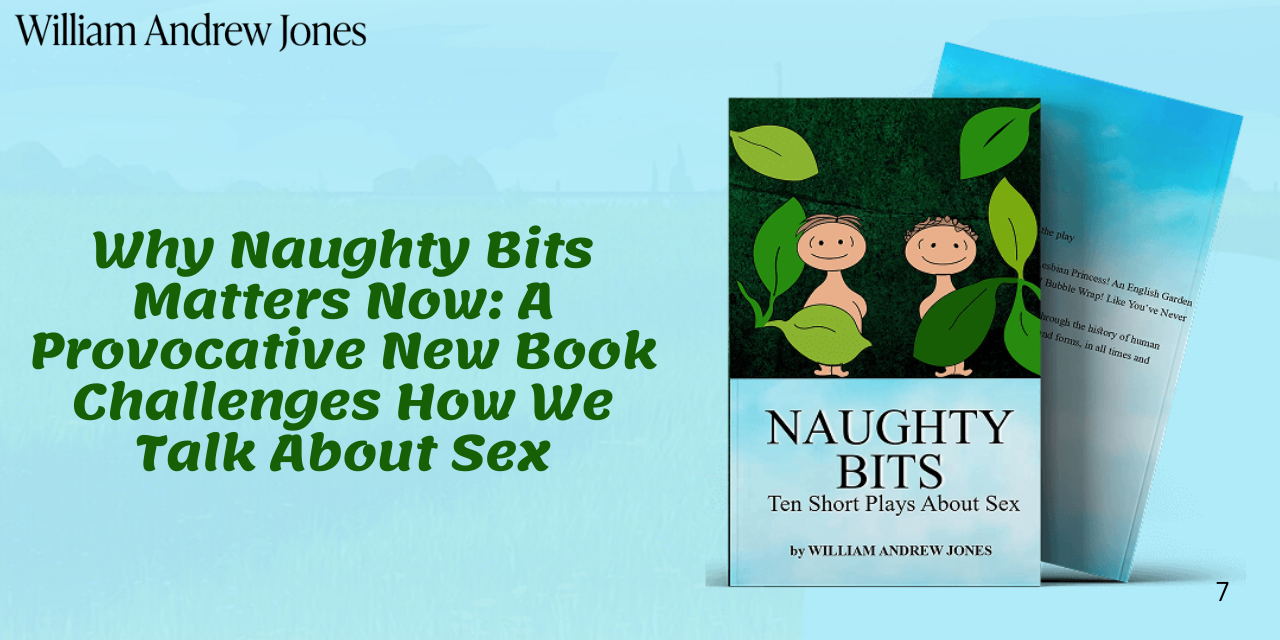
At a time when public conversations around sex are simultaneously omnipresent and tightly controlled, Naughty Bits: Ten Short Plays About Sex arrives as a deliberate disruption. Written by playwright William Andrew Jones, the collection confronts cultural contradictions around desire, language, and propriety through sharp satire, explicit humor, and unapologetically theatrical excess.
While sex saturates advertising, entertainment, and online spaces, direct discussion of desire—especially when it is awkward, obsessive, or intellectually messy—remains fraught. Naughty Bits addresses this tension head-on, using theatre as a space where taboo is not only acknowledged but explored.
A Culture of Exposure and Silence
Modern culture often frames itself as sexually open, yet discomfort persists. Certain words still provoke nervous laughter. Certain scenarios still feel unspeakable. In public discourse, sex is frequently aestheticized or commodified, while genuine conversation about desire is filtered, sanitized, or avoided altogether.
Naughty Bits exploits this contradiction. By placing explicit language on stage and treating it with intellectual seriousness, the collection exposes how selectively “open” contemporary culture really is. The plays ask not what is shocking, but why certain things still shock us.
Rather than offering commentary from a distance, Jones embeds these questions in theatrical form. The audience does not observe the taboo; it experiences it.
Theatre as a Space for Risk
Theatre has historically served as a testing ground for social boundaries. Unlike digital content, which can be consumed privately and dismissed quickly, live performance demands attention and accountability. Reactions are public. Discomfort is shared.
Naughty Bits is designed for this environment. The language is meant to be spoken aloud, in front of others, without the buffering effect of screens or algorithms. Laughter, silence, and resistance become part of the event.
In an age where risk is often managed preemptively, Naughty Bits insists on uncertainty. It does not guide audiences toward a preferred reaction or provide interpretive safeguards. Instead, it trusts viewers to confront their own responses.
Comedy That Refuses to Reassure
The humor in Naughty Bits is intentionally unstable. Jokes are pushed too far. Scenes escalate beyond comfort. Repetition becomes a tool of exposure rather than relief. The result is laughter that often arrives mixed with unease.
This approach reflects a deeper cultural reality: comedy has long been one of the few socially acceptable ways to approach forbidden topics. By leaning into exaggeration and absurdity, Naughty Bits uses humor as a means of access—inviting audiences in before revealing what lies beneath the joke.
The laughter opens the door, but it does not close the conversation.
Language, Power, and Control
Throughout the collection, sex functions less as physical act and more as linguistic and social performance. Characters talk about desire obsessively, analytically, or defensively. Words become tools of persuasion, domination, and avoidance.
By foregrounding language, Naughty Bits highlights how power operates through speech. Who gets to name desire? Whose language is considered acceptable? When does intellectual framing become a form of distancing?
These questions resonate strongly in a cultural moment shaped by debates over expression, offense, and authority. Rather than offering answers, Naughty Bits dramatizes the tensions themselves.
The Relevance of Being Uncomfortable
Discomfort is often treated as something to be minimized or avoided in contemporary discourse. Naughty Bits challenges that instinct. The collection suggests that discomfort can be productive—that it can signal the presence of unresolved questions rather than harm.
By refusing to smooth over its rough edges, the book creates space for reflection. Audiences are not told how to interpret what they’ve seen or read. Instead, they are left to process their reactions, assumptions, and boundaries.
In this sense, Naughty Bits aligns with a broader artistic tradition that values provocation not as spectacle, but as inquiry.
A Counterpoint to Cultural Caution
In recent years, many creative works have moved toward careful messaging and explicit framing. While this trend reflects legitimate concerns, it can also lead to work that feels overly mediated. Naughty Bits positions itself as a counterpoint.
Jones does not offer disclaimers or apologies. The plays exist as they are—explicit, exaggerated, and unapologetic. This refusal to preemptively justify the work is itself a statement about artistic freedom and trust in the audience.
By declining to explain itself, Naughty Bits reclaims theatre’s capacity to surprise, unsettle, and provoke dialogue rather than consensus.
About the Author
William Andrew Jones is a playwright whose work explores the intersections of language, power, and performance. His writing blends satire, intellectual rigor, and theatrical experimentation, challenging audiences to engage with difficult material without retreating into comfort.
Availability
Naughty Bits: Ten Short Plays About Sex will be available in hardcover, paperback, and digital formats through Amazon, Barnes & Noble, and major bookstores. Also, performances of NAUGHTY BITS begin on April 1, 2026 at the Players Theatre, 115 MacDougal Street, New York, NY. Tickets available at www.naughtybitsthebook.com or at http://www.theplayerstheatre.com/
For pre-order announcements, author events, and behind-the-scenes updates, visit: https://naughtybitsthebook.com/
Contact:
Author: William Andrew Jones
Website: https://naughtybitsthebook.com/
Amazon: NAUGHTY BITS: Ten Shorts Plays About Sex
Client email: williamandrewjones@gmail.com
About the Author